Wednesday, January 29, 2020

The Best Super Bowl Ads of All Time

The next Super Bowl is coming. And as we get closer to the big game, Americans aren't just looking forward to the football -- they're also excited to see what the nation's big-budget brands will come up with for this year's ads.

Because Super Bowl ads are so high-budget and infamous, many companies go to great lengths to keep them secret before they air. Some companies even add to the suspense of their ads by releasing teaser ads for their ads. (How meta.)

To give you an idea of how mysterious, and exciting these teasers are, here's an example of one from Doritos, which features "Old Town Road" rapper, Lil Nas X:


But teasers aren't the only thing we can watch to prepare for the marketing marvels we might see on Sunday.

To amp you up for this year's "Ad Bowl," I've collected some the best ads from the last decade and before.

Be sure to check back, as we'll continue to add to this list as new teasers are released.

Without further ado, please enjoy these attention grabbing and sometimes award-winning ads.

The Best Super Bowl Ads from the Past Decade

1. "Joust" - HBO and Budweiser (2019)

Prior to the 2019 Super Bowl, Budweiser launched a funny series of ads that followed a medieval kingdom where the king and townspeople would cheer, "Dilly Dilly!" when offered the beer. The series also featured a hero called the Bud Knight. In some advertisements, he would ride in on his horse and fight in battles clad in armor covered in Budweiser logos. 

At the beginning of Budweiser's 2019 Super Bowl ad, you see a handful of happy medieval characters waiting excitedly for the Bud Knight to arrive at a jousting match

As the Bud Knight heroically rides his horse on screen, the audience cheers, "Dilly Dilly!" as the competition begins.

But. things get grim quickly. Shocking, the Bud Knight loses and is knocked off his horse by the opponent. As the tall, masked opponent walks up to the knight, most Game of Thrones fans will begin to recognize him Gregor Clegane, a.k.a. "The Mountain" -- one of the show's most monstrous villains.

As Clegane towers over the Bud Knight, it becomes apparent -- especially to GoT fans -- that the ad is mimicking a dramatic death scene from the HBO series where The Mountain physically squished another heroic figure with his bare hands.

Clegane dramatically, but comedically, reaches down to grab the Knight with both hands. As townspeople react over-dramatically to what's going on, it's apparent that Clegane's killed yet another knight by squishing him off screen.

Suddenly, the Game of Thrones theme music begins to play as a dragon flies over Clegane and takes him down with a blow of fire. As the dragon escapes into clouds and smoke, the music gets louder as the show's logo and air date appears instead of a Budweiser logo. In a sense, Game of Thrones and HBO hijacked and destroyed the Budweiser ad series. 

This ad is hilarious as it comedically mimics an incredibly intense and notable scene from Game of Thrones. More interestingly, it surprises audiences who are just expecting it to be a standard Budweiser ad. This is a great example of how one ad combined cross promotion with a memorable storyline.

The ad, produced by Droga5 and Wieden+Kennedy, was so humorous and clever that it even won the 2019 Super Clio, a Clio Award for Super Bowl ad participants. 

2. "We All Win" - Microsoft (2019)

After it came to Microsoft's attention that people with missing limbs or limited mobility were having trouble holding and pressing buttons on video game controllers, the tech company developed an adaptive controller with touch pads rather than buttons.

After the controller's launch, Microsoft highlighted this story of how they solved for the customer in a 2019 Super Bowl ad titled, "We All Win."

n the Gold Clio-winning campaign, Microsoft interviewed children with mobility issues and missing limbs about why they loved video games, but how they still faced difficulties with game controllers due to their disabilities.

Many of the children and parents featured in the ad explain that gaming helps them connect with friends in ways that they might not be able to otherwise. However, because of the current line of controllers, they have difficulty playing or competing in many games.

"I never thought it was unfair. I just thought 'Hey, this is the way it is and it's not going to change," says one boy.

After demonstrating the problem with game controllers, the ad shows the children using Microsoft's new adaptive video game controller as they explain how it makes gaming easier and more accessible for them.

For example, one girl excitedly says, "I can hit the buttons just as fast as they can," while a boy exclaims, "Now everyone can play!"

"'We All Win' hit all the marks in terms of emotion, starting a dialogue, and fun. It wasn’t an ad about disabilities, it was about kids wanting to play video games," says Dmitry Shamis, Senior Director of Creative. "I loved it back in February and still love it now."

Not only does "We All Win" tug on your heartstrings, but it also encourages solving for the customer and accessibility by explaining how Microsoft took the time to develop a product that fixed a major problem faced by a unique group of customers. This ad makes you believe that Microsoft genuinely cares about its customers and will make extra efforts to ensure that everyone has a great experience with its products.

You can read more about this particular campaign and get inspired by a few more empowering ads in this blog post on inclusive marketing.

3. "It's a Tide Ad" - Tide (2018)

Another Super Clio winner was, "It's a Tide Ad," created by the clothing detergent company, Tide, as well as the agency Saatchi & Saatchi New York.

In 2017 and 2018, Tide released a number of commercials with storylines that had nothing to do with Tide, except for the actors’ noticeably clean clothes. When viewers were at the edge of their seats, someone in the ad would say, "It's just another Tide ad." Then, they'd see the Tide logo and text that said, "If it's clean, it's Tide."

This campaign started with a long Super Bowl ad, which also received an Emmy nomination. In the ad, Stranger Things' David Harbour shows up in several common ad scenes, including in the bathroom with a buff deodorant model, driving a sports car, and laughing on the couch with a fake family.

As he appears into each commercial, he explains that all of them have one thing in common: clean clothes that were washed by Tide detergent. In the end, he says, "So, does this make every Super Bowl commercial a Tide ad? I think it does."

Since Tide has one job of keeping clothes clean, they show off the brand's strength in multiple versatile and silly scenarios. Humor like this can also be a great way to make a simple product more memorable. If you go to the store to get detergent shortly after seeing this commercial, Tide might be the first thing to pop into your head because of the ridiculous ads.

4. "Band of Brands" - Newcastle (2015)

What do you do when you can't afford a Super Bowl ad? Cross-promote with other brands who will pay for it.  That's what Newcastle, a popular beer company, did back in 2015.

Prior to the 2015 Super Bowl, Newcastle launched a call to action video where Parks and Recreation actress Aubrey Plaza encouraged brands to pool their money for one big ad. Because Super Bowl ads that year were well over $4.7 million -- not including production -- a number of big and small brands reached out to Newcastle to join in for a chance to be featured -- even for just a few seconds -- in the ad

The one-minute ad is filled with product placements as it tells the story of a couple that's sharing Newcastle beers together to celebrate moving into a new home. As they walk through their new house, you can see brand logos hung on the walls like paintings, family photos, or decorations.

As they unpack the boxes, they not-so-subtly talk about all the appliances they have while holding them up to the camera. Aside from the obvious visual product placements, they also work brands into their conversations. For example, at one point, the man tells his girlfriend that he can't believe they're moving in together after "meeting on Match.com."

Although the ad starts off with more clever obvious product placements, it gets funnier as the couple starts pointing out every single product they have in their house as quickly as possible.

This ad is an incredibly clever example of a brand that took product placement and co-marketing to the extreme, while benefiting from a virtually free Super Bowl commercial. 

5. "Keep Your Hands Off My Doritos" - Doritos (2010)

"Keep Your Hands Off My Doritos" hilariously tells the story of an overconfident man meeting his love interests son for the first time. In the ad, the man walks into his date's home with flowers and sits with her child as the mother gets ready. When she leaves the living room, the man is seen noticeably checking her out.

He sits down with swag as he starts talking to her infant son. Without thinking to ask the child if he can have one of his Doritos, he grabs a chip. The boy immediately and loudly slaps him, stares him down in the most intimidating way a child can, and angrily exclaims, "Keep your hands off of my momma. Keep your hands off of my Doritos!"

The overconfident boyfriend ends the commercial cowering in fear as the screen fades. As the logo appears, you hear the boy's mother ask, "Are you playing nice?"

This ad was so funny that it's still seared into many of our minds. Even though it launched nearly a decade ago, I still tell friends to "keep their hands off my Doritos" when they grab one of mine without asking.

Although it's only 30 seconds, the ad is hilarious, relatable, a little bit shocking, and heartwarming, which makes it so memorable.

The Best Super Bowl Ads Before 2010

6. "Wassup" - Budweiser (1999)

If you grew up in the late '90s or early 2000s, you might have a memory of kids at your school yelling the word "WASSUP?" to each other. I know I do.

If not, you've probably seen the Budweiser ad that the now outdated greeting comes from:

In the ad, a man answers the phone while watching a big game. His friend on the other line asks, "Wassup?" The man on the couch says, "Nothing. Just watchin' the game and drinkin' a Bud." The conversation escalates when the man's roommate unexpectedly walks in and yells, "WASSSSUPPPPP?!"

In true 1990s fashion, the roommate rushes to pick up the other house phone to join the conversation. The three men then just start yelling, "Wassup!" in louder and more bizarre ways until they suddenly get quiet. One of the friends then asks, "So, wassup?" The two others on the phone again say, "Nothing. Just watchin' the game and drinkin' a Bud." Then, everyone says, "True." 

This video might seem like a waste of millions of dollars on a Super Bowl slot, but it definitely wasn't. As a viewer and consumer, all you need to know when watching is that the three friends are all watching the game and drinking Budweiser. The "Wassup?" marathon was essentially a tool meant to make the commercial funny and memorable. Based on the fact that, "Wassup" was still getting referenced in the second half of the 2010s, it's easy to see that this ad was a success.

7. "Your Cheatin' Heart" - Pepsi (1996)

This old Pepsi commercial highlights the consequences of what could happen if you "cheat" on your company's brand.

The short and sweet ad simply shows fake security footage of a Coca-Cola delivery employee placing Coca-Cola cans in a store refrigerator to the Hank Williams Sr. song, "Your Cheatin' Heart." Things get interesting when the delivery man looks to make sure no one's watching and then opens the fridge with Pepsi in it.

Suddenly, the shelves in the fridge collapse as all of the Pepsi cans noticeably barrel out of the fridge and on to the floor. The ad makes a short and simple point: Even Coca-Cola employees love Pepsi:

8. "1984" - Apple (1984)

At the dawn of 1984, Apple leveraged the George Orwell classic,"1984," in an award-winning Super Bowl campaign.

The 1948 George Orwell novel, followed a 1984 dystopian society where everyone dressed the same and conformed to the same leader, views, and ideologies.

As an innovative company, Apple has always tried to be "different" from competitors. The tech giant's approach to Super Bowl advertising stood by this same mission even back in 1983.

The Super Bowl ad brings the conformist community in 1984 to life as you see men marching in straight lines towards a room where their leader is on a giant screen, telling them, "We are one people, with one whim, one resolve, and one cause."

At the climax of the commercial, a woman with a hammer and colorful clothing starts running towards the screen. She launches her hammer into the screen as it explodes. 


A narrator concludes, "On January 24th, Apple Computer will introduce the Macintosh. And you'll see why 1984 won't be like 1984."

Not only did the ad, directed by Ridley Scott, highlight a well-known book. But it was boldly symbolic of early tensions and monopolies in Silicon Valley. At the time, Apple was considered a young, disruptive company while IBM was the only tech giant in the PC industry. Tech journalists and innovators in Silicon Valley often thought about IBM as a soulless corporation.

In this ad, Apple explains why innovation, disruption, and tech unique tech underdogs would destroy monopolies of the future. It also reiterated and enforced the brand's positioning as a company that wanted to make products that would allow people to embrace their unique qualities and skills. This is a strategy that they've continued to use in their campaigns today.

9. "I'd Like to Buy the World a Coke" - Coca-Cola (1971)

On the hills of Italy in 1970, Coca-Cola pulled together a group of young adults from a number of countries and filmed them sing a jingle called, "I'd Like to Buy the World a Coke."

This resulted in one of the most notable ads from Coca-Cola, let alone a popular ad from the 1971 Super Bowl:

This commercial is a great form of early inclusive marketing as it shows that everyone has something in common, despite the fact that we all come from different or diverse backgrounds.

In particular, this ad shows that millions of people from all around the world can agree on the fact that they enjoy Coca-Cola. Not only does it embrace the beauty of diversity and world peace, but it also highlights the international popularity of the soda beverage.

Super Bowl Ad Takeaways

Even if you're a small business marketer. you can learn from these ads for your own video or content marketing strategies. Here are a few things that many of these ads have in common.

  • Emotion: Whether they leave you feeling happy, sad, or optimistic, most of these ads drew your attention with a topic and storyline that built emotion.
  • Pop Culture: As you saw with Budweiser, HBO, Newcastle, and Apple, some of the most memorable ads acknowledged notable pop culture or literature and weaved a memorable story around them.
  • Relatability: Emotional ads don't often work without relatability. Many of these ads do an excellent job of putting you into their protagonist's shoes. Whether you're seeing children able to access gaming in a Microsoft ad, or laughing at the child who's protective of his mother in the Doritos ad, you identify with the characters or people featured on a deeper level.

For more examples of big brand ads you can learn from, check out these rosters of Emmy nominees, Clio Award winners, and our marketers favorite campaigns of 2019.

Editor's Note: This blog post was originally published in January 2015. It was updated for comprehensiveness and freshness in 2019.

http://bit.ly/36F0TV3

How to Use Google Ads Keyword Planner, According to 5 Specialists

When I used to work for a digital marketing agency, one of my responsibilities was to write blog content for our clients.

To do this, some SEO research was required because we wanted to improve organic traffic. So, I did keyword research to figure out what the target audience wanted to read about.

I was able to use the keywords to brainstorm topic ideas and pillar pages, while also creating a list of keywords we could target.

That's why Google ads keyword planner is an important tool for marketers.

Essentially, the Google ads keyword planner is a free resource you can use to research keywords, generate keyword ideas, and help you with your pay-per-click strategy.

Although you need a Google AdWords account to use this tool, which requires billing information, you never need to run a campaign or make a purchase to use the keyword planner tool.

Below, let's review how to use the Google keyword planner and implement this tool in your strategy. Then, we'll dive into other free alternatives you could use.

1. Generate keyword ideas.

One of the primary reasons to use the keyword planner is to generate keyword ideas. You'll start by writing in a few keywords that you've brainstormed ahead of time.

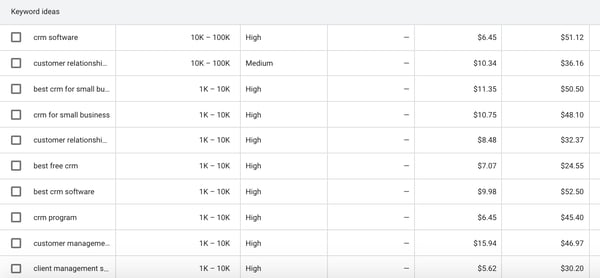
In the example below, I typed in "best CRM", "customer relationship management system", and "client management system."

Then, the tool generated a list of over 1,000 keywords. Briefly looking at this list, these keywords let me know that readers want to know the best free CRMs and the best CRM for small businesses. Those are two great blog ideas and keywords you could target in your content.

Google keyword planner generates keyword ideas.

When your keyword ideas come up, the keyword planner will also help you come up with other related keywords to add to your search. This is the "Broaden Your Search" section that is at the top of the page. It looks like this:

Google ads keyword planner gives keyword suggestions.

For each keyword suggestion, Google's keyword planner will also give you information such as average monthly searches, competition, and the PPC bid range.

Keep in mind that the competition isn't referring to how difficult it is to rank for that keyword, but rather how many advertisers are bidding on that keyword in PPC ads. It's still a useful column because if people are bidding on a keyword, that means there's commercial intent that's more likely to convert.

But what do the experts have to say?

Daniel Lofaso - Digital Elevator

Marketing Strategy: Leverage low competition keywords.

Lofaso says, "SEO pros must leverage low competition keywords into their overall strategies so that they can get their sites to compete with the big boys. Low competition keywords are those that can rank with little to no link building and little to no domain authority."

2. Look at search volume.

Another unit of measurement that is useful on the Google keyword planner is the monthly search volume (MSV).

When you're generating keyword ideas, you'll see the MSV in the second column. As you can see from the example above, Google gives you a wide range for the MSV.

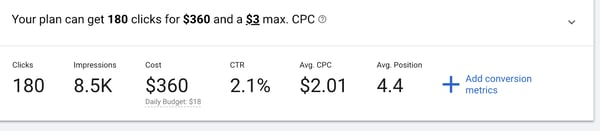
But don't fret. You can still get a good idea of a more specific number by selecting keywords and adding them to your "plan." When you go into the "plan overview" section, you'll find the impressions. This number is usually fairly close to the average MSV.

Google ads keyword planner monthly search volume numbers.

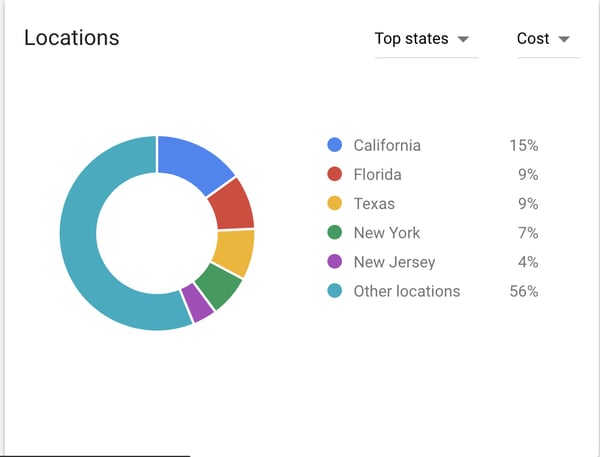
Additionally, you can filter keyword MSV by location. For instance, perhaps the keyword "charter schools" has a higher MSV in Florida than it does in California.

Your plan overview will have detailed locations. You can organize by state, city, county, or region.

Google keyword planner filter by location.

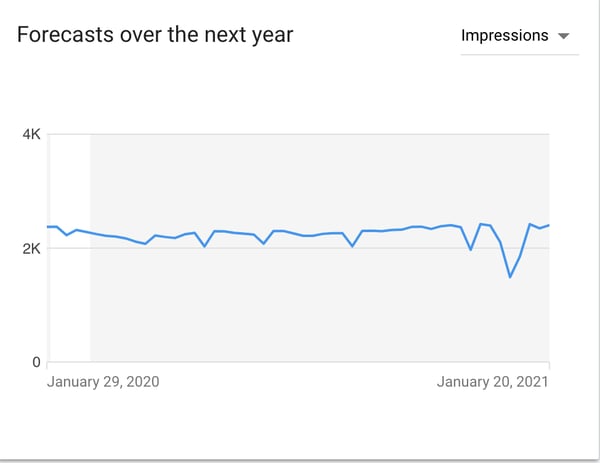
You can also look at a forecast of the MSV. This could be helpful in predicting seasonal trends.

Google keyword planner forecasts keywords for the year.

Now, let's consult an expert:

Dan Shewan - WordStream

Marketing Strategy: Use a balance of low and high volume keywords.

Shewan says, "Newer sites or those with lower domain authority may want to target lower-volume, less competitive keywords to attract external links and establish more authority in your space. Over time, you can become more confident and/or aggressive in how you target keywords, but don't forget to ensure that the keywords you're targeting are relevant to your business and your website as a whole."

3. Analyze search intent.

Once you've gathered a list of keyword ideas, you'll want to understand the search intent before you begin writing a piece of content or drafting ad copy.

Search intent is basically what the reader wants to know. If someone types in "best CRM," they're probably at the beginning of their research. They want to know what different kinds of software is out there, read reviews, and look up comparisons.

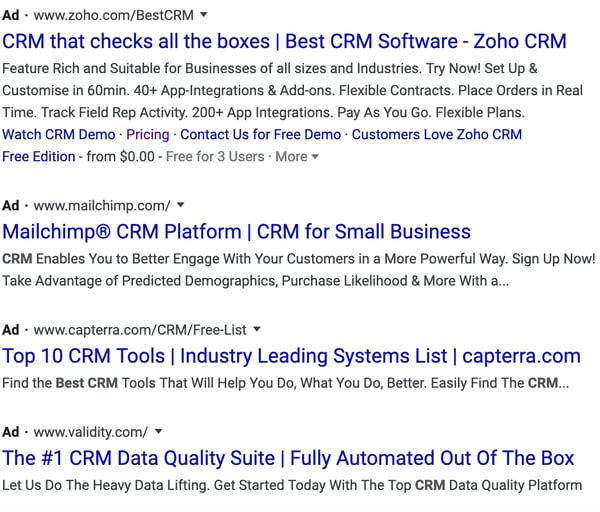
To analyze search intent, begin by looking at the ads that show up at the top of the search results page when you type in a keyword. If companies like yours show up, that's a good thing.

Google ads search results on search engine results page.

Additionally, you can then scroll through the organic search results to see what types of articles are being written. It should be easy to gather what search intent is.

You might be wondering, "Why is search intent so important?" Specialist Rachel Leist says it's a pivotal ranking factor:

Rachel Leist - HubSpot

Marketing Strategy: Address user problems in every piece of content.

Leist says, "User intent is now one of the most pivotal factors in your ability to rank well on search engines like Google. Today, it's more important that your webpage addresses the problem a searcher intended to solve than simply carries the keyword the searcher used."

4. Plan search engine ads.

The main purpose of Google's keyword planner is to help you develop Google ads.

When you log on to your keyword planner, you can get search volume and forecasts for keywords that you want to use in a PPC campaign. This section of the keyword planner is to help you run Google ads.

Google keyword planner can help with PPC keyword volume research.

Once you type in the keywords, you'll see how many clicks and impressions you might get if you ran Google ads targeting those keywords. Additionally, you'll find the average cost, click-through-rate, and cost-per-click.

Google ads keyword planner forecasts.

If you want to get started with Google ads, you might be able to use your CRM and web analytics to inform your ad campaigns directly. For example, HubSpot CRM allows users to create ads right through the portal.

But let's see what an expert has to say:

Christina Perricone - HubSpot

Marketing Strategy: Optimized Google Ad campaigns can lead to high ROI.

Perricone says, "Google Ads have a click-through rate of nearly 8 percent. Display ads yield 180 million impressions each month. For users who are ready to buy, paid ads on Google get 65% of the clicks. 43% of customers buy something they've seen on a YouTube ad. So, yes, Google Ads works. With an optimized ad campaign and lead flow, you can create a high-ROI marketing campaign."

5. Discover competitor keywords.

Lastly, another excellent way to use Google's keyword planner is to see what the competition is doing. You can search for a competitor's website to see what keywords they're ranking for.

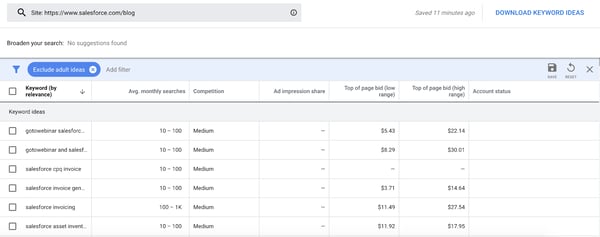
All you have to do is type in a competitor's URL in the keyword search bar. In the example below, we brought up keywords that Salesforce is ranking for.

Google ads competitor analysis.

By looking at the competitor's keywords, you can generate a whole new list of keyword ideas to target. Plus, they'll help you brainstorm content ideas. For example, you can look for gaps to fill in your competition's content.

Here's what SEO expert Neil Patel has to say:

Neil Patel - Neil Patel

Marketing Strategy: Use your competitors as your greatest allies.

Patel says, "At each stage of the customer journey, your customer has a different desire and will use different types of keywords. The goal now is to find a list of keywords for each stage of that journey."

Although Google's keyword planner is free and you can get a lot done with the free tool, you need to have an AdWords account or run a campaign to get more specific MSV numbers. That's why we've gathered a list of totally free keyword tools you can use in addition to Google's keyword planner:

Free Keyword Planner Alternatives

1. Answer the Public

Answer the Public is a great keyword researching tool for brainstorming questions that your audience might have.

When you type in a keyword, the site will generate a list of questions that people are asking. I've found that this is a great tool when you're trying to think of cluster ideas for a pillar topic.

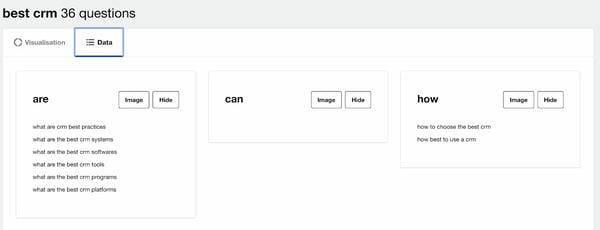
Additionally, this tool will help you figure out search intent by answering, "What do readers want to know?" and "What are their biggest questions?"

Answer the Public questions for keywords.

2. Google Trends

Google Trends is an excellent tool for searching keywords by location. This is especially helpful when you're deciding what regions you want to target for a PPC campaign.

Additionally, this is helpful when you want to improve organic traffic. If your company is a brick and mortar store, you should target keywords that people are searching for in your location.

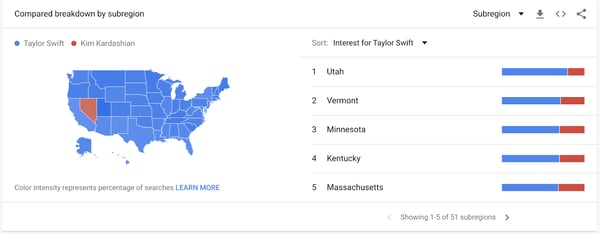
A fun example below shows that more people search for Taylor Swift rather than Kim Kardashian in every state in the United States except for Nevada.

Google trends example using Taylor Swift and Kim Kardashian popularity.

3. Keyword Surfer

One of the first things you'll do when you're generating keyword ideas is Google them. Google will show you search intent and give you related topic ideas or additional long-tail keywords.

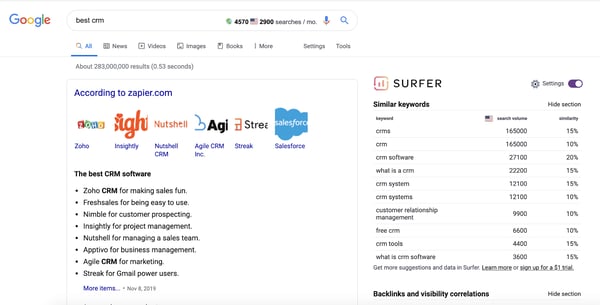
Keyword Surfer makes this process easier. This is a Chrome extension that'll show you global and national MSV right on Google when you search for a term.

In the example below, I searched for "best CRM." In the search bar up top, you'll see global and national MSV. On the right-hand side, you'll find similar keywords and the associated MSV.

Keyword Surfer extension shows monthly search volume right on Google.

Keyword research is an important step in any content or PPC ad strategy. Once you know your keywords, you can begin to plan out your content and ad campaigns. For more tips and information, check out our ultimate guide to SEO.

http://bit.ly/38LS5y6

Twitter Topics: How to Use It & What Marketers Need to Know

According to a report from Mention, roughly half a billion tweets are published on Twitter every day.

The platform, which enables you to tweet out your thoughts or content in under 280 characters, is swirling with constant conversations about trends, news, and other insights. With all of these tweets, thoughts, discussion threads, and trending hashtags, it can be hard to cut through the noise and find content around topics you're actually interested in.

To make it easier for the user to find and follow topics and trends they're passionate about in a crowded feed of tweets, Twitter unveiled Twiter Topics in November.

With Twitter Topics, you can follow topics as well as people that often tweet about relevant topics.

According to Twitter, the Topics feature was created in an effort to shift the platform towards conversation and away from one-off comments by influencers and celebrities.

In a recent blog post, Twitter provided more insight into why they launched the new feature:

"Previously, all of the work was on you to figure out the best way to keep up with what’s happening by following certain accounts, searching for it, or looking in the Explore tab for the latest. Now, you have the option of seeing the most relevant and interesting Tweets about what you care about with a single tap, and the conversation will come to you."

While this move might be helpful to an individual user's Twitter experience, marketing publications are already suggesting that it could also help brands. If you run a Twitter account that focuses on great content but is still growing, Twitter Topics could ultimately help you boost brand awareness.

If you post about relevant topics related to your industry, people who follow those topics could have a greater chance of finding your content than if they were just following tweets of thought leaders or brands in your field.

Although Twitter has not mentioned how this could impact brands, Google has set a precedent by releasing a similar feature that boosted traffic on company sites.

Two years ago, Google launched Google Discover, a feature within its Android app that showed users recommendations based on topics they followed or topics they'd searched in the past. Since then, publishers like Conde Nast haven't given specific data on how Topics impacts them, but do say they've been seeing significant jumps in mobile traffic from Google.

While we're still learning about Twitter Topics, there are a few ways that you can begin to leverage it as an online marketer. But, first, to help you understand the consumer's point of view, here's a step-by-step guide of how to use the feature.

How to Use Twitter Topics

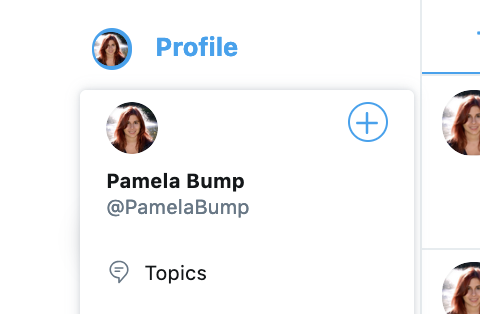
To access Twitter Topics, go to your feed and click "More" on the sidebar to the left of your feed. Once you do this, you'll see options including, "Topics."

Where to find Twitter Topics symbol

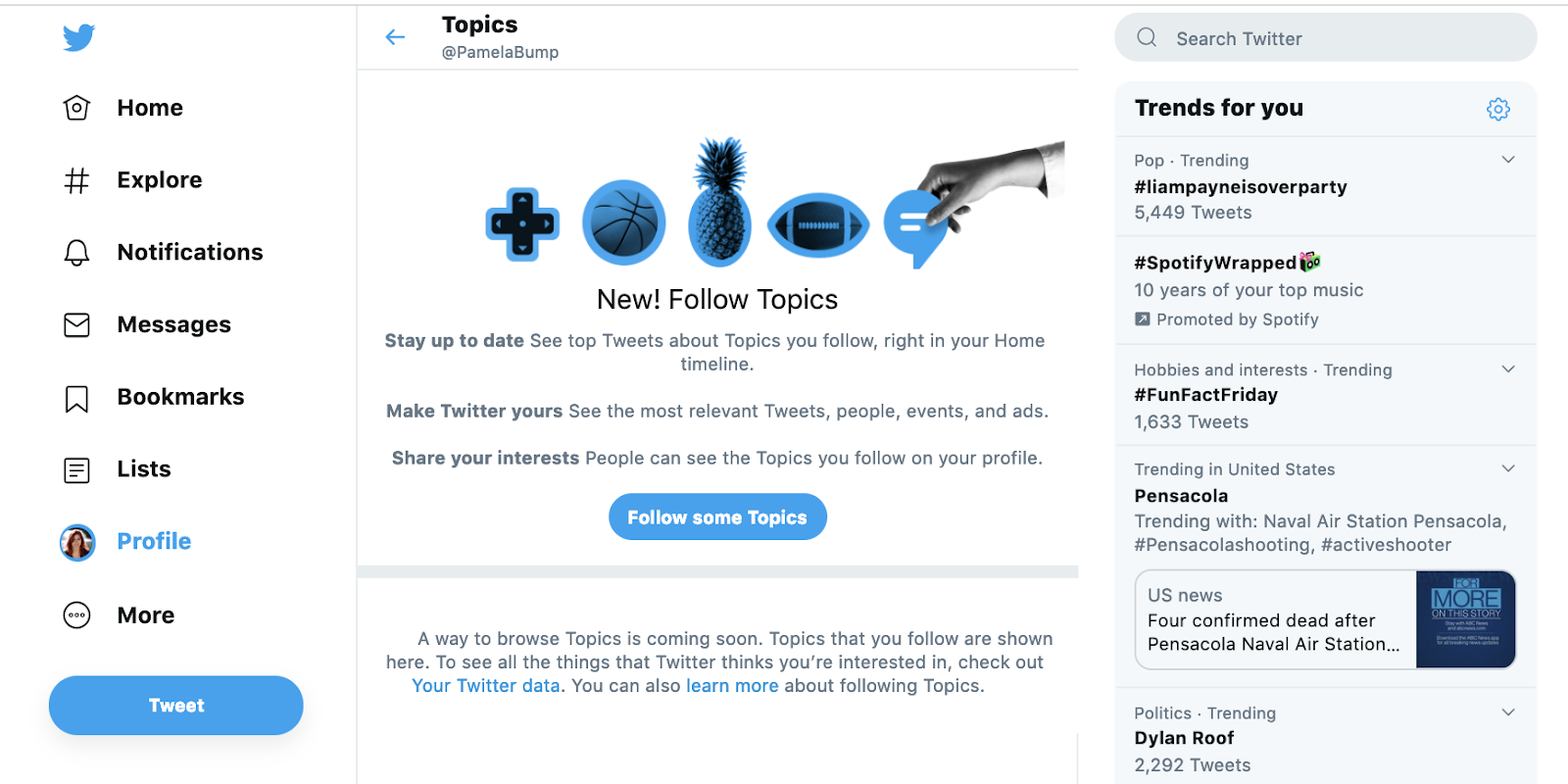
When you click on Topics, a welcome message explaining the feature will pop up where your feed is. From there you can start picking Twitter Topics to follow.

Twitter Topics dashboard

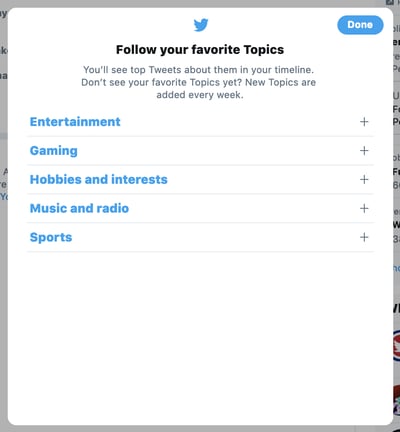
After clicking "Follow more Topics," you'll see a list of overarching Twitter Topics, like "Entertainment" with plus signs next to them. When clicking on a plus sign, you can see a drop-down menu with more specific topics within each industry.

Twitter Topic follow options

Once you follow a few Topics, your homepage's Twitter feed will start to show posts algorithmically pulled in from your Topic preferences.

To follow more Topics, you can simply return to the Topics page and click "Follow more topics."

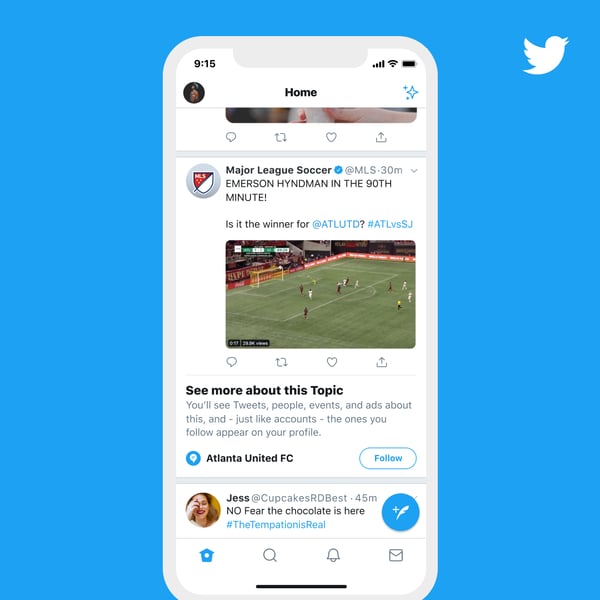
Additionally, some tweets in your feed will now offer a "See more about this Topic" pop-up, which includes a call to action to follow a related topic.

How Twitter Topics show up in Twitter feed.

Source; Twitter

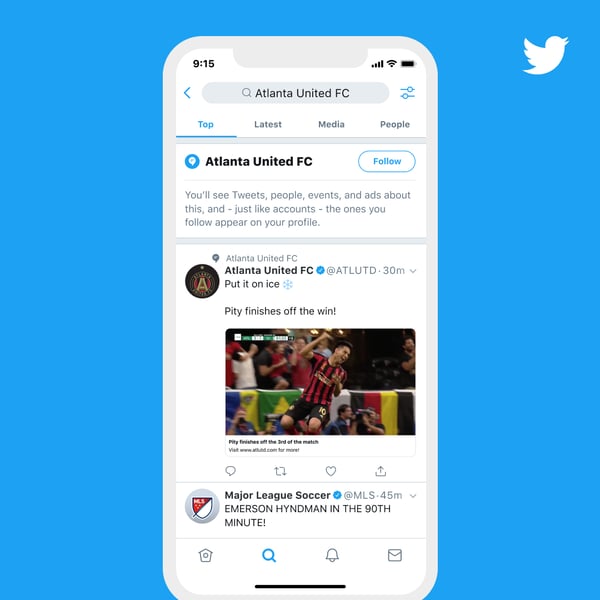
You can also search and follow a Topic using Twitter's search bar, as seen in the photo below:

How to unfollow Twitter Topics directly from Twitter feeds

Source: Twitter

To unfollow Topics, return to the Topics page, click "Follow more Topics," find the Topic you've followed, and click unfollow.

Unfollow a topic from Twitter Topics dashboard

For more details on how this feature works, check out Twitter's introductory blog post.

Four Ways Marketers Can Leverage Twitter Topics

While we're still learning about Twitter Topics, there are a few ways that you can begin to leverage it as an online marketer. Let’s look at these more closely below.

1. Follow topics related to your industry to stay informed.

When people research a product or service related to your brand, they'll want to see that you're well-informed of current trends in your industry. By following Twitter Topics related to your field, you can stay on top of trends that might be important to your customers and impact your business.

By keeping up with news and trends, watching conversations around certain Topics could inform you more about your prospective audience's delights, habits, work-life, or pain points. This information could help you keep your buyer persona up to date while also allowing you to create a more accurate go-to-market strategy as you launch products or services.

2. Discover and follow accounts or thought leaders in your industry.

In addition to learning about trendy topics in your industry, Topics can also help you learn about thought leaders or brands that are known for discussing certain insights or ideas in your field.

If you consistently see certain accounts or people show up in tweets marked with a Topic related to your field, you might want to check out their profile and follow them to see what type of content they're posting. Not only will this help youkeep up with the insights and trends in your industry, but reviewing their profile might also help you learn more about optimizing tweets to rank in the Topics tab.

Additionally, if you see tweets from a competitor under a topic related to your brand, you can keep track of what they're doing and create Twitter content or campaigns that improve upon it.

3. Create content or tweets related to trendy Topics in your industry.

If there's a Topic people are buzzing about that strongly relates to your product, start coming up with tweets that addresses that trend.

For example, if users are talking about a common pain point that your product or service can solve, post more about that pain point, inform your audience of the best ways to solve it, or create content that weaves a mention of your product into it, such as a video or infographic that you upload to Twitter.

While Twitter hasn't explained how Twitter Topics algorithms work or how you can leverage them to move up in feeds, tweeting about a Topic is still a strategy that enables you to learn what your audience is widely discussing and respond to it promptly in an engaging, valuable way. Even if you aren't pulled up in feeds immediately, you may still get reach or growth on your Twitter account simply by responding to what your audience wants to learn about.

4. Learn about trending hashtags and optimize your own tweets with them.

As you probably know by now, hashtags are one of the ways you can optimize your tweets with popular keywords or phrases. When someone clicks on a hashtag, they will see a feed of tweets that also used the hashtag.

While people might find your tweets under the Topics tab if you're discussing a certain trend, they might also find your tweets if they click on a hashtag that you've used. If you see a lot of people in your industry tweeting out certain hashtags, find a way to create tweets that naturally leverage or include that hashtag to further optimize your content and profile.

Embracing Trendy Topics on Twitter

Twitter has always been a solid platform for topical or trend-based discussion. And, although Topics will help users and brands zone in more on what they really care about, it's not the only strategy you can use to make sure that your content gets seen.

By using Twitter Topics to learn more about how to interact with a wider range of users and create valuable content related to trends in your industry, you can ultimately boost online brand awareness and your following.

To learn more about how to optimize and grow your Twitter profile, check out our Ultimate Guide to Twitter Marketing.

http://bit.ly/3aRFxHc

How to Analyze Your LinkedIn Profile Using the LinkedIn Dashboard

Looking for analytics to assess your LinkedIn profile’s performance? Are you looking at the LinkedIn dashboard for profiles? In this article, you’ll discover how to use the dashboard on your personal LinkedIn profile to analyze and improve your profile visibility, prospecting, and content strategy. What Is “Your Dashboard” on LinkedIn? Every LinkedIn profile has a […]

The post How to Analyze Your LinkedIn Profile Using the LinkedIn Dashboard appeared first on Social Media Marketing | Social Media Examiner.

January 29, 2020 at 12:00PM http://bit.ly/2GzwU6s
read more...
from Social Media Marketing | Social Media Examiner http://bit.ly/317UIaP
via IFTTT

Tuesday, January 28, 2020

What Is a CMS and Why Should You Care?

Deep in the sea of acronyms in the marketing world, there's an overwhelming amount to keep straight. SEO, CRM, SERP, CTR, and CToR are all important acronyms that can roll off of the tongue for most of us.

What about CMS?

Whether you're new to marketing or have been in the industry for years, this acronym may be completely new to you. It also may be the answer you're looking for if you need a professional website, fast, with limited technical resources.

A CMS can help you build exciting, delightful content, resulting in more conversions and lead generation. If you've never heard of it, or have always seen the term thrown around and never knew exactly what it meant, this post is for you.

Rather than opening up HTML or JavaScript, CMS software does that for you, so you're able to pick and choose how your content will look once it's live on a webpage. Additionally, to save you the task of building systems that create pages and CTA buttons, a CMS can take care of those things for you.

Having a CMS helps marketers who need to operate a fully-functioning website, but lack coding experience. A CMS can be used to create web pages, such as an "About" page or a blog, so focusing on customer-specific content is easier (and less stressful).

Why do you need a CMS?

If any of these scenarios are pain points at work, it may be time to look into how a CMS can help you streamline processes and organize content.

Limited Resources

If you're working with limited technical resources, it might be imperative to save you time and the gripe of wondering if your website is professional enough. For example, maybe you don't have the software needed to code a webpage or don't have a developer.

Because CMS software is so expansive and comprehensible, it's a simple process to add, update, or remove content from a website. You won't have to spend extra time figuring that out.

SEO Plugins

Additionally, with a CMS, you can optimize web pages for search engines, which is extremely helpful in getting your contact to rank highly on Google. That way, potential leads can find you, and you'll have an amazing-looking website when they do.

Lack of Coding Knowledge

You may find yourself in a position where you need a new landing page or something similar, but you don't have enough time to build one from scratch. With a CMS, that process can be straightforward.

Allows for Collaboration

Multiple members can have access to CMS software. Every team member would individually use their account to work collaboratively on team projects, like editing a landing page. They also have the capability to save templates of webpages, as well.

Ultimately, a CMS consolidates processes that may be impossible to a marketer.

Best CMS Platforms

HubSpot offers a CMS that's for businesses at any stage. If you're thinking of piloting a CMS, find out more about HubSpot's trial here. There are alternative CMS options like WordPress, Joomla, or Drupal, as well — take a look at WordPress, Joomla, or Drupal: Which Is the Right CMS Platform for Your Site? To investigate alternative options to HubSpot.

HubSpot

HubSpot's CMS allows you to build websites that are powerful, optimized for search engines, and secure. You can manage all of your marketing and content in one place, which allows for easy collaboration.

The tools in HubSpot's CMS lets you personalize every visitor experience. Personalized content improves the experience of the user, having felt targeted.

WordPress

With WordPress, you'll have more than a blogging website. With the plugins and widgets you can add to a WordPress site, you can create a unique experience specific to your brand.

These plugins and widgets can add sidebars, calls-to-action, unique forms, and more. The easy-to-use tools in WordPress is that you can be as minimal with the design or as flexible as you want.

Joomla

Joomla is similar to WordPress in that it offers many plugins and widgets to expand your website. Both platforms are also free and come with webpage templates.

While other CMS platforms adopt an expansive all-in-one experience with content management, Joomla focuses on building and designing websites. It's a good platform to use for straightforward website management.

Drupal

Drupal's homepage has CMS information split into sections for developers, marketers, and agencies. As an open-source platform, Drupal is another website that allows for a lot of customization opportunity.

Drupal is different because the platform is more on the technical side. It would mostly benefit the marketer with more than a working knowledge of code who doesn't have the time to learn the extra skills needed to build an entire website.

It can be a huge pain to get a proper website up and running — that's why more SMBs are finding that having a CMS has helped them exponentially.

If you're in a spot that sounds similar, give a CMS a try and see if it works for you.

http://bit.ly/38ReE4j

The Social Media Content Calendar Template Every Marketer Needs [Free Template]

"We have a 9 a.m. meeting? Hold on -- let me just click around the internet like a maniac to find something for the morning tweet." 

Sound familiar? Scrambling for social content is nothing new. We have meetings. We run late. Things come up. And it's really hard to get any meaningful amount of work done when you have the next social media update looming over your head every 30, 60, or 90 minutes. It all moves so fast that you might periodically feel a case of the vapors coming on, which is why pre-scheduled social media content should be your new best friend.

To make social media content easier for companies to plan and schedule across the accounts they manage, we created a social media content calendar template. And recently, we updated to be better, faster, stronger, and just generally prettier. 

You can fill it in at the same day and time every single week to prep for the following week's social media content. That means when you burst through the office doors at 9 a.m., you won't be in panic mode looking for something to push out to your Facebook fans -- you already took care of that last week.

This blog post will walk you through exactly how to use the template to stay on top of your social media content planning for Facebook, Twitter, LinkedIn, Instagram, Pinterest, and Google+.

Note: HubSpot customers can also schedule content through Social Inbox, or use this spreadsheet to organize their content and subsequently upload it to Social Inbox. Detailed instructions for doing this exist in the cover sheet of the template.

How to Use the Social Media Calendar Template to Plan Your Content Schedule

When you open up the social media content calendar template, you'll notice the bottom of the Excel spreadsheet has several different tabs, most of which are dedicated to a specific social network.

social-media-calendar-excel-tabs.png

The reason you'll want a different worksheet for every social network is simply that every social network is a little bit different. You can't just craft one, single social media update and use it across LinkedIn, Facebook, Twitter, Instagram, Pinterest, and Google+. You can certainly promote the same piece of content across all six of those networks, but that doesn't mean you'll craft your update in the same way for every single one of them. (In fact, you may even want to add additional tabs if you're active on other networks, like Quora or YouTube.)

This following sub-sections will walk you through how to fill out each of the four tabs you see in this template -- the updates for Twitter, Facebook, LinkedIn, Instagram, Pinterest, and Google+. But before we get to that, let's just walk through the "Monthly Planning Calendar" so you know what that's for.

Monthly Social Media Schedule 

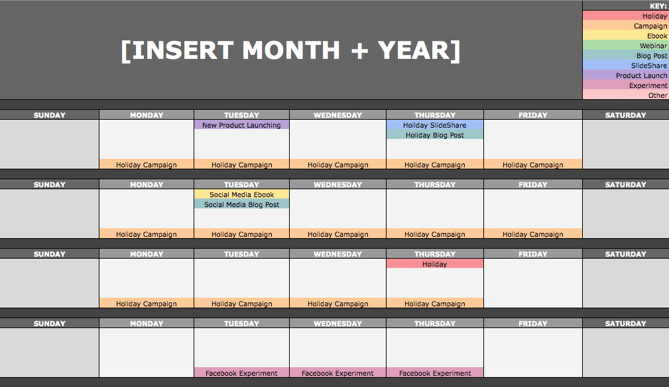
The tab "Monthly Planning Calendar" provides an overall snapshot of your monthly social media campaigns. It'll help you coordinate better with other stakeholders, not to mention keep all the moving parts straight in your own mind. Here's what it looks like:

social-media-calendar-month-view.png

There are three sections to take note of when you edit this template for your own purposes. First, the color-coding key: These are the types of content or campaigns around which you might coordinate, like ebooks, webinars, blog posts, product launches, and so on. Though only some of these might be relevant to you, they're there to indicate what you may want to put in there -- so be sure to edit these categories to align with your own campaigns.

The other two sections you'll need to edit are the Month and Year at the top of the calendar (duh), as well as the cells below each day of the week. In those cells, you should enter the type of content you'll be promoting that day and color-code it to align with the campaign it's supporting.

Instead of deleting all the content in this spreadsheet each month, I recommend copying this worksheet twelve times over, and creating a separate sheet for each month. (If that gets to be too overwhelming, you can always save those tabs as a separate file.)

Planning Your Twitter Content Calendar

Alright, now let's get to the social media content. This section will be the lengthiest, because all subsequent sections will draw on the instructions we go through here. So if you read one section in this whole post, make it this one.

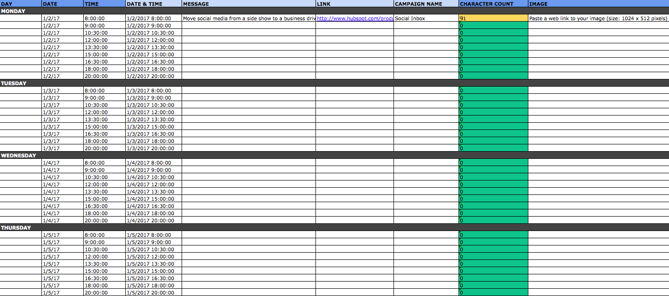
Let's say you want to add some tweets to your scheduling template. Skip over to the "Twitter Updates" tab, where you'll see this:

Social media calendar template for Twitter content

The first four columns, "Day," "Date," "Time," and "Date & Time" are there for your convenience, and if you choose to use a third-party app for pre-scheduling your tweets (like HubSpot's Social Inbox), then these columns will be useful. For now, just fill in the date on which you'd like your updates to publish to Twitter, and the time at which you'd like them to go out. The "Date & Time" column will automatically change based on what you input in the previous two columns.

Now, let's move over to the "Message" column. Here, input the copy you'd like to appear in your tweet, bearing in mind you should cap it at 116 characters to allow enough room for a link, and at 115 characters to allow room for an image. (Read this blog post for a full character count guide.) This spreadsheet will auto-calculate the number of characters you've entered to keep you on-point, turning yellow when you've reached 95 characters, and red when you've reached 116 characters.

After you've composed your tweet, paste the URL you'd like to include in your tweet in the "Link" column. Be sure to include UTM parameters so you'll know whether all of these tweets are actually driving traffic, leads, and customers. This is an important step to remember if you'd like to be able to demonstrate ROI from social. You can also use the "Campaign" column to add an associated campaign, which helps which more robust tracking and reporting.

Finally, in the "Image" column, attach the tweet's image (if you have one). For Twitter, we recommend images that are 1024 x 512 pixels. (Click here for a full cheat sheet of social media image sizes.) If you're having trouble attaching your image to the spreadsheet, follow these steps:

Step 1: Right-click the cell in which you'd like your image.

Step 2: Click "Hyperlink," then click the "Document" button, and finally, click "Select" to choose your image.

Step 3: In the "Choose a File" window, select the image from your computer and click "Open."

Step 4: You'll now see the image attached to the "Insert Hyperlink" screen. Feel free to edit the "Display" text to change the file name, then click "OK."

Note: This process is simply for organizational purposes. If you decide to upload the spreadsheet to your social media publishing software, it will not attach -- you'll have to do that with your marketing software. If you're a HubSpot customer, details for how to bulk upload your Twitter content to Social Inbox can be found within the downloaded template.

Planning Your Facebook Content Calendar

Now, let's talk about how to plan your Facebook marketing in advance with the template. Navigate on over to the tab in your template labeled "Facebook Updates."

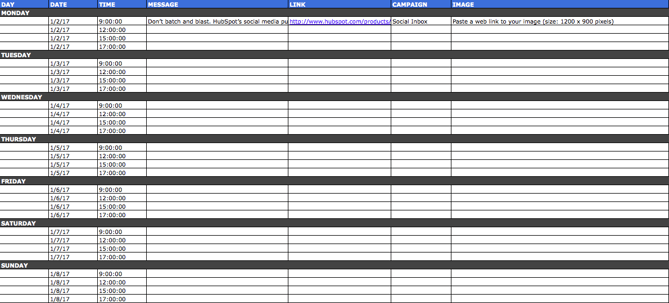
Social media calendar template for Facebook content

Facebook updates work similarly to Twitter updates, with the exception being bulk uploading your content is not possible in Social Inbox.

The first three columns, "Day," "Date," and "Time" are there for your convenience. Head on over to the column labeled "Message" and input the copy you'd like to appear in your status update, corresponding to the days and times you'd like those updates to run. Then, move to the "Link" column and input the link you'll be, you know, linking to in the update. (Don't forget that tracking token.) If you'd like the update to be tagged to a certain campaign, include this in the "Campaigns" column. Finally, attach an image just like you did with your Twitter updates -- if you're using one, we suggest you edit it to be 1200 x 900 pixels. (Click here for a full cheat sheet of social media image sizes.)

Planning Your LinkedIn Content Calendar

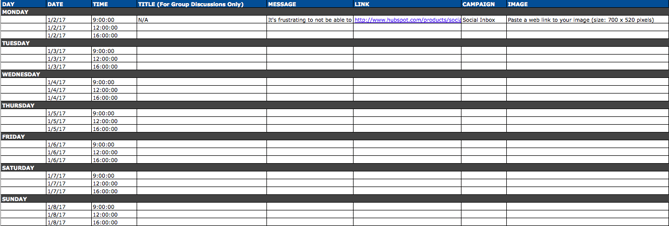
LinkedIn updates are the most unique, because you have both Company Pages and Groups to consider. To demonstrate the difference between Company Page updates and Group updates, let's navigate over to the column labeled "Title (For Group Discussions Only)."

Social media calendar template for LinkedIn content

LinkedIn Groups let you post a few kinds of updates, one of which is called a "Discussion." You will only fill out the "Title (For Group Discussions Only)" column if you're looking to post a Discussion to your LinkedIn Group -- because Discussions are the only update you'll be posting that requires a title. If you're not posting a Discussion to a LinkedIn Group, you don't need to fill out this field, because your update will not have a title.

You'll fill out the next column, "Message," for every type of update you post, whether it's for a Company Page or a Group. Simply input your copy into this column, and then navigate to the next two columns, "Link" and "Campaign" to input the URL to which you're directing readers with the tracking token you'll use to track activity, and the associated campaign if one exists. If you'd like to use an image for an update, attach it per the instructions laid out in the "Twitter" section. We recommend editing the image to 700 x 520 pixels.

Planning Your Instagram Posting Calendar

Now, let's move on to how to set up your Instagram photos and videos in advance with the template. Navigate on over to the tab in your template labeled "Instagram Updates."

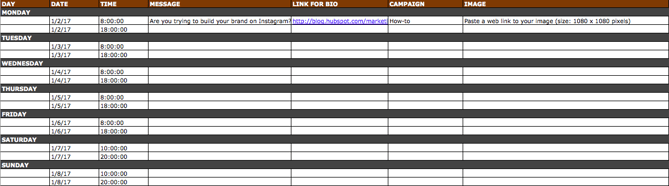
Social media calendar template for Instagram content

Instagram updates work similarly to Facebook updates, in that content can't be uploaded in bulk to Social Inbox like it can with Twitter.

The first three columns, "Day," "Date," and "Time" are there for your convenience. Head on over to the column labeled "Message," and input the copy you'd like to appear in your post's caption, corresponding to the days and times you'd like those updates to run. Keep in mind that although Instagram captions can be up to 2,200 characters long, they cut off in users' feeds after three lines of text. The exact length of these three lines depends on the length of your Instagram handle. (Read this blog post for a full character count guide.)

Next, move to the "Link for Bio" column and input whichever link you plan to put in the bio when you publish the accompanying Instagram post. (The reason you'd put a link in your bio and not the photo caption itself is because clickable URLs aren't allowed anywhere except the single "website" box in your bio. See #13 in this blog post for more on how that works.) Oh, and don't forget that tracking token.

If you'd like the update to be tagged to a certain campaign, include this in the "Campaigns" column. Finally, attach an image just like you did with your other social media updates -- we suggest you edit it to be 1080 pixels x 1080 pixels. (Click here for a full cheat sheet of social media image sizes.)

Planning Your Pinterest Content Calendar

Alright, now let's go over how to set up your Pinterest pins in advance with the template. Navigate on over to the tab in your template labeled "Pinterest Updates."

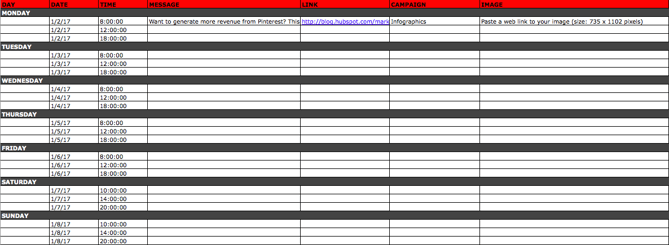
Social media calendar template for Pinterest content

Pinterest updates work similarly to Facebook and Instagram updates, in that content can't be uploaded in bulk to Social Inbox like it can with Twitter.

The first three columns, "Day," "Date," and "Time" are there for your convenience. Go to the column labeled "Message," and input the copy you'd like to appear in your pin's description, corresponding to the days and times you'd like those updates to run. Then, move to the "Link" column and input the link you'll be, you know, linking to in the update. (Don't forget that tracking token.)

If you'd like the update to be tagged to a certain campaign, include this in the "Campaigns" column. Finally, attach an image like you did with your other social media updates -- we suggest you edit it to be 735 pixels x 1102 pixels.

Planning Your Google+ Posting Calendar

Finally, we come to Google+.

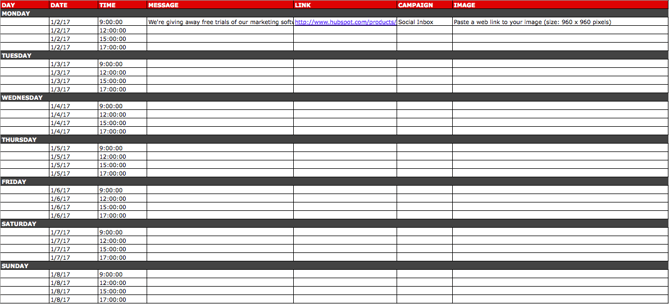
Social media calendar template for Google+ content

Update: Google recently announced it is shutting down its Google+ platform. Please consider using the template and instructions below for any potential social networking platform Google launches in the future, and check back with us for an updated template that reflects this rollout.

Start in the "Message" column, and input your status update. Then move over to "Link" column, where you'll input the link to which you're directing readers. If you'd like the update to be tagged to a certain campaign, include this in the "Campaigns" column. If you're attaching an image, you could use multiple different sizes, but 960 pixels x 960 pixels works best. (Click here for a full cheat sheet of social media image sizes.)

Content Repository (Or, Where to Source Social Media Content)

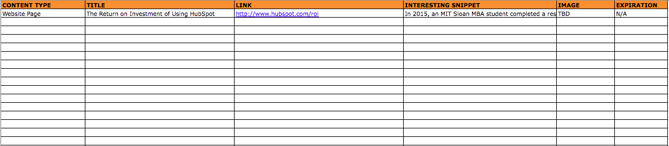
This template also provides you with a tab called "Content Repository," which should help you keep track of all your content and maintain a healthy backlog of fodder to make sourcing social media content easier.

social-media-calendar-content-repository.png

As you create more assets, you'll likely want to resurface and re-promote those pieces down the line, too. To ensure you don't lose track of all of that content, record it on this tab so you're never at a loss for what to publish on social. If the content you're promoting isn't evergreen, be sure to include an expiration date in the column marked "Expiration" so you don't promote it when it's jumped the shark.

This tab will also help you maintain a healthy balance of content: A mix of your own content and others', a mix of content formats and types, and mix of lead generation content vs. MQL-generating content vs. traffic-friendly content.

Don't Forget to Interact With Your Followers

Whether you use this spreadsheet to plan your content out in advance or upload to a third-party app, you'll still need to supplement these updates with one the fly content. Breaking news hits? Whip up a quick update to share it with your network. Someone in your network tweets something interesting? Give it a retweet with some commentary. Got a fascinating comment on one of your updates? Respond with a "thank you" for their interaction or an additional follow-up comment.

Coming up with and scheduling your social media content in advance is a huge time-saver, but it should go without saying that you still need to monitor and add to your social presence throughout the day.

Finally, we encourage you to experiment with your social media publishing. This template provides publishing dates and times for each social network, but you may find those are way too many updates for you to fill, or perhaps too infrequent for your booming social presence. You should adjust your social media publishing frequency as needed.

http://bit.ly/2ifJpp2

How to Turn YouTube Viewers Into Subscribers and Leads

Is your YouTube marketing delivering results? Wondering how to get more subscribers and prospects from YouTube? In this article, you’ll find tips to develop and optimize YouTube content that turns viewers into subscribers and leads. #1: Attract Cold Leads on YouTube With Topical Content Total video views is one of the factors YouTube’s algorithm takes into […]

The post How to Turn YouTube Viewers Into Subscribers and Leads appeared first on Social Media Marketing | Social Media Examiner.

January 28, 2020 at 12:00PM http://bit.ly/37JYzxz
read more...
from Social Media Marketing | Social Media Examiner http://bit.ly/2S1Z67o
via IFTTT