Monday, April 29, 2019

How to Use the Facebook Event Setup Tool

Do you use the Facebook pixel? Want an easier way to assign Facebook event tracking to specific URLs on your website? In this article, you’ll learn how to set up Facebook event tracking with the Facebook Event Setup Tool for Web. What Is the Facebook Event Setup Tool? Previously, setting up Facebook pixel events required […]

The post How to Use the Facebook Event Setup Tool appeared first on Social Media Marketing | Social Media Examiner.

April 29, 2019 at 12:00PM http://bit.ly/2vs5h9O
read more...
from Social Media Marketing | Social Media Examiner http://bit.ly/2PDz9cI
via IFTTT

20 of the Best Form Builder Tools for 2019

You’ve heard it before -- forms are the gold standard when it comes to capturing leads, learning about industry trends, doing market research, and even just getting some customer feedback. It might be one of the older methods in the book, but old is gold.

Before we dive into the best form builder tools for 2018, though, let’s talk about what a form builder exactly is.

With no shortage of options, the best form builder apps tend to be quite similar and user-friendly. Whether you want to make a contact form, a sign-up form, or a survey, form tools are the easiest way to create web forms, with drag and drop questions, multiple form fields, and different color and structure options.

Once your responses start coming in, most forms will also import each entry into a spreadsheet or centralized database and send you notifications when people complete them.

Form tools today usually offer many different features too, like progressive profiling, smart fields, and interactivity.

Easily build and embed forms on your site. Try HubSpot Forms for free!

Ultimately, there’s a form for each of your business’ needs and goals -- and we’re here to help you pick the best-fit tool specifically for you.

20 of the Best Form Builder Tools for 2018

1. HubSpot’s Free Online Form Builder

HubSpot’s online form builder is one of the most powerful form builder tools available. The tool combines the foundations of form creation with cutting-edge technology to give you much more capability than a normal online form builder can -- and it’s also free.

Even though it’s one the more advanced form builder tools, you don't need any technical expertise when you use HubSpot’s form builder. You can quickly create forms with the drag-and-drop form builder and convert anonymous website visitors into leads with unlimited forms, fields, submissions, and custom forms that all connect to your contact database.

Once someone fills your form out, they’re automatically routed to HubSpot CRM. Once they’re in your CRM system, you can set reminder tasks, call them, and send them one-to-one personalized emails, letting you better manage and nurture relationships with your contacts.

HubSpot's form builder also has data enrichment for contact profiles and deep integration with HubSpot's marketing hub, making it a good option for teams who want a single system to manage their forms, contacts, and marketing efforts.

2. Google Forms

Google Forms’ unique selling point is that it’s fast, free, and easy to use, with unlimited forms and entries. It’s also built into the Google Docs suite, so it automatically pulls your data into a Google Sheet for you to analyze.

While Google Forms’ design may not be customizable, this form tool is best for quick market surveys, rather than a professional survey or lead capture form placed on your website.

Image Source: Google

3. JotForm

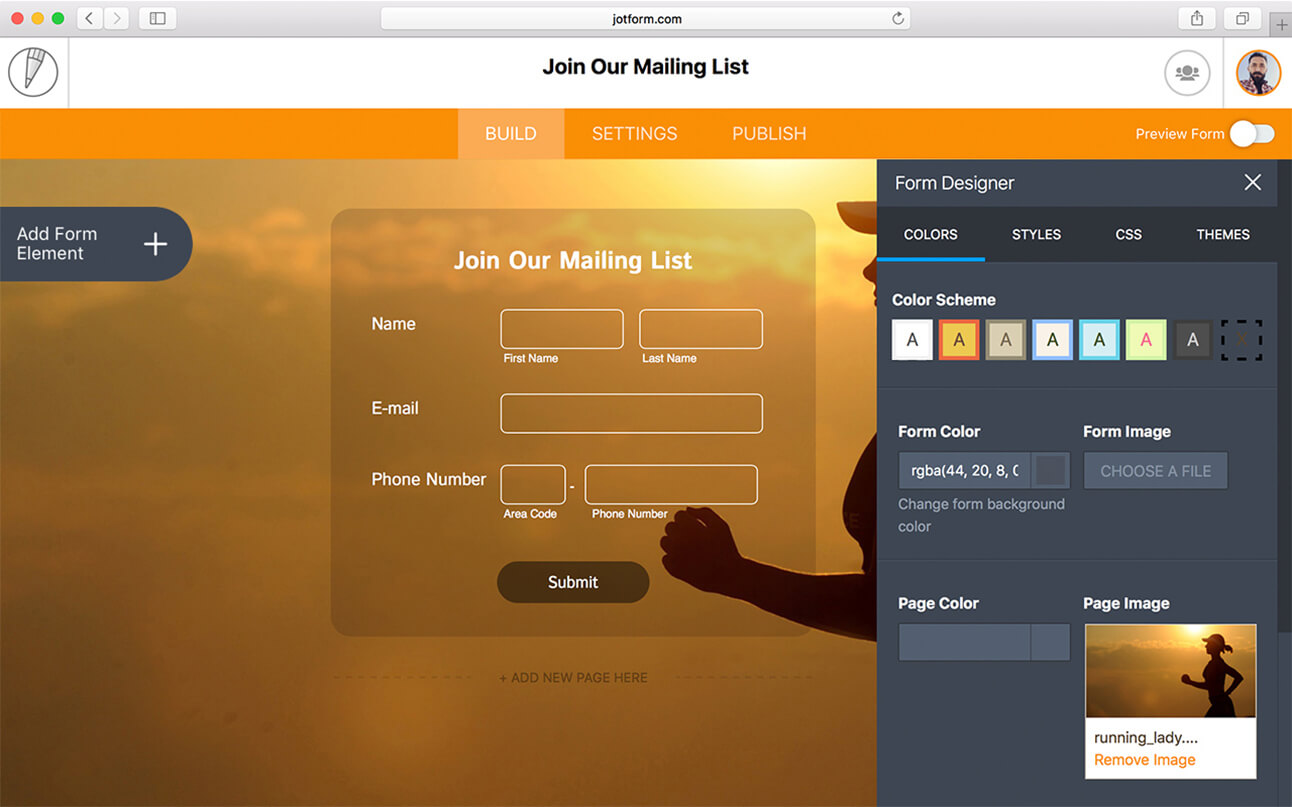
JotForm is an online form builder with an intuitive visual editor, known for making form building faster than ever.

The tool has all the normal form building capabilities as well as unique fields to customize your own forms. It also integrates with almost every marketing platform.The free plan caps out at 5 forms, with up to a 100 entries per month.

jotform design

Image Source: JotForm

4. Typeform

Typeform takes an innovative approach to the world of form building. With an intuitive design, the tool guides you through the form creation process one question at a time and makes the experience of building a survey fun and interactive.

Typeform is also great for customer surveys and user research -- you can create and send standalone survey links out to your list. If you want to try something with an engaging, straightforward user experience, the tool is a solid option.

Image Source: Typeform

5. Microsoft Forms

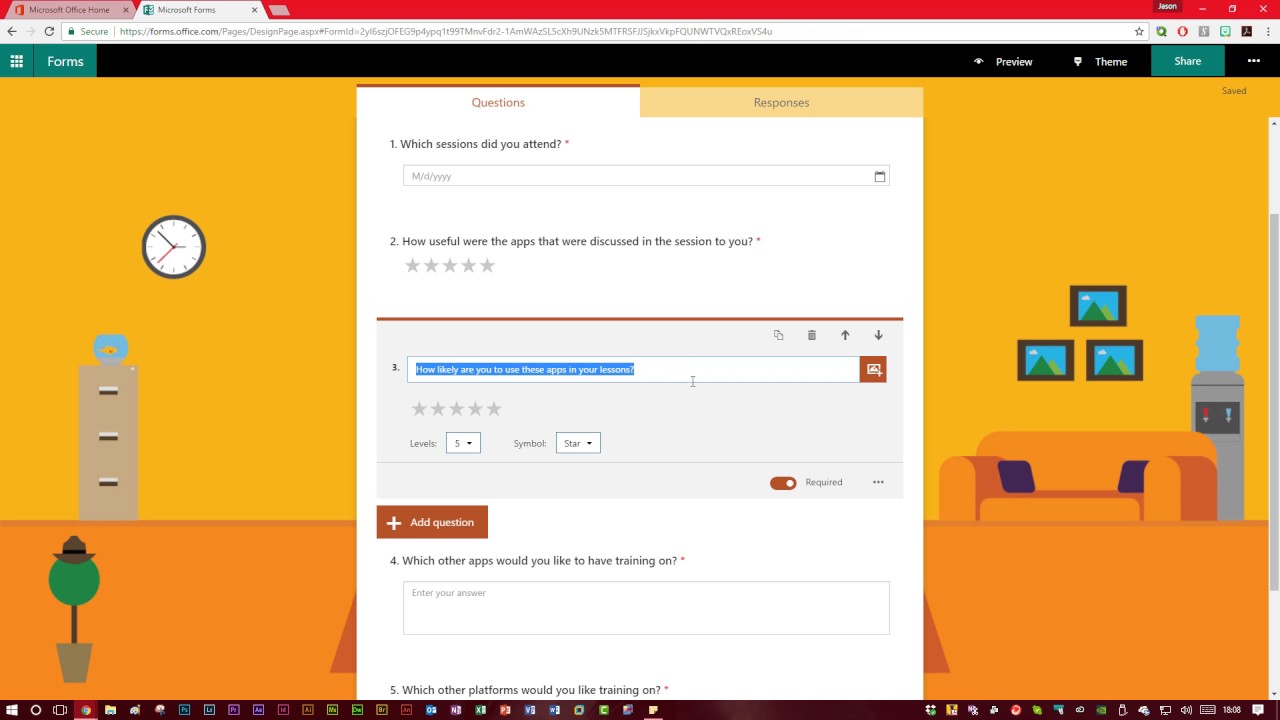
Microsoft Forms is a simple, easy-to-use form creator that integrates with the Microsoft Office suite. With full customization options, users can quickly make surveys, feedback forms, quizzes, and lead forms.

Since Microsoft forms doesn't integrate directly with an online CMS, the tool might not be the best option for lead generation. But the form builder can collect data in real-time and import all your responses in an Excel spreadsheet, so you can perform powerful yet simple analysis with Excel filters and pivot tables.
maxresdefault

Image Source: YouTube

6. Form Crafts

Form Crafts is a basic form builder tool that has a user-friendly interface and simple design.

The WordPress plugin allows you to create moderately customizable lead capture forms, email sign-up forms, surveys, and feedback collection forms. One of Form Crafts’ best features is that it’ll send you email notifications about your lead generation process, so you don’t need to constantly monitor your results anymore.

Image Source: WordPress

7. FormTools

FormTools is a flexible form creator that focuses on feedback, data, insights, and beautiful form building.

The form builder tool allows you to create most types of forms and tracks your results on a visually appealing dashboard. FormTools also give you an option to integrate their app with a third party provider of your choosing, like Salesforce or Dropbox.

Image Source: Form Tools

8. Wufoo

Part of the SurveyMonkey family, Wufoo is one of the oldest form tools in the space. You can design some appealing online forms with it and it’s super easy to use.

The app also allows you to embed forms on your website, set up payment fields that are compatible with a number of payment processing services, and turn on automatic email notifications to alert you when someone fills out your form.

Image Source: WuFoo

9. Ninja Forms

Ninja Forms is a powerful WordPress form tool that’s used by wide range of marketers, from novices to gurus.

The tool is free, integrates quickly and easily with a number of different tools, and it can greatly boost your marketing efforts. Ninja Forms also offers unlimited forms, fields and submissions. But, sometimes, the tool lacks clear documentation and can be difficult to use when you want to customize your forms.

Image Source: CodeCanyon

10. Cognito Forms

If you’re looking for a form builder with sound logic branches and robust payment fields, Cognito Forms is for you. The form tool also offers calculated fields, conditional logic, repeating fields, and more, making it easy and simple to create advanced forms.

Cognito Forms integrates with Stripe, PayPal, and Square and offers a free version that includes unlimited forms with 500 entries per month.

Image Source: Microsoft Store

11. FormStack

FormStack is mostly focused on building business and professional style forms. The tool’s best features include intelligent forms, built-in workflows, and seamless integrations with Google Sheets, PayPal, and MailChimp (and others through their API).

One of FormStack’s more sophisticated features is an A/B testing tool that can compare different versions of your forms and tell you what performs better.

The tool also offer electronic signatures and payments, and users can save their form drafts and return later to finish them.

Image Source: GetApp

12. FormSite

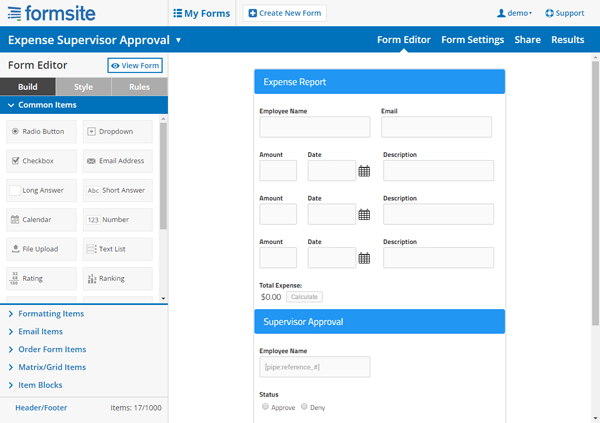
FormSite has all the essential features you need for cranking out some quick “prototypical” web forms. As one of the more basic form builders, it’s often used for simple contact or feedback forms.

The tool also has a number of pricing plans that can suit your specific business needs. The free version offers 5 forms each month with 10 results per form.
formsite-makeover-form-builder

Image Credit: FormSite

13. Clearbit Forms

Clearbit Forms lets you leverage smart forms and flexible data enrichment technology to automatically collect specific user information. This lets you create shorter forms with less fields, and, in turn, produce happier customers (because who doesn’t love a short survey?)

With two plans designed for startups and enterprises, Clearbit can definitely meet your modern marketing needs.

Image Source: Clearbit

14. FormKeep

FormKeep is a tool unlike most on this list -- it’s an easy-to-use tool that finds a happy medium between coded and drag and drop forms.

With FormKeep, you have the option to code your own form, style it according to your brand guidelines, and integrate it with Zapier to manage your submission data.

Image Source: Intercom

15. Gravity Forms

Another WordPress-powered plugin, Gravity Forms helps you create amazing forms with the help of multi-page/multi-step forms and a number of time-saving features.

With this tool, you have access to a variety of integration options and add-ons for email software, messenger platforms, payment options, and automation software. You can also create advanced forms, but, for non-techies, they can be a little complicated to set up.

Image Source: WPML


16. SurveyAnyPlace

SurveyAnyPlace has proven that surveys don’t have to be boring. With their gamification elements, interactive features, and incentives like coupon codes, you can make all your surveys and quizzes fun and enjoyable.

By leveraging SurveyAnyPlace’s unique approach to form building, you can easily collect leads, information, and insights from visitors.

Image Source: GetApp

17. Contact Form 7

One of the most popular WordPress plugins, Contact Form 7, has upwards of 5 million active installations on the CMS.

A free tool for everyone to use, it’s a super simple and basic form creator with a heavy focus on contact forms. But it’s also important to note that the tool has some limitations, especially with its customization options.

Image Source: WordPress

18. Conversational Form

An open source platform, Conversational Form lets you transform your web form into a simple chatbot.

By using a novel and clever way to gather data, this form builder is bound to drive user engagement. At the same time, though, due to its new entrance into the marketing space, it might be difficult to learn your way around the tool.

Image Source: Pagely

19. FormBakery

As one of the easiest drag and drop form tools out there, FormBakery lets you build professional forms in the most straightforward way possible.

For those looking to build a super simple form in under 5 minutes, the tool is a great choice. You can quickly customize forms with your own designs, with no coding necessary. If you’re looking to build a more advanced form, though, FormBakery may not be the right choice for you.

Image Source: AppStorm

20. DeviceMagic

DeviceMagic is a mobile form solution on a mission to ditch all paperwork, automate lead generation processes, and enhance data collection.

Since the tool solely focuses on building mobile forms, it has a number of great benefits over other form builders, like quick and accurate data collection, lower operations costs, and less time wasted on administrative work.

Image Source: Device Magic

The options are endless for form builder tools.

Most form builders offer all the essentials needed to make a basic form, but your options start to narrow down when you want better customization and deeper data analysis. Ultimately, for you, the best form tool depends on your team’s purpose and particular business needs.

http://bit.ly/2DEck6a
Sunday, April 28, 2019

Earned Media, Explained in 400 Words or Less [Examples]

Remember when people used to learn about upcoming events, the latest trends, and cool new products exclusively from magazines, newspapers, and TV shows?

These publications and broadcasts are where brands used to get all their earned media. But earned media has expanded beyond print and TV, and marketers can harness it in several ways.

In many ways, earned media's nickname is "publicity." You haven't paid for this media to be created -- the way you would for, say, an advertisement -- and therefore your actions alone "earned" you this attention. But because the places we get information have changed over the last 30 years, how has earned media changed as a result?

Click here to download our ultimate toolkit for social and PR branding.

Still you might also hear earned media referred to as "free media," because you haven't paid for this media to take place.

How Earned Media Has Changed

Earned media used to be the 90-minute segment on cable news about a new consumer product. And to some extent, this is still a critical source of earned media.

However, earned media now also comes in the form of a customer tweet about "the best brunch ever!" at a restaurant that got several likes and retweets. It's that horrible Yelp review about how a different customer had "the worst brunch ever" at that very same restaurant. And, it's that technology blogger's "Top 10 Apps of The Year" article that was viewed and shared by thousands of people after you launched your new mobile app.

What Earned Media Isn't

Earned media isn't publicity you pay for or own. When a company pays a publication to write a glowing article about them, for example, that's not an example of paying for earned media -- that's just paid media. And when you write a blog post for your company blog about your latest product release, that's not earned media, either -- that's owned media, since you own that blog post.

The distinctions are fairly clear between these camps, but they're important for any marketer to know.

How effective is earned media?

In short, very. Today's consumers are influenced greatly by family, friends, and what they read and see online. People no longer share the good, the bad, and the ugly of brands exclusively at the water cooler -- they share it with everyone they're connected with online, which can include hundreds, thousands, or maybe even millions of people.

And a lot of those people listen and use those stories to make buying decisions. In fact, according to HubSpot Research, 57% of people in the U.S. trust what they hear from friends and family the most when they discover a new product. About one third of U.S. buyers prefer what information they can find from a Google search.

As digital marketing and social media continue to evolve, so will earned media -- and departments other than public relations, like marketing and customer service, will become more responsible for capturing earned media attention.

To make sure you're caught up on this "web 2.0" version of an old-school term, let's dive into what earned media means today and the various ways you can use it in your marketing.

Earned Media Examples

You may have heard of earned media as compared with paid media and owned media. As we hinted to above, there are pretty thick lines between paid media, owned media, and earned media: You "pay" for paid media, you "own" owned media, and you "earn" earned media. To show you what this looks like in practice, here are some common examples of earned media today.

TV News Segment

If your business makes a big-enough splash in its industry, you can still expect to see earned media in the form of a 90-second news spot on a local (or national) station. This is some of the oldest earned media out there, and it still occurs today.

For example, a business that relocates its headquarters to a new city -- and promotes that relocation online -- might capture an interview opportunity with the city's local news station about some of the new jobs it will be hiring for.

Newspaper Article

Newspapers, both in print and online, constantly share big community developments that impact people both locally and nationally. So, just like a story on TV about a new business development, local newspapers can just as easily pick this story up and write it down for online readers.

Tweet

Twitter might revolve around trending topics worldwide, but there are also countless smaller communities of Twitter users who broadcast their thoughts on issues related to their industry. A tweet, therefore, is a tiny instance of earned media. But it depends on whom the tweet comes from.

For example, if a business starts using new lead-generation software to help their marketing team, and an employee tweets, "Just started using @HubSpot and it's helped us deliver amazing leads to our sales team!" We here at HubSpot might call that a positive dose of earned media.

Article on a Trade Publication

Smaller business developments might not earn the attention of major media conglomerates, but they very well could capture the interest of a trade publication focused on their industry. This, too, is earned media.

For example, an environmental business that creates a new method of composting might get overlooked by the evening news, but a magazine all about sustainability is likely to want to write an article about this innovative method for its niche audience.

Product Roundup

There are always content creators out there who are writing "roundup" articles, which list the best of a particular type of product for customers who seek high-quality items. If you build a product, and it's good enough, getting included in somebody's roundup is a form of earned media.

For example, a tent maker that develops a new one-person tent for a low price could wind up in an article called "The 10 Best One-Person Tents for Campers on a Budget."

Organic Traffic

This example is a tricky one to define. Earned media usually comes in the form of content, either in written or video form. But if you create your own content, and "earn" traffic to this content from ranking highly on search engines, the traffic you receive to this content is, in some ways, earned media. But let's be clear: There's an important difference between SEO and organic traffic ...

For example, if you write a blog post -- a form of owned media -- and conduct keyword research on this blog post to optimize it for Google Search, your blue linked result shown on Google's search engine results page (SERP) is an "earned" ranking. This makes the traffic you get from people who click on this result earned media attention.

Customer Review

One of the biggest things to change in the world of earned media over the last decade is how customers express their feelings about a product they've used. Gone are the days where your clients' opinions of you are limited to phone calls and dinner conversations. When people love or a hate a product, they make it known in writing via reviews on sites like Yelp, Google Reviews, TripAdvisor, Amazon, and more. Every review about you is earned media.

Word of Mouth

You might not think of "word of mouth" as an example of earned media, but today, it continues to be as free and impactful as a tweet or Yelp review.

Every time your business affects a customer, whether that effect is good or bad, you earn a place in day-to-day conversation. This means departments like marketing and customer service are just as critical to the tone of that conversation as the product itself.

For example, when a marketing team creates helpful or entertaining content for its audience, it's making potential customers happy. When a customer service team solves a critical problem for someone, it's making current customers happy. And the happier your customers, the more positive earned media you'll get the next time they're chatting with someone who's looking to buy a product like yours.

Of course, the lines between earned and paid media can blur at times. Take viral videos, for example. A video doesn't just go viral by accident -- most of the time, there is a lot of careful planning involved to kick start the video's exposure with paid media, and at some point the paid media stops once earned media picks up.

The lines can blur between earned and owned media, as well. A blog post you write featuring your own industry research, for example, could get picked up by other bloggers and media outlets. Similarly, a press release you write following a product launch serves to encourage others in the industry to share your news on other publications. So, while earned media isn't always a direct result of owned media, owned media can help you get more attention from third parties.

The key to understanding the difference between the three is this: Unlike paid and owned media, earned media isn't controlled by brands, which makes it less biased and more trusted.

How do you "earn" earned media?

Because earned media is owned by third parties, it may seem like it's out of your hands -- but that's actually not true. Marketers have the tools to influence some (not all) conversations about their brands. Here are three of the best ways to do just that:

1. Create content worth sharing.

Get people to want to share your content with one another by ... drum roll please ... creating awesome content worth sharing! Shareable content tends to be either really useful or really funny, and in the form of a list, infographic, or video. There's even a science to what makes content shareable. Also, make it easy for people to actually share your content by placing social share buttons where appropriate.

2. Invest plenty of time in interacting on social media.

Without social media, you and your potential customers are basically strangers. That's the really cool thing about social media: It brings you so much closer to consumers. To have an impact on them and to encourage them to talk about your brand, you should spend plenty of time and energy interacting with them individually online.

Set up filters in your social monitoring tools to help monitor conversations about your brand, and jump in when you can add something to the conversations. Ask your followers questions about their daily lives or about their experiences with your brand. Give your biggest fans a shout out from your account. Your willingness to show people you care enough about them, about their experience, and about your own business to respond to their posts can elicit positive emotions about your brand, and those positive emotions are share-worthy.

3. Make your customers really, really happy.

All customers don't automatically become brand promoters -- you have to put the work in to not only meet their expectations, but exceed them. When you go above and beyond for your customers, you become a lovable brand. And when customers love you, they are more likely to give referrals, share good things about you on social media, give testimonials, and remain loyal to your brand for a long time.

According to research published by Oberlo, 54% of people on social media are researching products they're interested in. Product sentiment can spread virally through social media sites like Facebook -- and that positive vibes spread faster than negative ones. Create cool content, interact with people, and delight your customers -- and you can bet they'll spread the word.

New Call-to-action

http://bit.ly/2ZIbJr6

Saturday, April 27, 2019

Future of Facebook and Twitter

Welcome to this week’s edition of the Social Media Marketing Talk Show, a news show for marketers who want to stay on the leading edge of social media. On this week’s Social Media Marketing Talk Show, we explore where Facebook and Twitter are heading based on signals from this week’s Q1 2019 earnings calls. Our […]

The post Future of Facebook and Twitter appeared first on Social Media Marketing | Social Media Examiner.

April 27, 2019 at 12:00PM http://bit.ly/2ZGCJaC
read more...
from Social Media Marketing | Social Media Examiner http://bit.ly/2UISHNu
via IFTTT

Friday, April 26, 2019

Why We Interviewed a Bunch of Rappers About Marketing

Can you imagine a world without music?

I can’t.

When I think about the things in life for which I’m the most grateful, music always falls on the list -- rap music, in particular.

For me, rap is the thing to listen to when I’m happy. Sad. Angry. Tired. When I have a big meeting to prepare for. When I’m dreading a workout. When I’m not feeling any particular way, but just want to disrupt the silence around me. And as we’re about to see -- it has not only profoundly carved out my own path thus far, but those of myriad consumers, business owners, and artists.

Before I worked for HubSpot and started covering marketing and tech news, I wrote primarily about two things -- food, and indie hip hop.

Indie artists are those who aren’t

signed to a major label,

and are often responsible for things

like their own marketing,

tour scheduling,

and the business side of music

that we don’t often think about

as listeners.

A quick vocabulary lesson: Indie artists are those who aren’t signed to a major label, and are often responsible for things like their own marketing, tour scheduling, and the business side of music that we don’t often think about as listeners.

Keep that in mind -- we’ll get back to it in a bit.

As it turns out, these two categories -- food and hip hop -- have more in common than I first imagined. Years ago, the former introduced me to the latter. I wrote about one rapper’s journey to food consciousness, who then introduced me to another rapper whose mother owns a grass-fed cattle ranch. These various things we consume, it seems, are quite inter-connected.

I had to ask: Is there a chance that indie hip hop is somehow connected to marketing and tech, too?

growth_raps_four_fistsRappers Astronautalis and P.O.S -- a.k.a. Four Fists --discuss their career growth

Let’s go back to the earlier quick-and-dirty definition of what constitutes the responsibilities of an indie rapper:

  • The many elements of promotion.
  • Planning events (tours and shows = experiential marketing).
  • Connecting with and building audiences (fans = customers).
  • Finding the right people to collaborate with (side projects and recording tracks with other artists = co-branding).

… All while cultivating both awareness and a career trajectory (name recognition = brand recognition).

Sound familiar? That’s because indie rappers are quintessentially very human, creative, small-to-midsize businesses. Of course we had something to learn from them -- and we think everyone else does, too.

That’s why we decided to film a series of interviews with indie rappers who have been tasked with and mastered many of the same things that you -- our dear readers -- have also experienced.

growth_raps_four_fists_performFollowing a conversation about growth, Four Fists performs live in our studio

We asked them about where they’ve been, where they are now, and how different everything looked in between -- and how, throughout it all, they’ve continued to create music that remains core to who they are. And, just for fun, we had them play a song or two during their times with us. In a way, it all sheds new light on marketing that gives it, well, a different sound and energy. After all, around here, we’re big into work that has heart.

As the rap group Dead Prez once so perfectly phrased it: This is bigger than hip hop. This is about the humans behind the music, their journeys to and through it, and how it’s not only shaped their lives, but those on the receiving end of their work.

These are their stories. This is Growth Raps.


http://bit.ly/2vlrDcZ

How to Boost a Post on Social Media [Facebook, Instagram, and Twitter]

In the social media marketing world, marketers reminisce about the times where they could fill up on organic reach a lot like my parents reflect on their college years -- those were the good old days.

But similar to how the real world flipped most people's life upside down when they graduated from college, social media’s purge of organic reach flung marketers on a spinning teacup ride.

With almost 3 billion social media users today, millions of brands have promoted their content on these platforms for years. But the popularity of social media has flooded each platform with hoards of articles, photos, and videos, skyrocketing the supply of content while the demand for it has plateaued. This has decimated the amount of opportunities that brands can leverage to interact naturally with their fans.

Needless to say, social media marketing is a pay-to-play strategy now. And one of the most effective ways to leverage paid social media advertising is by boosting your posts.

How to Boost a Post on Social Media

Facebook

1. Pick an existing post on your Facebook Business Page that you want to boost.


2. Click “Boost Post” on the bottom right corner of your Facebook post.


3. Choose your audience.

Before you boost your Facebook post, you can either distribute your post to a recommended audience that Facebook will make for you or create a new audience based on a robust set of targeting options and distribute your post to them.

4. Set your boosted post’s budget and duration.

Your budget is how much money you’ll spend to boost your post. Your duration is how long you’ll boost your post for. Facebook will estimate how many people your post will reach based on your budget and duration.

Instagram

1. Click the “Promote” button at the bottom of your post.


2. Pick a goal.

Before you boost your post, Instagram will ask you whether you want to attract more profile visits, website traffic, or promotion views. Whatever your goal is for the specific post you want to boost, make sure you choose the option that best aligns with it.

3. Choose an audience.

After choosing your goal, you can pick from three different targeting options: Automatic, Local, and Manual. Automatic tells Instagram to target people who are just like your followers, Local lets you target people in a specific location, and Manual lets you target specific people, places, or interests.

4. Set your budget and duration.

Instagram will estimate the expected reach and clicks that your post will attract after you set your post’s budget and ad duration.

Twitter

1. Click “View Tweet Activity” at the bottom of your Tweet.


2. Click “Promote Your Tweet”.


3. Choose your targeting.

Twitter’s targeting is less sophisticated than Facebook’s and Instagram’s. You can only target based off location, like country, state/province/region, or metropolitan area.

4. Set your budget.

After setting your budget, Twitter will estimate the amount of impressions and engagements your boosted Tweet will attract.

http://bit.ly/2PxS5cH

First vs. Third-Party APIs: What You Need to Know

Have you ever wondered how Google Maps is able to deliver relevant information depending on your location? Or, alternatively, how Hotels.com knows when a random hotel in Austin, Texas has a specific room available?

The answer is APIs, or application programming interface.

At its most basic definition, APIs let applications communicate with each other.

If you're a HubSpot customer and you want to integrate your WordPress website with your HubSpot CRM, an API is an interface that allows you to do just that, since an API can allow the two applications to access data from each other.

In today's world, whether you're aware of it or not, APIs are everywhere -- they control how we get information from social media sites, how we navigate our GPS's, and how we book tickets online.

Additionally, they're incredibly helpful for businesses. At HubSpot, for instance, APIs are necessary as we strive to become an "all-on-one" platform, which will enable our customers to use all their favorite software and applications in one place.

But whether you're interested in developing a unique one-of-a-kind API for your client, or want to install one for your own internal systems, you might be wondering -- should I use time and resources to build my own internal API, or should I access a Third Party API?

Here, we're going to explore the pros and cons of First vs. Third Party APIs, so you can ensure you're choosing the best option for your business.

Pros and Cons of First Party APIs

A First Party API gives you complete control over every aspect of the API lifecycle, including development, design, and implementation. Developing a First Party API, then, makes the most sense for unique client cases or security scenarios.

For instance, Connor Barley, who's on HubSpot's Developer Support team, told me -- "The obvious benefits to developing an API 'in-house' is that you have total control over what data is returned, its capabilities like filtering and pagination, and you can safely know exactly what data you'll get back every time. You also have the added bonus of being able to iterate quickly, and really tailor the API to your businesses particular needs."

However, developing and implementing an API in-house is expensive and takes time and resources to ensure it's functioning properly at all times. As Barley notes, "Good software requires constant upkeep and time spent on it, so you need to be willing to put in the time and money to keep your API up-to-date and able to be used."

Additionally, as complexity increases, so does expense. In the long run, particularly if you believe you'll need an API that can scale as your business grows, it might not be an optimal solution for your budget.

Next, let's consider the benefits and limitations of a Third Party API.

Pros and Cons of Third Party APIs

An API developed by a third-party will have requirements and regulations, so it's not necessarily an optimal solution if you need to tailor an API for specific business or client needs. However, most of the time, a Third Party API will meet your needs and be a safer and more effective solution.

As Brett Adkins, a Business Technology Analyst at Deloitte Consulting, notes -- "An API can expose a lot of data that you don't necessarily want certain users to access, so it has to be secure and have the right rules in place. Unless you work for a large company that does a lot of development work, it's unlikely you'll have the resources to efficiently develop an effective and safe API. In the long run it's probably much safer, and a better use of resources, to have an expert third-party develop it."

Oftentimes, there's no real need to reinvent the wheel. For instance, why go through the trouble of developing, designing, and implementing a maps platform with an in-house API when you can just as easily use Google Maps?

Plus, and perhaps most appealingly -- since you don't own a Third Party API, there's very little upkeep. As Barley notes, "Third Party APIs are reliable if you pick a good service, and can provide you with all the data you might need to run your business, without the hassle of developing it yourself."

Additionally, a Third Party API might enable you to approach a problem from a unique point-of-view that you wouldn't get from your developers in-house.

Of course, it's critical to note, you'll want to consider Third Party APIs rules and regulations before choosing one. You might find a Third Party APIs' rules are too constricting, and won't enable you to do what you need to do.

So … First or Third Party, which should you pick?

Ultimately, the decision to choose First vs. Third Party is entirely dependent on your resources, existing software infrastructure, budget, and business goals.

Isaac Takushi, a Developer Support Specialist at HubSpot, sums it up like this -- "A decision between first and third-party APIs is generally one between full control and out-of-the-box simplicity. When you decide to develop your own API, you must be prepared to embark on a journey and weather its perils. You're able to tailor your solutions to fit into your organization's existing infrastructure and meet your users' specific needs, but it can be easy to get tunnel vision. Third-party APIs, on the other hand, can open up worlds of possibilities that aren't afforded by your organization's time and resources, but force you to put trust and information in others' hands."

If you're considering using a Third Party API for your business, here are a few you might explore:

Additionally, if you're a HubSpot customer, take a look at some of the apps and web services you're able to integrate with -- an example of an API, in action.

http://bit.ly/2vlrAOl