Sunday, February 25, 2018

How to Create an Ebook From Start to Finish [Free Ebook Templates]

At age 11, I dreamed of being an editor at a major magazine. I even put together my first publication, Teen Scene Magazine, using colored construction paper, yarn, and in-depth feature interviews with ... my dad.

Flash forward to today. I've swapped my colored construction paper and yarn for PowerPoint and InDesign. I've replaced my dad with marketing experts and influencers (in the office, that is). And week after week, I have the satisfaction of being an ebook creator.

But making an ebook can be overwhelming. Not only do you have to write the content, but you also need to design and format it into a professional-looking document that people will want to download and read. With lead generation being the top goal for content marketing, however, ebooks are an essential part of an successful inbound marketing program.

In this post, we'll walk you through the ins and outs of creating an ebook by, well, creating an ebook. And if you're worried about your lacking design skills, fret not ...

Click here to download our collection of customizable ebook templates.

Got your free ebook templates? Ready to make an ebook? Great -- let's get to it.

How to Create an Ebook

Step 1: Choose a Topic That Matches Your Audience's Needs

Remember: The goal of your ebook is to generate leads for your sales team, so pick a topic that will make it easy for a prospect to go from downloading your ebook to having a conversation with your sales team.

This means your ebook shouldn't deviate much from the topics you cover in your other content marketing channels. Rather, it's your opportunity to do a deep dive into a subject you've only lightly covered until now, but something your audience knows they need to learn more about.

For example, in listening to sales and customer calls here at HubSpot, I've learned ebooks for use in content marketing is a huge obstacle for our audience, who are marketers themselves. So if I can provide not only this blog post, but resources to make ebook creation easier, I'm focusing on the right topic for opening up a sales conversation.

To get your creative juices flowing, here are some example ebook titles to consider. (Note: Replace "x" with an appropriate number.) You can also use our free Blog Topic Generator tool to come up with more ideas. Most blog topics can be made comprehensive enough to serve as longer form ebook topics.

  • X Best Practices for [Insert Industry/Topic]
  • An Introduction to [Insert Industry/Topic]
  • X Common Questions About [Insert Industry/Topic] Answered
  • X [Insert Industry/Topic] Statistics For Better Decision Making
  • Learn From The Best: X [Insert Industry/Topic] Experts Share Insights

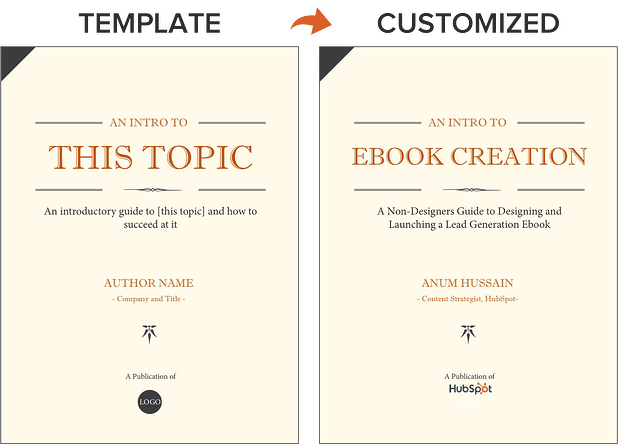
For this blog post, I'm going to use the PowerPoint version of template two from our collection of five free ebook templates. Through each section of this post, I'll provide a side-by-side of the template slide and how I customized it.

Below, you'll see my customized cover with my sales-relevant ebook topic. For help with writing compelling titles for your ebooks, check out the tips in this blog post.
how-to-create-an-ebook-1

Step 2: Outline Each Chapter of Your Ebook

The introduction to your ebook should both set the stage for the contents of your ebook and draw the reader in. What will you cover in your ebook? How will the reader benefit from reading it? For tips on how to write an effective introduction, check out this post.

Some ebook creators say that an ebook is simply a series of blog posts stitched together. While I agree you should treat each chapter like an individual blog post, the chapters of your ebook should also flow fluidly from one to the other.

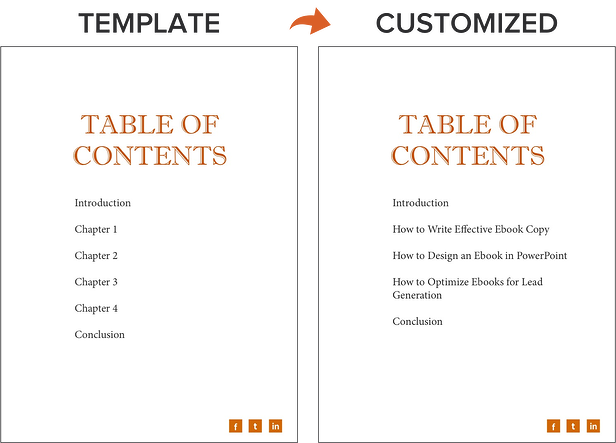
The best way to outline your ebook is by thinking of it as a crash course on the sales-relevant topic you selected. In my example of creating an ebook, I know I need to cover how to:

  1. write effective copy
  2. design an ebook
  3. optimize ebooks for lead generation and promotion

While my example has a few chapters, keep in mind that your ebook does not need to be lengthy. I have one golden rule for ebook length: Write what is needed to effectively educate your audience about your selected topic. If that requires five pages, great! If that requires 30 pages, so be it. Just don't waste words thinking you need to write a long ebook.

With that, let's move on to the actual copy you're writing.
how-to-create-an-ebook-2

Step 3: Break Down Each Chapter as You Write

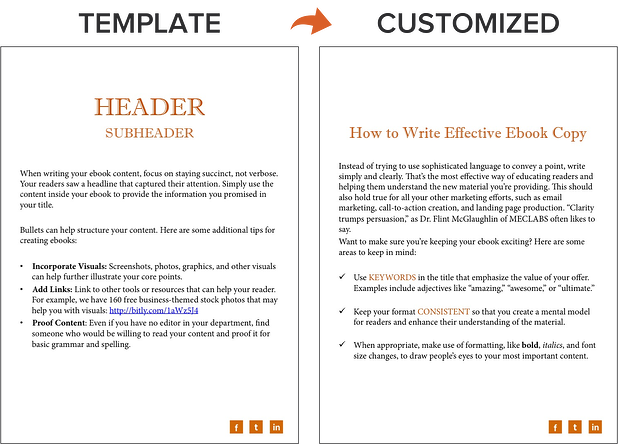
Get writing! Here, you can approach each chapter the way you might write a long blog post -- by compartmentalizing each chapter into smaller sections or bullet points, as shown in the picture below. This helps you write simply and clearly, rather than trying to use sophisticated language to convey each point. It's the most effective way to educate readers and help them understand the new material you’re providing.

Be sure to maintain a consistent structure across each chapter, as well. This helps you establish natural transitions between each chapter so there's a clear progression from one chapter to the next (simply stiching blog posts together can rob you of this quality).

These practices should hold true for all your other marketing efforts, such as email marketing, call-to-action creation, and landing page development. “Clarity trumps persuasion,” as Dr. Flint McGlaughlin of MECLABS often likes to say.

Want to make sure you're keeping your ebook exciting for readers? Here are some key tips to keep in mind:

  • Use keywords in the title that emphasize the value of your offer. Examples include adjectives like “amazing,” “awesome,” or “ultimate.”
  • Keep your format consistent so you create a mental model for readers and enhance their understanding of the material.
  • When appropriate, make use of formatting -- like bulleted lists, bold text, italics, and font size changes -- to draw people’s eyes to your most important content or emphasize certain points you want readers to remember.
how-to-create-an-ebook-4

Step 4: Design Your Ebook

Our downloadable ebook templates are offered in both PowerPoint and InDesign. For this example, we'll show you how to do it in PowerPoint, since more people have access to that software.

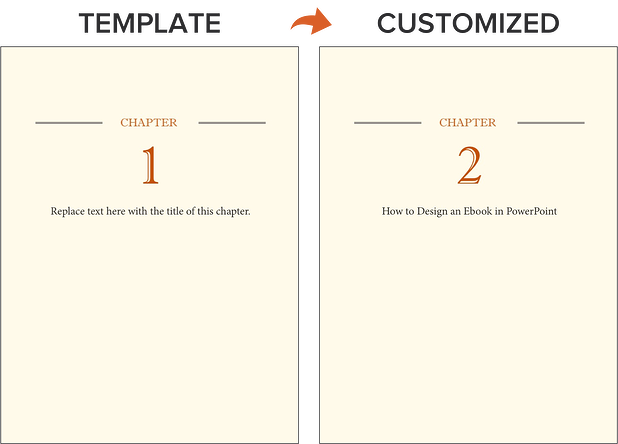
You'll notice we only have one "chapter page" in the template (slide three). To create additional chapter pages, or any pages really, simply right click the slide and choose Duplicate Slide. This will make a copy of your slide and allow you to drag it to its proper place in your ebook via the sidebar or Slide Sorter section of PowerPoint. You can then customize it for any subsequent chapters.
how-to-create-an-ebook-5

Step 5: Use the Right Colors

Ideally, our free ebook templates would magically match your brand colors. But, they probably don't; this is where you get to truly personalize your work. However, because ebooks offer more real estate for color than your logo or website, it's a good idea to consider secondary colors within your brand's color palate. Ebooks are where this color scheme can truly shine.

To learn how to add your brand's colors to PowerPoint, check out this blog post. That way, you can customize the color scheme in our ebook templates to match your brand!

Step 6: Incorporate Visuals

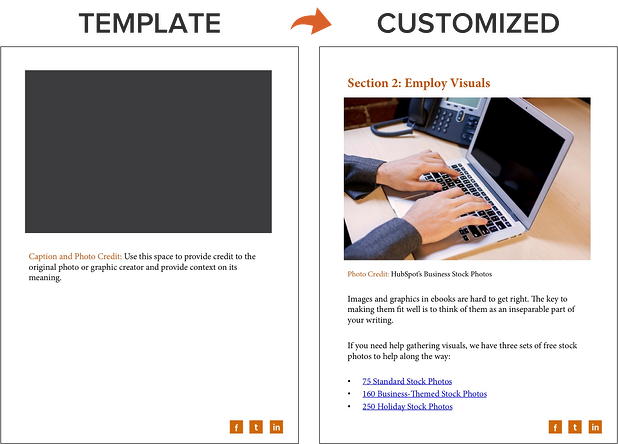
Images and graphics in ebooks are hard to get right. The key to making them fit well is to think of them as complementary to your writing. Whether you add them during or after you’ve finished writing your ebook’s copy, your visuals should serve to highlight an important point you’re making or deconstruct the meaning of a concept in an easy-to-understand, visual way.

Images shouldn’t just be there to make the ebook easy on the eyes. Rather, they should be used to enhance the reader’s understanding of the material you’re covering. If you need help gathering visuals, we have three sets of free stock photos that might help you along the way:

And if you're compiling a data-heavy ebook, you might want to download our free data visualization ebook for tips about designing compelling charts and graphs for your content.
how-to-create-an-ebook-6

Step 7: Highlight Quotes or Stats

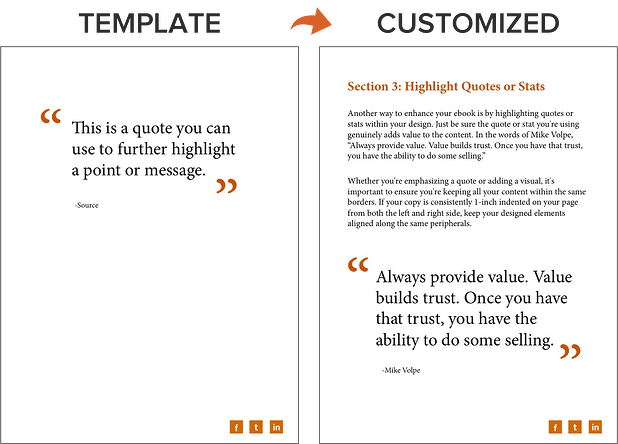
Another way to enhance your ebook is by highlighting quotes or stats within your design. Just be sure the quote or stat you're using genuinely adds value to the content.

Whether you're emphasizing a quote or adding a visual, keep all your content within the same margins. If your copy is consistently 1-inch indented on your page from both the left and right side, keep your designed elements aligned using that same spacing.
how-to-create-an-ebook-6-1

Step 8: Place Appropriate Calls-to-Action Within Your Ebook

Now that your content is written and designed, it's time to optimize it for lead generation, reconversion, and promotion.

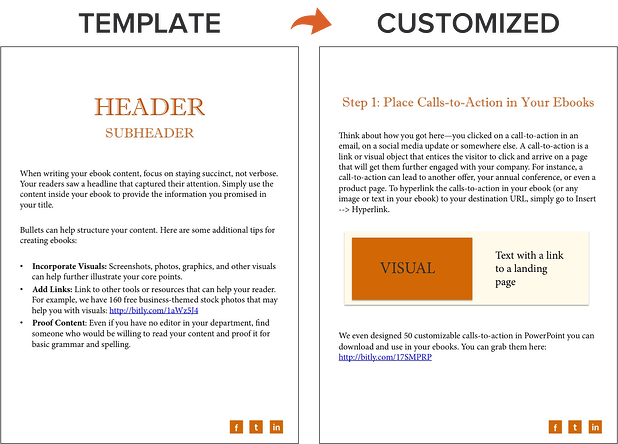
Think about how you got here -- you clicked on a call-to-action (CTA) in an email, on a social media post, or somewhere else. A CTA is a link or visual object that entices the visitor to click and arrive on a landing page that will get them further engaged with your company. Since your ebook readers have probably converted into leads in order to get their hands on your ebook to begin with (more on this in Step 2 below), use the CTAs within your ebook to reconvert your readers and propel them further down your marketing funnel.

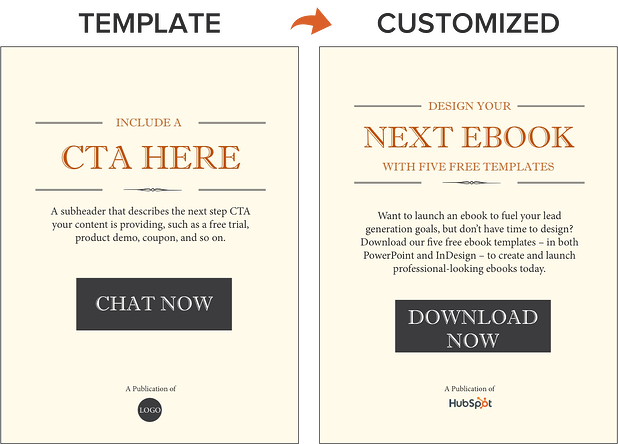
For instance, a CTA can lead to another offer, your annual conference's registration page, or even a product page. Depending on what this next action is, CTAs can be an in-line rectangle or a full page teasing the next offer (see both images below).

To hyperlink the CTA in your ebook (or any image or text in your ebook) to your destination URL, simply go to Insert >> Hyperlink in PowerPoint.
how-to-create-an-ebook-8-1

how-to-create-an-ebook-10

We've even designed 50 customizable calls-to-action in PowerPoint you can download and use in your ebooks. You can grab them here.

Now, we don't have a dedicated CTA template slide in the PowerPoint ebook templates for you to customize ... but it's still simple! All you have to do is duplicate slide four (the Header/Subheader slide) and customize copy or add images as needed. You can also go to Insert >> New Slide and work from there.

Step 9: Convert It Into a PDF

Once you've finished writing your ebook -- CTAs and all -- it's time to convert it to the right file type so it's transferrable from you to your recipient.

To convert your ebook to a PDF, click File >> Save As in the ebook template you have open. Under File Format, select PDF and select a destination on your computer for this new file.

Why can't you just attach what you have to a landing page and be done with it? Word documents, PowerPoints, and similar templates are perfect for creating your ebook, but not for delivering it. Because these templates are editable, the contents of your ebook are too easily corrupted, distorted, or even lost when moving from your computer to the hands of your future leads. That's where PDFs come in.

You've seen these letters at the end of files before. Short for Portable Document Format, the .PDF file type essentially freezes your ebook so it can be displayed clearly on any device. A popular alternative to PDFs is the .EPUB file type. See a comparison of EPUB to PDF here.

Step 10: Create a Dedicated Landing Page for Your Ebook

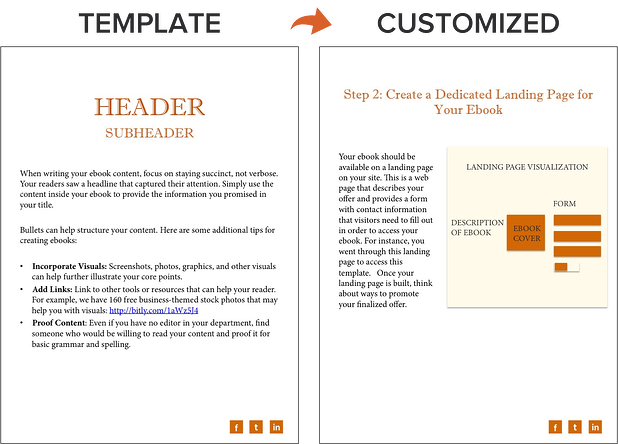
Your ebook should be available for download through a landing page on your site. A landing page is a web page that promotes/describes your offer and provides a form that visitors need to fill out with their contact information in order to access your ebook. This is how you are able to convert your visitors into business leads that your sales team can ultimately follow up with.

For instance, you went through this landing page in order to access this ebook template. To learn more about how to optimize your landing pages for conversion, download this free ebook.
how-to-create-an-ebook-9-1

Step 11: Promote Your Ebook and Track its Success

Once your landing page is all set, you can use that destination URL to promote your ebook across your marketing channels. Here are five ways you can do this:

  • Advertise your new ebook on your website. For example, feature a CTA or link to your offer’s landing page on your resources page or even your homepage.
  • Promote your ebook through your blog. For instance, consider publishing an excerpt of your ebook as a blog post. Or write a separate blog article on the same topic as your ebook, and link to it at the end of your post using a call-to-action to encourage readers to keep learning. (Note: This very blog post is the perfect example of how to promote an offer you created with a blog post.)
  • Send a segmented email to contacts who have indicated an interest in receiving offers from your company.
  • Leverage paid advertising and co-marketing partnerships that will help you promote your ebook to a new audience.
  • Publish posts to social media with a link to your ebook. You can also increase social shares by creating social media share buttons within your ebook, such as the ones at the bottom right of this ebook. Here’s a blog post that shows how to hyperlink them.

After your content is launched and promoted across your marketing channels, you’ll also want marketing analytics in place to measure the success of your live product.

For instance, you should have landing page analytics that give you insight into how many people downloaded your ebook and converted into leads, and closed-loop analytics that show how many of those people ultimately converted into opportunities and customers for your business. Learn more through HubSpot's Landing Pages App.

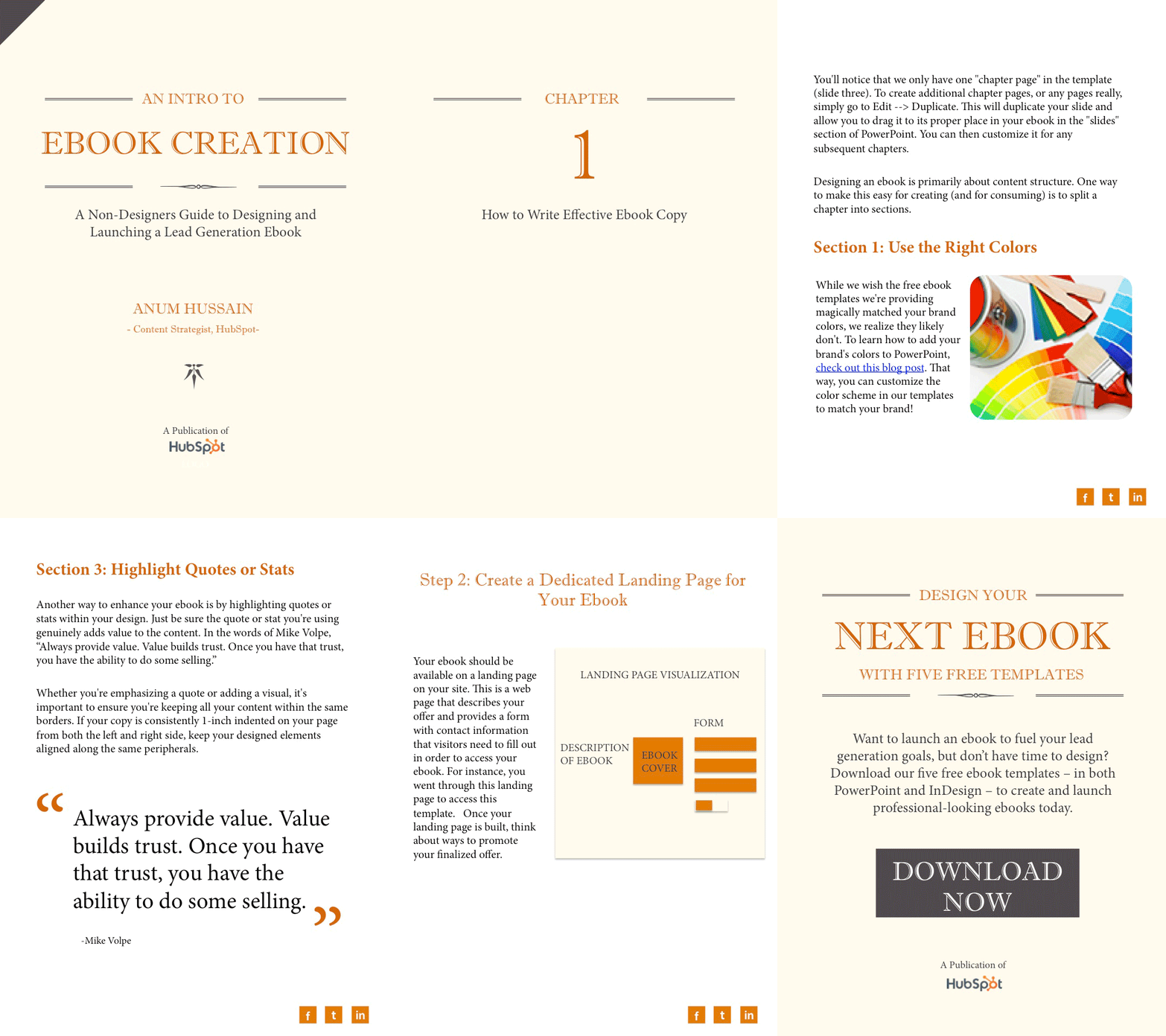
And with that, we've built an ebook, folks! You can check out the packaged version of the example I built through this post here:
5-free-ebook-Templates

After your content is launched and promoted across your marketing channels, you’ll need to have marketing analytics in place that measure the success of your ebooks. For instance, having landing page analytics that give you insight into how many people downloaded your ebook, or show how many of those downloaders converted into opportunities and customers for your business.

Ebook Creation Resources

Do you have any other tips or resources for making ebook creation easier? Apply them to your content marketing strategy. I'd be remiss not to admit every company's ebook will come to fruition differently. It all depends on the needs of your brand.

Free Download 13 Ebook Templates

Free Download 13 Ebook Templates
http://bit.ly/2oqb38M

Saturday, February 24, 2018

Twitter Cracks Down on Bots and Automation

Welcome to this week’s edition of the Social Media Marketing Talk Show, a news show for marketers who want to stay on the leading edge of social media. On this week’s Social Media Marketing Talk Show, we explore Twitter cracking down on bots and automation with Madalyn Sklar, Instagram DM replay changes, and other breaking [...]

This post Twitter Cracks Down on Bots and Automation first appeared on .
- Your Guide to the Social Media Jungle

February 24, 2018 at 12:00PM http://bit.ly/2mAgcdm
read more...
from http://bit.ly/2CFKzV3
via IFTTT

Friday, February 23, 2018

6 Ways Marketing Content Can Support a Customer Service Team

"Hold on, let me just confirm the solution for you," the service rep responds as she scrambles to look up the answer to a customer's question.

It's the corporate equivalent of a retail employee wandering aimlessly down each aisle when you ask where a certain product is, like you couldn't have done that yourself.

Customers will eventually stump customer service (a department sometimes known as customer success, if it's more focused on proactive goal-setting than reactive troubleshooting) with a question they ask over the phone or in a live chat window. And that's okay; it's hard to always have all the answers at the ready.

What's not okay is when this becomes a pattern -- customer success employees seeming puzzled by the same problems or questions every time their clients bring them up.

Does this sound like the situation at your company? Consider tapping your marketing department to fill those knowledge gaps.

You may have heard the term "smarketing," which describes the ideal alignment of Marketing and Sales through shared goals and direct communication. What if I told you the same alignment could benefit Marketing and Customer Success, too?

There's a critical opportunity for both Marketing and Customer Success to help each other better serve their common audience. Here are six ways Marketing can help customer success managers (CSMs) and service reps transform the client experience, and the benefit Marketing can receive in return.

6 Ways Marketing Content Can Support a Customer Service Team

1. Distilling Marketing Content Into Monthly Digests

Customer Success might already receive their company blog's newsletter, but their conversations with clients can benefit from more tailored recommendations.

A dedicated roundup email just for these employees -- offering a digest of the most product- or customer-focused material from the previous month or quarter -- can ensure the team is always tuned into the issues Marketing knows their audience is most interested in.

A good place to start? Identify the latest ebooks, how-to articles, and data sheets your website is offering for download, and highlight the key points across each piece in this recurring email. Also known as "middle-of-the-funnel" content, this type of content can be hugely helpful to a customer success team because it reinforces product and value proposition comprehension.

Putting this material in client-facing hands ensures their remarks to customers are consistent with what people are reading on your blog or website.

2. Creating a Content Library on the Intranet

An internal wiki or intranet for sharing resources with coworkers is the perfect space for a content library. According to CMO Council, 40% of salespeople's time is spent looking for content that Marketing has created. Because Customer success talks to customers just as often as Sales does, it stands to reason they do the same thing.

Rather than letting your CSMs Google everything Marketing has published -- and potentially sending a dreaded "unusual traffic" signal to Google if they search too much -- repost this content as links on an intranet page created just for Sales and/or Customer Success.

Sort the relevant articles and offers by common customer queries: An article on good email subject lines, for example, might be appropriate bucketed under the topic "how customers can stay out of their own clients' spam folders."

3. Reporting on Social Media Interaction

What do social media and community managers have in common with customer success managers? They see lots of customer complaints -- but in a Twitter post or Facebook comment, rather than over the phone or in a live chat window.

And yet customer service experts at Sparkcentral suggest only 8% of marketing and customer service employees work together on social media. This is a missed opportunity.

If the internet has taught us anything, it's that people are more willing to be honest about their feelings and experiences from behind a computer screen than they are in person or over the phone. That means Marketing could be sitting on a goldmine of feedback from social media followers that the folks in customer success hasn't seen.

Want to help them serve your customers better? Open a line of communication with Customer Success to report on the latest interactions with followers of the brand's social media accounts on a regular cadence. This should include both public comments and private messages, allowing CSMs to see how Marketing talks to users and diagnoses problems their clients may not be revealing directly.

4. Joining Kickoff or Implementation Meetings

Customer success departments that also onboard new customers are sometimes thrown broad questions about the industry during initial calls.

For example, in the marketing industry, a customer might ask, "what content should I publish?" versus or in addition to, "how do I integrate my content management system (CMS) with your product?" The first question may go beyond the product issues that service reps are trained to handle.

Luckily, industry best practices are marketers' bread and butter, making them excellent wingmen during these kickoff meetings. Including just one marketing employee in this process can help keep the customer thoroughly educated in the early stages of a business relationship.

These kickoffs can take place frequently, though, and it's important to be respectful of the marketing department's time. If your marketing employees are separated by industry specialization, consider rotating them into kickoffs for clients that fit their area of expertise.

If their workload simply doesn't allow for it, having marketing's leadership staff (such as the CMO or VP of Marketing) take this responsibility may be in the best interest of the rest of the team.

5. Reporting on Chatbot Conversations

Chatbots and similar chat tools powered by artificial intelligence (AI) aren't yet ubiquitous in marketing, but for companies that have deployed AI-powered chatbots, these transcripts are invaluable to your customer service team.

(Skeptical about the AI hype? Research shows you may already be using AI and not realize it!)

Chatbot technology allows companies to talk to customers via messaging apps -- or natively as a feature of their website -- with an automated "bot" programmed to answer common questions about their services.

If your company hosts a chatbot on, say, HubSpot Conversations (get it for free here), it was likely set up to handle quick-answer queries so client-facing staff can spend time solving more complex problems for the customer. A smart move, no doubt about it.

However, this might also mean a log of some very interesting dialogue between a prospect visiting your website and a robot who speaks on the company's behalf is going unseen by employees who can learn from it.

This chatbot might be designed to lighten the load of questions normally posed to a human service rep, but don't let the automated conversations go to waste. Go a step further and examine how people are interacting with the chatbot.

57% of people use AI chatbots from customer success to get business information.

People tend to lean on chatbots for open-ended, educational needs rather than technical issues, so examine your transcripts for trends in what users need the most information on when perusing your business' website.

For example, you might baffle Customer Success with how many people ask the chatbot about a third-party integration your product offers relative to how little detail your website or CSMs provide on the subject themselves. Time to create some informational middle-of-the-funnel content ...

6. Using Their Insights to Make Your Marketing Content Better

Like in Smarketing, the role of Marketing to Customer Success is a two-way street. Customer Success can offer valuable client insights right back to Marketing, which allows marketers to improve their content so it's addressing the questions Customer Success typically needs help answering for clients.

Just as marketing teams have the opportunity to distill their content into an internal email specifically for service reps (per section 1 above), Customer Success likely keeps transcripts or recordings of their conversations with clients. Consider working with your Customer Success peers on a simple report that highlights call FAQs. Who knows? The company blog or website may be neglecting your customers' most burning questions.

In addition, brainstorming sessions shouldn't always be exclusive to the Marketing team. Everyone at the business can bring valuable content suggestions to the table, and Customer Success in particular has a breadth of on-the-job experience with clients that could make for a great how-to article or video.

Don't hesitate to invite them to your next idea meeting.

Companies with the best customer experience share information across every department, and Customer Success is no exception. By keeping this department informed on what Marketing does all day, you equip them with the answers they're expected to have and offer a more stable buyer's journey to everyone the company works with.

http://bit.ly/2orCjmA

Emotional Intelligence is the Key to Career Growth [Video]

http://bit.ly/2oqgHqA

Twitter Engagement: How to Connect With People on Twitter

Wondering how to increase your reach on Twitter? Want tips for building your audience and boosting engagement? To explore the Twitter algorithm and creative ways to interact with others on Twitter, I interview Andrew Pickering and Peter Gartland. More About This Show The Social Media Marketing podcast is an on-demand talk radio show from Social [...]

This post Twitter Engagement: How to Connect With People on Twitter first appeared on .
- Your Guide to the Social Media Jungle

February 23, 2018 at 12:00PM http://bit.ly/2FplnVD
read more...
from http://bit.ly/2EP24UZ
via IFTTT

Thursday, February 22, 2018

Leveraging Breaking News: The Journey, Episode 18

The Journey, a Social Media Examiner production, is an episodic video documentary that shows you what really happens inside a growing business. //http://www.youtube.com/watch?v=-qk9lJq6MXA Watch The Journey: Episode 18 Episode 18 of The Journey follows Michael Stelzner, founder of Social Media Examiner, as he continues to pursue what many will see as an impossible goal: to [...]

This post Leveraging Breaking News: The Journey, Episode 18 first appeared on .
- Your Guide to the Social Media Jungle

February 22, 2018 at 01:00PM http://bit.ly/2zqjbZQ
read more...
from http://bit.ly/2CCBPir
via IFTTT

Your Email Strategy Needs a Facebook Messenger Strategy

As of late, it feels like an arms race between email marketing or Messenger marketing. A world where marketers have to pick: the workhorse of today or the most exciting channel of tomorrow?

At first glance, I can see why. We’ve seen audiences engage an insane amount on Messenger -- 619% more than email. There’s also a cool 1.3 billion people who use Messenger on a regular basis.

When companies ask me which one to use, my answer surprises them: have your cake and eat it, too. Email and Messenger together will make your business more money than picking one. Which one you should use when -- and for whom -- comes down to context.

Here are three things to consider as you decide which areas of your marketing strategy need email, and which need Messenger.

Purpose

Every interaction your company has with someone needs a purpose. All communication should be deliberate, whether it's with a prospect or a customer. Your marketing goal will determine whether email or Messenger makes more sense.

In some cases, you have a lot to say -- or show. That’s a big reason email remains the channel of choice for long-form communication. Email wins at getting lengthy points across that people can store and share later. More often than not, though, most marketing and sales emails I get don’t fall into that camp.

“Chatting with you > Talking at you”

This is where Messenger's shorter communication style thrives. When you get an email, it feels like companies are talking at you. With Messenger, those same companies are chatting with you. It also pays to keep in mind who you're trying to reach. Even though chatting is better for some, it's not better for all.

Demographics

Did your audience use the internet between 1990-2005? Chances are email was how they kept in touch with friends and businesses. It still is older generations’ line to businesses, according to HubSpot. Email used to be our connection to businesses and a personal CRM. But times have changed.

Younger generations don’t spend time in their email inbox; they message one another. It’s part of a larger shift where messaging apps have become the activity that dominates 91% of our time on screens. To be a successful marketer in 2018, you need to meet users where they spend their time. The most delightful marketing experiences of tomorrow will happen on platforms like Messenger.

How my dad thinks I use my phone, anyways.

Experience

If you and I are anything alike, you've gone through a few email addresses over the years. Student email? Good until graduation. Work address? Great until you change jobs. Email addresses tie to finite periods in our lives. Things like Facebook IDs, though, will never change. You're always going to be you. Messenger Marketing means you can engage with someone throughout their life.

Okay, not as many as Homer. But you get the idea.

Over time, you’ll learn more about prospects that you can use to personalize how you engage them. It’s a best practice across platforms. Messenger has a secret sauce in this camp, though, that many marketers don’t realize. You can personalize in real-time on Messenger. Every word they say or button they click can steer them into a hyper-targeted experience. You’ll capture their intent and delight right away, without having to wait until the next email goes out.

Better Together

Let your audience set the tone for where they want to engage with you. It'll add value across all your channels in both the short and long-term. There's some group of your email audience that wants to hear from you, but not in their email inbox. Give those people another option for staying in touch, like Messenger.

Once you do that, there’s a good chance that you see an improvement in both open and click-through rates. Every message going out the door is only to people who want to hear from you on that channel. This can help your deliverability score in the long-term, too.

That's not to say it's an absolute one or the other. Be tasteful and use both together. We have a lot of people who prefer to download e-books on Messenger. But after talking with them, we learned that many of them still read it on desktop. We started emailing them a copy of their e-book, too, to provide a better experience. Think back to the differences between email and Messenger we discussed in this post. Use both channels together in tandem when you see value.

There are few times in life where 1+1=3. Marketing through email and Messenger in tandem is one of them. The behemoth channels of today and tomorrow have their differences. It's not about how you use one, though, it's about how you use both. Great marketers will use context to have their cake and eat it, too.

I find and analyze the most interesting messaging articles so you don’t have to. Follow me here. 👈 Want to chat about chat? Message me here.

http://bit.ly/2or3jlZ