Wednesday, May 2, 2018

And on the Second Day of F8, Facebook Said, ‘Let There Be AI Ethics’

If there's one thing that Facebook wants everyone to know it's taking seriously, it's the topic of ethics.

The general idea of an ethical approach to everything it does -- its innovations, initiatives, and new products -- is executed with and undercurrent of ethics, user control, and privacy.

That's what CEO Mark Zuckerberg said in his opening keynote on Day 1 of F8, Facebook's annual developer conference. The new products and features unveiled yesterday, including its up-and-coming Facebook-for-dating services, was built "with privacy and safety in mind."

Today, ethics was one topic that took center stage, especially when it comes to Facebook's highly-boasted investment in AI to help combat things like hate speech and other moderation activity on the site. Here's what company executives had to say.

Ethics and AI Take Center Stage on F8 Day 2

While it's nice to know that your friends won't see if you're using Facebook's dating services and you won't be matched with them, according to yesterday's keynote, the privacy and ethical specifics weren't revealed in much data, and actually left great room for interpretation.

Today, the company chose to elaborate a bit on its efforts in the "ethical" arena.

AI Ethics

When Zuckerberg appeared before Congress in April, one initiative he repeatedly emphasized throughout his testimony was the advances Facebook has made in the realm of artificial intelligence (AI) and how it can be used to combat the misuse and weaponization of the network. 

But one area where it would be difficult to perfect that technology is detecting hate speech. The AI has a long way to go, he said -- though he didn't go into tremendous detail on the company's plans to improve it.

Today, Facebook Director of Machine Learning and AI Srinivas Narayanan acknowledged that, displaying cases where a machine might not understand the nuance of what might make a given sentence hateful or abusive. Using examples like, "Look at that pig" and "I'm going to beat you," he said that understanding the context of such statements requires human review.

The Fairness Flow

Which is where the area of focus known as AI ethics comes in, said Facebook Data Scientist Isabel Kloumann. Humans, she pointed out, have implicit biases -- using herself as an example, she said most people in the audience would deduce that she is a white female. What they might not consider, she noted, is that she's part Venezuelan, for instance.

And since machines are trained using the data given to them by humans, AI might learn to have these same biases, Kloumann said, which introduces the need for ethics and standards when it comes to building it. 

That's why Facebook created the Fairness Flow, which is to help determine how much bias has been built into Facebook's algorithm, whether intentional or not. There's a need now, Kloumann said, to ensure that the company's AI is "fair and unbiased," especially since the company has come under especially intense scrutiny over what content it deems in violation of its standards.

At the April hearings, for instance, many lawmakers accused Facebook of improperly moderating content, allowing some that could have severe impacts -- like ads for narcotics, for instance -- to remain live for far too long, while other content might be improperly deemed in violation.

Not long after Zuckerberg's testimony, The New York Times profiled the way this imbalance has manifested in grave violence in Sri Lanka.

But Is It Enough?

But overall, Facebook has many (potentially PR-related) reasons to place the concept of ethics at the center of its messaging. The company came under fire in March when it was revealed that data analytics and voter profiling firm Cambridge Analytica -- which it was today announced will be shut down by its parent company, SCL, as well as SCL Elections Ltd. -- improperly obtained and used personal user data. 

It would appear that, in addition to the questions and accusations mentioned above, people still don't entirely trust the network in terms of protecting their data and privacy. And after Zuckerberg's Congressional hearings, it seems, our survey of 300 trust in the company actually fell.

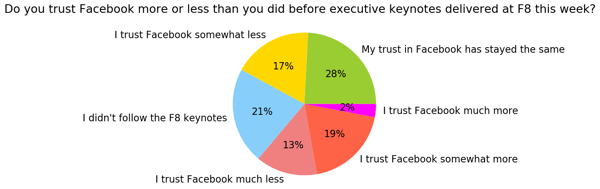
And among those who paid attention to them, the remarks made at F8 thus far had a mixed impact on overall trust in Facebook. In a HubSpot survey of 303 U.S. internet users, just under a third said they trust the company less, while roughly one-fifth of respondents said the keynotes improved their trust in the company. 

221b6f44-71c2-4621-851f-9eb50c235508

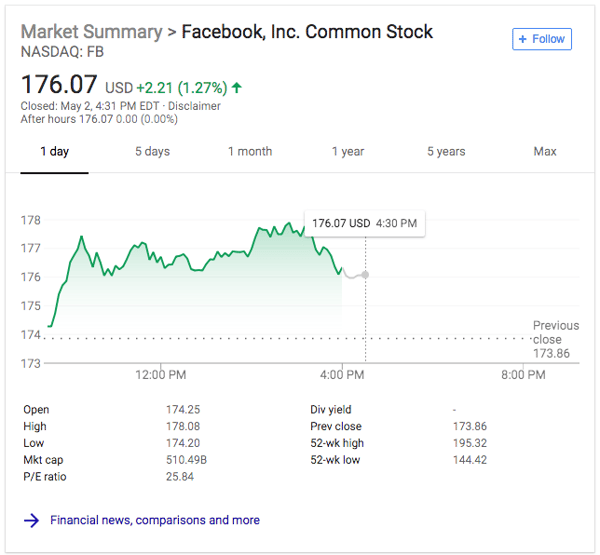
That has yet to show up financially, however -- and as of the NASDAQ closing bell today, Facebook's stock price was strong.

Screen Shot 2018-05-02 at 1.34.24 PM

Source: Google

How all of this plays out in the long-term remains to be seen. But the stark contrast between last year's F8 -- when Facebook announced innovative progress in the area of reading people's minds through their skin -- and this year's event is evident.

The type of pressure and scrutiny faced by the social network continues to evolve, as well. Despite reporting strong Q1 2018 earnings, UK Parliament still demands testimony from Zuckerberg -- and recently stated that if he does not appear before members of parliament for questioning during his next visit to the UK, he shouldn't enter the region at all.

And as for the ethics -- that seems like it will be a slow, gradual road to fruition, if that's the conclusion that actually takes form. 

http://bit.ly/2I9tsBS

How to Retarget People Who Click on Curated Content

Do you share curated content on social media? Wondering how to retarget people who click on the third-party content you share? In this article, you’ll discover two ways to retarget people who click links to content you share, whether that content is yours or someone else’s. What Is Link Retargeting? Retargeting gives you the power [...]

This post How to Retarget People Who Click on Curated Content first appeared on Social Media Examiner.

May 02, 2018 at 12:00PM http://bit.ly/2w4Z06V
read more...
from http://bit.ly/2I9OGj4
via IFTTT

8 Impressive Ways to Start a Cover Letter, with Examples

According to Addison Group, only 18% of employers rank cover letters as important.

But if you had to flip through a hundred cover letters a day, and each one began, “To whom it may concern, I am applying for the digital marketing position at your company,” how important would you rank them?

A cover letter might not always be the most important thing to a hiring manager, but if your resume or connections aren’t enough to get you through the door, a powerful cover letter could be the factor that gets you an interview. For instance, a hiring manager might only read your cover letter if your resume raised questions about why you’re applying for the position, or why you’re leaving your current role. In cases like this, your cover letter can become a critical factor in whether or not you move forward.

Your cover letter is an opportunity to showcase your personality, display your interest in the job, and include relevant information that otherwise wouldn't be surfaced in your application. But there’s a fine line between standing out and coming across as brash or gimmicky. An ideal cover letter leaves the hiring manager with a positive and memorable impression of you, something a resume alone won’t always do.

Read on to find out eight ways to grab an employer’s attention with an exceptional cover letter introduction.

1. Start with humor.

Employers are humans too, and they’ll often appreciate a good joke, pun, or funny opening line as much as the next person. If done tastefully and respectfully, starting your cover letter off with a joke can be an excellent way to stand out.

Plus, a joke can still include a powerful explanation for why you’re the right person for the job, without coming off as boastful. For instance, think about something you love to do or something you’re really good at, and then imagine how friends or family might make a joke about it -- if you’re really good at analyzing data, for example, a joke or pun related to that might be a good way to exemplify both your skills and personality.

Here’s a good example of using humor to bring attention to your skills, from The Muse: “I considered submitting my latest credit card statement as proof of just how much I love online shopping, but I thought a safer approach might be writing this cover letter, describing all the reasons why I’m the girl who can take Stylight’s business to the next level.”

Right away, the personality displayed here grabs the reader’s attention. Even better, this applicant uses humor to convey an important message to the employer -- she loves shopping, and she’s well-versed in ecommerce as a consumer -- which might’ve otherwise not come up on her resume or phone screening.

2. Start with passion.

For an employer to know you’ll stay dedicated to the role and company, they’ll want to ensure you’re passionate about what the job entails. Passion is more incentivizing than a paycheck.

For an employer, demonstrating how your passion matches the required skillset is a promising sign that you’d enjoy your job -- if you enjoy your job, you’re more likely to stick around longer, help drive company growth, and become a dedicated member of the team.

Consider starting your cover letter with a few lines that showcase your passion: “I’ve been passionate about writing since I was ten years old. My love for writing has led me to write two personal travel blogs, get published in a local newspaper, and pursue two summer internships at publishing firms. Now, I’d love the opportunity to combine my writing skills with my interest in storytelling as a content marketer at Company A.”

If you don’t have extensive work experience in the industry you're trying to break into, but you’ve been unofficially preparing for years, let the employer know. In the above example, the candidate’s resume would probably look weak, with only internships indicating professional experience. Her cover letter introduction, however, shows the employer she’s been writing for audiences and advancing her natural ability for years.

3. Start with an accomplishment.

Employers like seeing numbers. It isn’t enough to mention you’re a “digital marketer with proven success in SEO strategies.” Proven success? Okay, can we see?

It’s more powerful to provide statistics. You want to show the employer you’re capable of solving for long-term results. How have you contributed to your company’s bottom line? For instance, did your Facebook marketing campaign grow your social media following, or has your blog content increased organic traffic?

Consider starting your cover letter with something like this: “Over the past year as digital marketing manager at Company A, I’ve generated $30k+ in revenue, increased organic traffic to our blog by 14%, and almost tripled our social media ROI.”

Even if you don’t have the work experience to report impressive numbers, you can still offer proof when opening with an accomplishment. Think about the qualitative feedback you’ve received from employers. For instance, how would your boss compliment you or tell you you’re doing a good job? An accomplishment can be as simple as your boss sending you an appreciative email regarding your diligent meeting notes.

In this example from The Muse, the applicant provides an example of a skill for which he’s been previously acknowledged: “My last boss once told me that my phone manner could probably diffuse an international hostage situation. I’ve always had a knack for communicating with people -- the easygoing and the difficult alike -- and I’d love to bring that skill to the office manager position at Shutterstock.”

Even though the applicant doesn’t offer numbers as proof of success, they do manage to highlight some proof of their past performance in the form of a former boss's praise. The candidate’s candid and funny explanation -- that his last boss liked his phone manners -- is another good way to brag about accomplishments without, well, bragging.

4. Start with excitement for the company.

Employers want to know why you like their company, and they’ll appreciate an explanation on why you’re interested. But it’s imperative your reasoning is thoughtful and considerate, and specific to the company. For instance, if you’re applying for a financial position, don’t write about your interest in finance; write about how your interest in finance relates to the company's goals.

You don’t want to just say, “I’m excited to work at Company A because I’m passionate about finance, and I think my skills and experiences will be a good match.” Sure, you’ve explained why you want to work in the financial industry, but you’ve done nothing to explain why Company A specifically suits your interests.

Instead, you’ll want to mention something about the company and culture in correlation to your interest in finance. Take a look at this example from Glassdoor: “When I discovered Accounting Solutions was hiring, I knew I had to apply. I’ve been waiting to find a company where I feel like I can make a difference while working as an accountant. Not only are your clients awesome, but the overall mission of your company is something I believe in, too.”

This candidate shows they've done their research and care about Accounting Solutions in particular. Remember, employers want to hire people who have a demonstrated interest in working at their company. They want someone who will enjoy the nature of the work, but just as importantly, they want a candidate who enjoys the work culture and the company mission as well.

5. Start with news about the company.

Mentioning company news in your introduction indicates you’ve done research on the company. Plus, including company news might give you the chance to incorporate your own values, as well. If the company just won an award for its innovative solutions in the computer industry, for instance, you might add how you value forward-thinking methods in technology, as well.

Here’s an example of an introduction that uses a newsworthy event, from Indeed: “When I saw that Company ABC was featured in Fortune Magazine last month for its commitment to renewable energy and reducing waste in the workplace -- all while experiencing triple-digit revenue growth -- I was inspired. With my track record of reducing costs by 30%+ and promoting greener workplaces, I’m excited about the possibility of taking on the account executive role to expand your company’s growth and work towards a more sustainable future.”

The candidate does a good job demonstrating how Company ABC’s news aligns well with the candidate’s personal achievements. She shows she’s done her research on the company, and also indicates she values similar environmental efforts in the workplace.

6. Start with what they don’t know.

Your cover letter should never directly restate what’s already listed on your resume -- it should offer something new, expand on what the employer already knows about you, and offer new details about what you can bring to the company. Impress employers by telling them something about your skills or experiences they don’t already know.

To offer new information not displayed on his resume, one of my colleagues at HubSpot wrote this cover letter introduction: “My resume will tell you I’m Content Marketing Certified. Your records will tell you I’ve interviewed for a few different HubSpot positions in the past. What neither one will tell you is that I’ve been working with your customer success team to build a new campaign strategy for my company--one of your latest (and largest) clients.”

The candidate wrote an introduction that captured the reader’s attention and demonstrated he wasn’t interested in wasting anyone’s time. This is a memorable and impressive tactic. Consider writing a similar introduction, where you provide information absent from your resume.

7. Start with what you can bring to the table.

A hiring manager here at HubSpot told me she always looks for cover letters to tell her how the company and applicant can benefit each other.

Any employer is going to want to know why you think you can grow from the position you're applying to. An employer is more inclined to hire you if she thinks you have a genuine, intrinsic motivation to work hard in the role.

A hiring manager is also going to want to know how you’ll contribute to the company’s larger vision and goals. It’s important for the manager to know what you want to get out of the role, but it’s equally important to know how you’ll help the company grow. How will the company benefit from you, over someone else?

Here’s an example: “I am seeking opportunities to improve my writing ability in a forward-thinking environment, while growing organic traffic and optimizing content to beat out competitors in search engines. At Company A, I believe I will find that match.”

See how it works? In the example above, the candidate explained how she’d benefit from the role. She also explained what Company A could get out of the transaction -- increased organic traffic, and optimized content -- so the hiring manager is informed of the equality of the potential relationship.

8. Start with a statement that surprises them.

When applying for a role at HubSpot, one of my colleagues began her cover letter like this: “I like to think of myself as a round peg thriving in a square hole kind of world.”

Doesn’t that make you want to keep reading? It certainly kept me interested. Of course, you’ll only want to include a bold statement if you can follow it up with some concrete supporting information. My colleague, for example, continued by writing this: “What does this mean? It means that my diverse background makes me a well-rounded candidate who is able to comprehend, develop and execute various functions in business.”

While the rest of her cover letter veered on the side of professsional, her opening line was casual, quirky, and surprising. Plus, you feel her personality in the line, and when an employer feels like a real person is behind the cover letter, she’s going to want to keep reading.

http://bit.ly/2JHaXla

Tuesday, May 1, 2018

Facebook for Dating, and 5 Key Takeaways From F8

We kind of saw this coming, did we not?

In Facebook's most primitive days -- if you can remember a time when it was restricted to college students, there was no News Feed, and status updates forced the inclusion of the word "is" -- there was also the "Poke" feature.

Poking, as many of you recall, was a fairly simple feature in which you could click a button that allowed you to "poke" someone else on Facebook -- often, even if you weren't friends with the person. That user would then receive a notification that you had Poked them, and could Poke you back, ignore you, or send you a message.

And I'm about to get real with y'all. Back in the day, I loved the Poke feature. As a fresh college grad/twenty-something, Poking was a simple gateway to indirectly introduce yourself to someone with whom you had mutual friends but didn't yet know yourself, or -- as was more often in my case -- flirt with someone.

So now, nearly 12 years after the height of my Poke usage, the inevitable has happened: Facebook is getting into the dating game. And that was just one of the major announcements made in today's opening keynote at F8: Facebook's annual developer conference in San Jose, California.

Facebook for Dating, and 5 Key Takeaways From F8

1. Leading up to the Event

There was a lot of speculation around what the nature of this year's opening keynote might be like. I predicted that one of three things would happen:

  1. Mark Zuckerberg would ignore the recent Cambridge Analytica and data privacy scandal entirely -- which is not entirely unlike what he did for the opening keynote at Oculus Connect in October, not long after it had been revealed that foreign actors had weaponized the network to influence the 2016 U.S. presidential election.
  2. Zuckerberg would mention the scandal at the beginning of the keynote, but quickly move on to product announcements and new initiatives.
  3. Zuckerberg would lean into the "mea culpa" aspect of the scandal to the point where the keynote would almost go overboard.

In the end, it seemed that the keynote was a combination of the second and third predictions, with Zuckerberg kicking things off with a mea culpa and maintaining that theme of safety, people first, and privacy reverberating throughout the two-hour opener.

"This has been an intense year," Zuckerberg said. "I can't believe we're only four months in."

And not just for him, he was sure to point out -- but for many of the developers that have long leveraged the Facebook platform to build experiences and marketing initiatives. Those in the audience, Zuckerberg acknowledged, were trying to use the platform to build good things, and that was why Facebook has reopened app review. (More on that here.)

Before the keynote even began, Zuckerberg published a post on his official Facebook page on the soon-to-be-launched "Clear History" feature, which will allow users to see which websites and apps send Facebook information on when they're used, and delete that information from their accounts. Users will also be able to turn off Facebook's access and storage of that information in their accounts moving forward.

It's not entirely unlike the ability to delete your browsing history, cookies, and cache from a web browser, causing many to argue that this move is long overdue for Facebook. And yet, writes Facebook VP and Chief Privacy Officer Erin Egan in a formal written announcement, "It will take a few months to build Clear History."

But overall, Zuckerberg opened the keynote with remarks not entirely unlike those used to start his congressional hearings last month: acknowledging Facebook's role in organizing good things, but how that's come with the bad -- including Russian interference and major setbacks from data privacy problems.

From there, it the focus was almost entirely forward-facing, with a constant underlying theme on "people first."

2. The Emphasis On "People First"

Not long into his opening remarks, Zuckerberg commented on "how little of our industry is focused on people first. ... I believe we have to design technology to bring people closer together."

That's one thing Facebook set out to do even before the Cambridge Analytica fallout, but after foreign interference was revealed, when it overhauled its News Feed algorithm in January to give better ranking to content from friends and family.

Since then, Facebook has continued to lean into the narrative, announcing several new initiatives today to emphasize experiences on the network and the other apps it owns that bring people together.

Watch Party

Facebook first unveiled its plans for Watch Party -- a group video-view feature that allows Facebook friends to watch an event on the network as a group -- in January, when Facebook VP of Product Fidji Simo published a blog post on the experience.

Today, Watch Party had its official debut, with Zuckerberg making light of his recent Congressional hearings as an example of something your friends might want to watch on Facebook together while commenting it in real-time -- something that some of his friends actually did last month, he said.

3. Facebook for Dating

Yes, here we arrive at the inevitable: new features that Facebook will be rolling out within the realm of dating.

To cover the ground rules, here are a few of the items Zuckerberg immediately addressed when he first unveiled this new, yet-to-be-named product:

  • Dating will not "co-mingle" with the rest of your Facebook experience and will "live" separately from the rest of the network's tools or features.
  • Your friends will not be able to see if you're using the dating features, nor will you be matched with any friends who are using it.
  • According to tech journalist Molly Wood, it won't be available to those who have indicated they are "Married" or "In a Relationship" on their profiles.

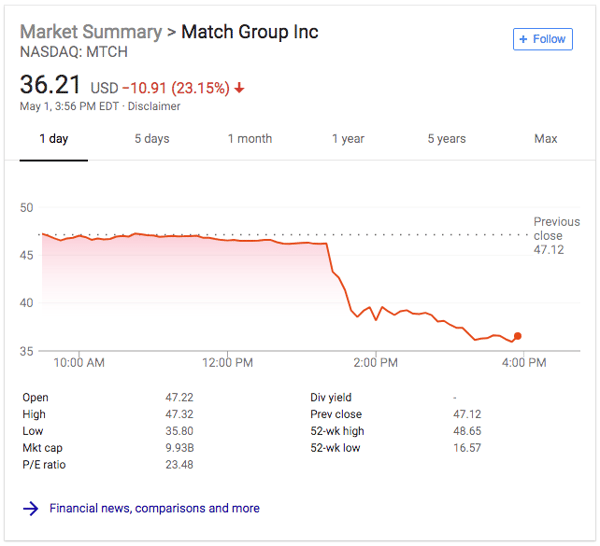
The news of Facebook for dating seemed to spook many investors in competing apps, like Match Group, which owns many of the players in the space like Tinder. Here's a look at how MTCH's stock was behaving as of writing this post:

Screen Shot 2018-05-01 at 12.56.38 PM

Source: Google

As I mentioned in the introduction, this move makes sense for Facebook, especially when you consider that it will be integrated with the network's event and group features. For the former, for instance, users enrolled in the dating features can see other "singles" who will be at an event that interests them, and given tools to connect in advance.

It also aligns with Facebook's recent "bringing people together" campaign and the messaging around it making a statement that the company wants to go back to its roots of connecting people. Where once that was limited, at least on the surface, to friends and family, now there will be a designated system for forging romantic relationships through the site. That's the plan, at least.

But it serves as a possible significant new revenue stream for Facebook. Its pricing structure, if any, was not mentioned in today's announcement, and given the financial reprecussions (even if they are only short-term for now) experienced by publicly-traded competitors, this could be another space for acquisition for Facebook.

One of the first brands in the space that I thought of was dating space Bumble ... 

... who, according to a statement, had already been in talks about ways to collaborate before today's announcement was made.

4. New From Instagram

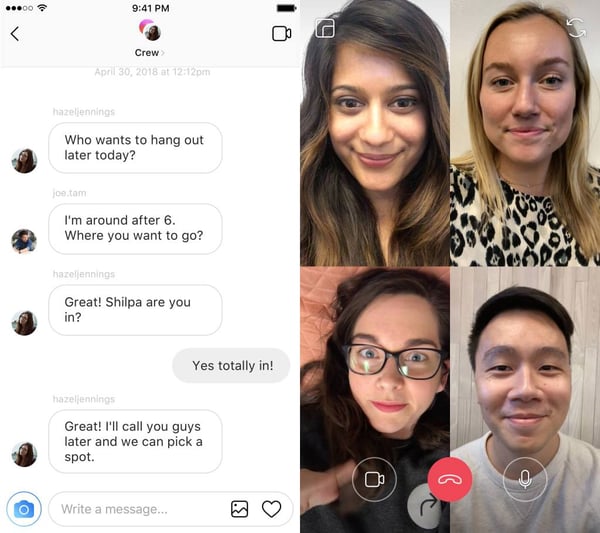
Watch Party wasn't the only new group chat feature unveiled today. Similar capabilities will also be coming to Instagram, with a video call feature due to roll out in the coming weeks.

31277489_380939525718929_282803538944327680_n

Source: Instagram

But perhaps even more significant was Instagram's announcement that it would be adding a new filter for bullying comments. This filter will have a particular emphasis on younger members of Instagram, especially those who are public figures.

"This new filter hides comments containing attacks on a person’s appearance or character, as well as threats to a person’s well-being or health," the official announcement reads. "The bullying filter is on for our global community and can be disabled in the Comment Controls center in the app. The new filter will also alert us to repeated problems so we can take action."

This announcement comes after what Facebook later called a temporary "bug" that allowed all users to respond to a prompt asking if a given post contained hate speech. While it wasn't a carbon copy of these new Instagram filters, the timing was interesting, to say the least.

Finally, Instagram is introducing new integrations within Stories: adding your listening activity from Spotify to your Story in real-time, as well as seamlessly adding GoPro video footage.

5. And finally, VR

In what was arguably the most exciting moment for most of the keynote audience, Zuckerberg announced that its VR headset Oculus Go would be shipping starting today -- and that everyone attending F8 would be receiving their own.

Priced at $199, many of today's speakers made the case that at that price point -- combined with its wireless nature -- the Oculus Go is the "most accessible" VR headset on the market.

It's another step in the direction of Facebook's efforts to make VR a mainstream technology. That was an underlying theme at Oculus Connect in October, where Zuckerberg stated his goal of getting one billion people using VR -- by when, we aren't sure.

But it would be yet another revenue stream for Facebook, and the company might be leaning into these other brands and how they can be monetized in the wake of shell-shocked advertisers who might be straying from the platform in the wake of the Cambridge Analytica scandal.

In the meantime, Facebook is also leaning into augmented reality (AR) technology, namely by integrating new AR camera effects to Messenger: a program that will first launch in closed beta.

That's a wrap on the major announcements from today. Day 2 of F8 kicks off with another keynote at 10:00 AM PST, and I'll be there, live-tweeting and offering insights.

Of course, after the event, there will likely be more thoughts coming out of the woodwork regarding how these changes can impact the tech industry at-large and the businesses that use it -- and I'll be offering up an analysis of it when the conference has concluded.

In the meantime, if you've got questions or something you're hoping to come out of tomorrow's keynote, feel free to weigh in on Twitter.

Featured image credit: Facebook

http://bit.ly/2FzfXpx

What Does a Future With No Jobs Look Like?

In 1931, at the height of the Great Depression, British economist John Maynard Keynes published the essay, "Economic Possibilities for Our Grandchildren."

Keynes concluded that the Depression was only temporary and predicted that by 2030, people would work no more than 15 hours a week, devoting the rest of their time to leisure and culture.

Keynes was right about economic growth recovering, but most of us work far more than 15 hours a week. We’re still living in a time of over-rapid changes. Technological innovation has fundamentally changed the way we work, but are we really moving toward a society where humans are free to pursue culture and leisure while enjoying an age of abundance?

We Are Living in An Unprecedented Age of Change & Progress

null

For the majority of human existence, we’ve made progress at an unremarkable pace, but in the last 80 years, as this chart shows, progress has exploded.

Human progress can be marked by five significant revolutions, the most transformative of which occurred 50 years ago, as Yuval Noah Harari wrote in Sapiens. First was the Cognitive Revolution; about 70,000 years ago, we invented language and started to preserve knowledge. Then came the Agricultural Revolution; about 11,000 years ago, we transformed from nomadic tribes to town and city dwellers after we learned how to harness the power of nature to farm instead of forage for food. The Scientific Revolution brought Europe into the age of imperialism and rapid expansion about 500 years ago. This in turn kickstarted the Industrial Revolution, about 250 years ago and Information Revolution, about 50 years ago.

Each time human history jumps forward, we’ve replaced countless jobs by inventing ways to do them better: The farmer replaced the hunter, steam engines replaced human workers. At every single point, such inventions have coincided with rapid economic growth, making the lives of humans better off as a whole.

Even though we’ve demonstrably been good at replacing ourselves with machines, we still pride ourselves on being the best thinkers and decision makers on earth. Because while machines could help a farmer increase his crop yield, the ultimate decision on what to sow and when to harvest still lies on him.

We believed we were the best thinkers and fastest learners on earth. But it’s no longer true.

In 2016, history was made when AlphaGo became the first computer program to beat the highest ranked professional Go player, Lee Sedol, without handicaps. One reason this was so impressive is that Go is considered much more difficult than other strategy-based board games, with over 250 possible opening moves compared to chess’ 20.

Machines are rapidly replicating (and improving upon) our previously unique ability to learn quickly and make decisions in reaction to changes in our environment. Eventually, machines could replace most types of jobs  --  including roles where the worker has to make decisions based on limited amounts of information, not just routine and predictable human labor.

It’s Hard for Humans to Predict Technological Change

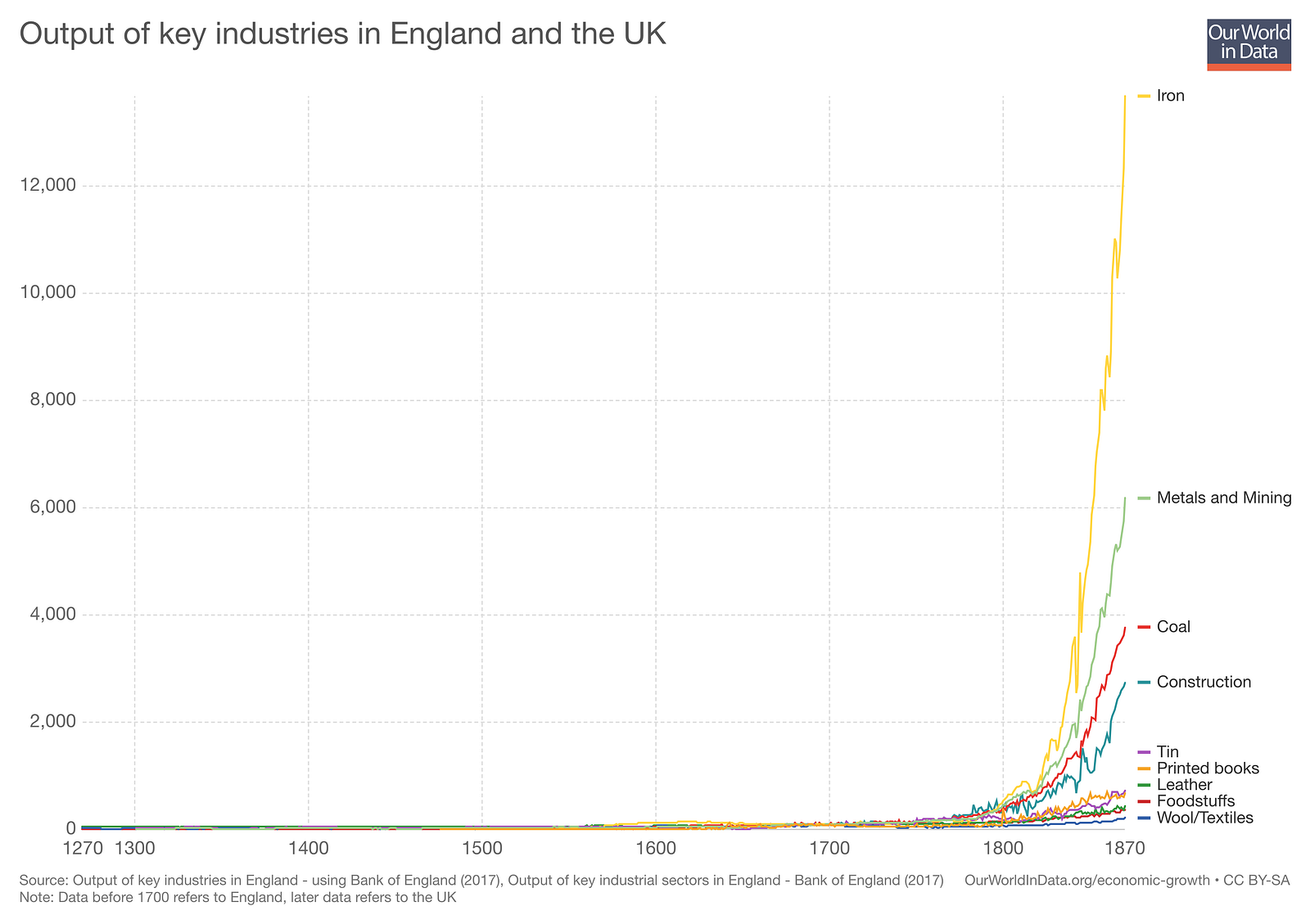
If someone invented a time machine and transported an ordinary person from the 16th century to the 18th century, she would not, for all intents and purposes, have a hard time understanding the world. The same would not be true if someone was transported from the 18th century to the 20th century  --  technology has changed so quickly that she’d probably think she’d been brought to a different universe!

null


The changes in outputs of key industries created a drastically different worldThe changes in outputs of key industries created a drastically different world.

In the same vein, if you asked a factory worker from the 1970s if he believed that machines would eventually put him out of a job, he would find the question hard to understand, let alone answer. That’s why we must constantly question our understanding of the rate of technological progress and acknowledge that the vast majority of us are ill-equipped to make sense of it all.

It’s estimated that as much as half the world’s labor could be automated over the next 20 years. There are two potential outcomes of this massive disruption of the labor market:

(1) an era of mass unemployment and social instability, or
(2) an age of abundance where we are free to pursue creative work

Scenario 1: An Era of Social Instability

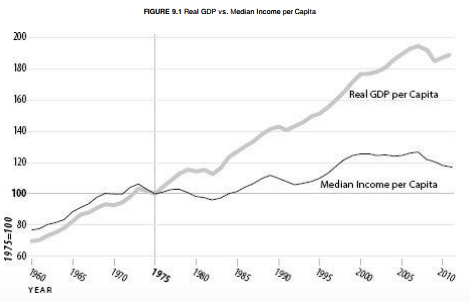
In 1990, the real inflation-adjusted income of the median American household reached $54,932, but then started falling. By 2011, it had fallen nearly 10%, even as overall GDP hit a record high, according to The Second Machine Age by Erik Brynjolfsson and Andrew McAfee.

null


Source: The Second Machine Age

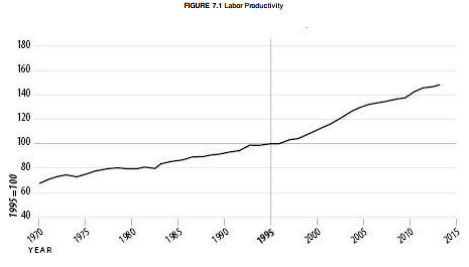
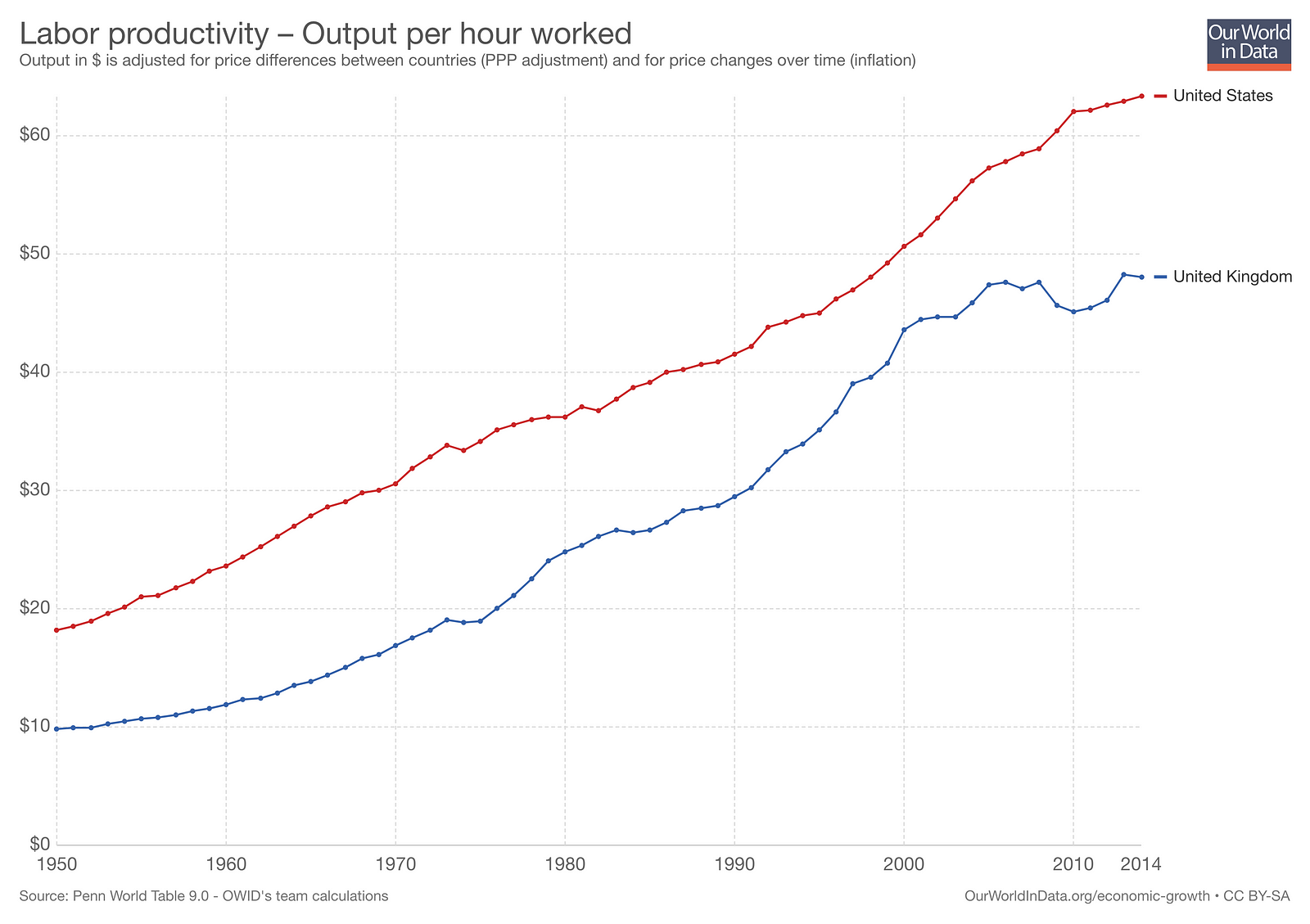
In contrast, productivity grew at an average of 1.56% per year during this period, and most of this growth directly translated into comparable increases in average income. Brynjolffson and McAfee argue that median income shrank because of increases in inequality.

null


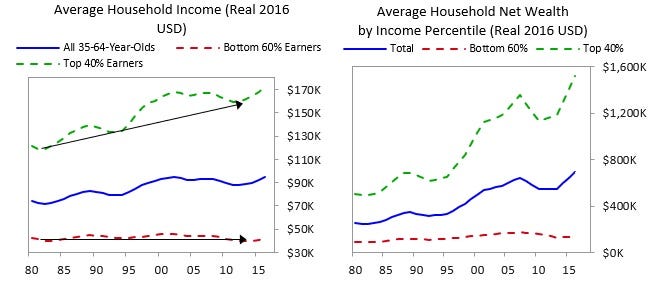
Source: The Second Machine AgeRay Dalio, founder of Bridgewater Associates , came to the same conclusion. In October 2016, Dalio evaluated the US economy by separating it into two cohorts, the top 40% and the bottom 60%.

He found that the average household in the top 40% earns four times more than the average household in the bottom 60%. While the bottom 60% has experienced some recent income growth, real incomes have been flat to slightly down since 1980 (in the same time period, income has increased for the top 40%). Those in the top 40% now have on average 10 times as much wealth as those in the bottom 60%.

null

Brynjolfsson and McAfee argue that the main driver of this inequality in income is the rapid downward pressure on wages for jobs that are being fully or partially replaced with automation.

For example, if one hour’s worth of human labor can be done by a machine for one dollar, then under a free-market system, profit-focused employers won’t offer a wage of more than one dollar. That worker will need to settle for lower wages, and could be laid off entirely.

Because digital technologies can replicate innovative ideas at low cost, a person who finds a way to leverage them will earn exponentially more than has been possible  --what Brynjolfsson and McAfee call a “winner-take-all” market. For example, a relatively small number of designers and engineers could create fact-checking software. Once the software works, it can be delivered to millions of users at almost zero cost. If this software gains widespread adoption, tens of thousands of fact checkers will be put out of work while a small group of individuals capture the wealth their software created.

A second important characteristic of winner-take-all markets is that individuals who create disruptive technologies don’t just get relative advantages — they win the whole market. In a traditional market, someone who was 90% as good would make 90% as much money. But in today’s market, there’s no reason to use the second-best fact-checking software when you can access the best.

In this type of economy, innovators gain disproportionate wealth while reducing demand for previously important types of labor.

This wealth gap will likely intensify if we fail to implement preemptive measures. In a hyperbolic scenario where technology causes mass unemployment, consumers will have less money to spend on products and services. Businesses will have to chase a shrinking pool of customers by cutting prices, sending the whole economy into a deflationary spiral.

null


Scenario 2: An Age of Abundance

The economic inequality that’s resulted from technological progress doesn’t show any signs of slowing, and the gap has implications beyond just differences in net worth. Another data point from Dalio’s study suggests that as differences in wealth get wider, premature deaths among the bottom 60% will also increase. We’ve already been seeing this trend from an increase in deaths associated with drug and alcohol use (up 100% since 2000) and an increase in suicides (up over 50% since 2000).
Unless action is taken to reduce this inequality, it is very likely that it will only continue to rapidly worsen. It won’t be an easy path  --  potential solutions require major changes in social policy that can only occur through a political process and require a dramatic shift in how we distribute wealth.

If policies aimed at solving this issue are successful, there’s a chance technological advancement could create an age of abundance, where we find viable solutions to mitigate the effects of a widening income gap caused by a consolidation of wealth.
One possible solution to provide people with basic security is a Universal Basic Income (UBI). A country using this system would pay citizens a basic wage that is conditional on their participation in the economy. By providing people with a safety net given their participation in the economy, people are incentivized to be productive and given the means to participate in the market.

Some proponents of UBI argue that we’ll be able to eliminate all social welfare programs once UBI is instituted, since those programs are just alternate ways of giving people money. One income system eliminates the need to run multiple programs side by side, reducing cost and complexity.

Another potential solution is the negative income tax. Under the present tax law, we operate a positive income tax, where a household is progressively taxed after income reaches a certain cutoff point. Under a negative income tax system, a person earning less than that cutoff point has a negative taxable income of the difference between their earnings and a cutoff point. Think of the cutoff point as a mirror of progressive tax brackets — the higher a person’s total earnings are before they hit the cutoff, the less taxable income they have and the less they’ll receive from the government.

This system provides a minimum income while incentivizing people to work. Research by Brynjolfsson and McAfee shows that people still stay productive if a negative income tax is in use. For example, if a cutoff point was $3,000 in annual income, someone who earned nothing could receive something like $1,500 in negative income tax and have $1,500 in total earnings for the year, but someone who earned $2,000 might receive $500 and would still end up with higher total income.

This system incentivizes people to find work, even if the income for that work is low, because they still get an uplift from every dollar they make.

A universal basic income or negative income tax could:

  • Allow people to pursue work that has traditionally not been compensated well in a capitalist economy, such as community-building and social work.
  • Create a more progressive entrepreneurial environment by enabling people to take bigger risks in pursuing valuable work.
  • Help reorder social expectations. At the moment, we treat employment as a choice — but UBI and NIT treat unemployment as a market failure, not an individual one. As more and more people face being phased out of their jobs by automation, reframing how we think about work is essential to maintaining social stability.
  • On top of UBI, another option is what Nobel Prize–winning conservative economist Milton Friedman termed as Negative Income Tax. Under the present tax law, we operate a Positive Income Tax, where a household is taxed on a Progressive Income Tax system above a certain cutoff point. Under a Negative Income Tax system, a person earning below the cutoff point will get a certain percentage of that difference from the government.

A future without jobs does not equal a future without work.

null

For either of these systems to work, we still have to focus on productivity, the driver of economic growth. Distributing money to be used just for consumption as a basic income rather than for improving production will diminish the value of money and stagnate the economy.

Unconditional grants of money can cause demand-pull inflation to occur because the aggregate demand for goods and services in an economy will increase more rapidly than an economy’s production.

So the key to an effective tax program would be:

  1. A cutoff point or grant amount low enough that people will still strive for more
  2. Grants that are only released to eligible consumers
null

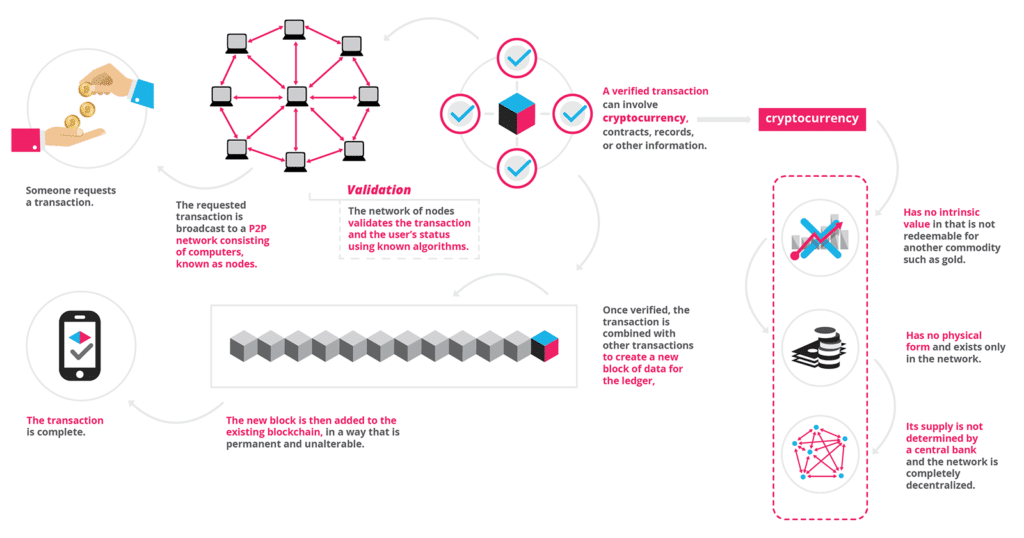
Technology like blockchain creates an unprecedented opportunity to test out decentralized decision making on resource allocation. Using a distributed ledger system to ensure money is distributed only to people who’ve done productive work, as determined by an ever-changing set of conditions or priorities monitored by an artificial intelligence engine.

While we are still far away from developing general-purpose artificial intelligence, the computational tools we have at hand are already helping us make decisions on the factors that motivate different people. For example, Eitan Hersh, a political science professor at Yale University and the author of Hacking the Electorate: How Campaigns Perceive Voters studied how campaigns use big data and machine learning to mobilize voters. The algorithms developed to analyze voter behavior might be a precursor to developing more sophisticated models that predict how best to encourage participation in the economy.

Ultimately, the question of whether to adopt a tax system that could help solve for growing inequality is more of a political than an economic question. It’ll be difficult to suggest the concept of ‘free money’ to a country built on the idea of free markets and fiscal conservatism. Any solution will have to blend new and existing policy, and allocate spending to training programs that can help workers be better equipped to work in a post-job economy, rather than just offering a universal payment for consumption.

The fact remains that no one has all the answers, and navigating the political landscape to arrive at a solution will be an uphill battle.

The policies advocated in this piece will not be easy to implement, and even if they are successfully adopted, rising inflation and decreasing wages will not be curbed immediately.

The Way Forward

As technology continues to progress, more traditional jobs will be threatened by automation. Any solution will involve government intervention to regulate the free-market conditions that create inequality in the first place.

One potential outcome of is the call for technology to be regulated or restricted in a way so fewer jobs will be threatened. That would be a huge mistake that can happen because progress in technology is the reason why we are better off today than even just a decade ago. Research done by the team at Human Progress shows that the cost of light has fallen by a factor of 500,000, where the amount of labor that once bought 54 minutes of light now buys 52 years of light.

However, the belief that the American government agreeing to tax reformers’ idea on handing out monthly checks to support a working class is a huge leap of faith.
My hope is that we have to actively tap on technology to help make our lives better and if not, change the way we utilize it with small course corrections instead of halting advancements through regulation or denying UBI and negative income tax based on pre-conceived notions of what a free capital market is.

The policies that are currently evaluated include:

  • Support sectoral training, apprenticeships, and earn-while-you-learn programs.
  • Implement universal pre-K, with subsidies that phase out as incomes rise.
  • Raise the minimum wage and index it to inflation while raising the overtime salary threshold.

It is likely no single solution is perfect and we have to discuss and explore a multitude of policies to create a better future. While there’s a lot of work to be done, I’m just hopeful and optimistic that the future is bright.

Interested in taking a first hand look on how Artificial Intelligence can help you do your job better instead of replacing it? GrowthBot is a chat based digital assistant to help growth professionals (Sales & Marketing) grow better.

Message GrowthBot on Facebook Messenger or Slack.

http://bit.ly/2w08SyO
3 Overlooked Facebook Lookalike Audiences That Will Improve Your Ad Results

Want better results from your Facebook lookalike audiences? Wondering which custom audiences yield the best-performing lookalike audiences? In this article, you’ll discover how to create three highly tuned Facebook lookalike audiences from your most valuable custom audiences. #1: Reach a Lookalike Audience of People Who Spend Time on Your Website’s Product Pages Website traffic lookalike [...]

This post 3 Overlooked Facebook Lookalike Audiences That Will Improve Your Ad Results first appeared on Social Media Examiner.

May 01, 2018 at 12:00PM http://bit.ly/2I3cyow
read more...
from http://bit.ly/2HIY49L
via IFTTT

9 of the Best Free Website Builders

Today, it’s almost impossible to maintain a successful business without a fully functional, responsive, SEO-compatible website -- but you don’t have to shell out the big bucks to afford one.

There are plenty of options for building and designing a website for free -- whether you know how to code, or not -- and these website builders are often comparable in quality to their paid alternatives, particularly for small businesses or personal brands.

The free website builders we're sharing today offer SEO benefits, embedded analytics systems, mobile optimization, and professional-looking templates. If you’re on a tight budget and can’t quite swing the paid builders, these are the next best thing. Read on to check out nine of the best free website builders, so you can build a website for free without forfeiting quality.

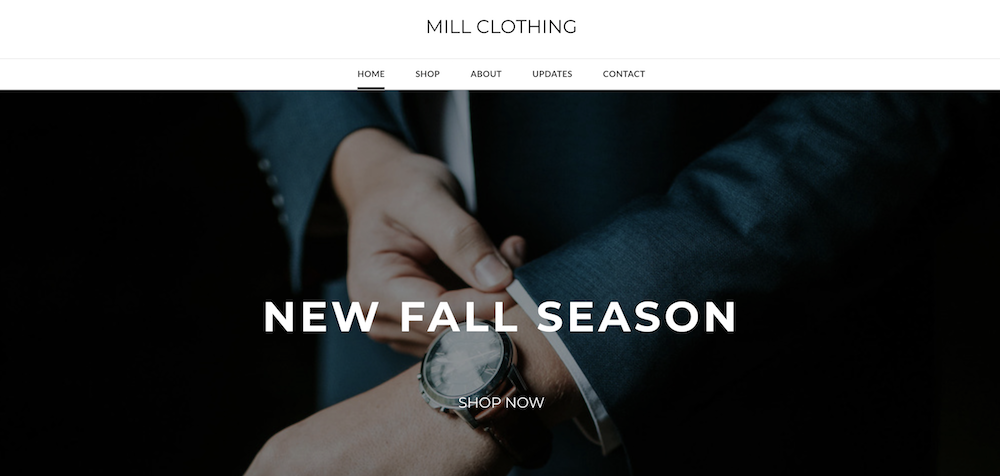
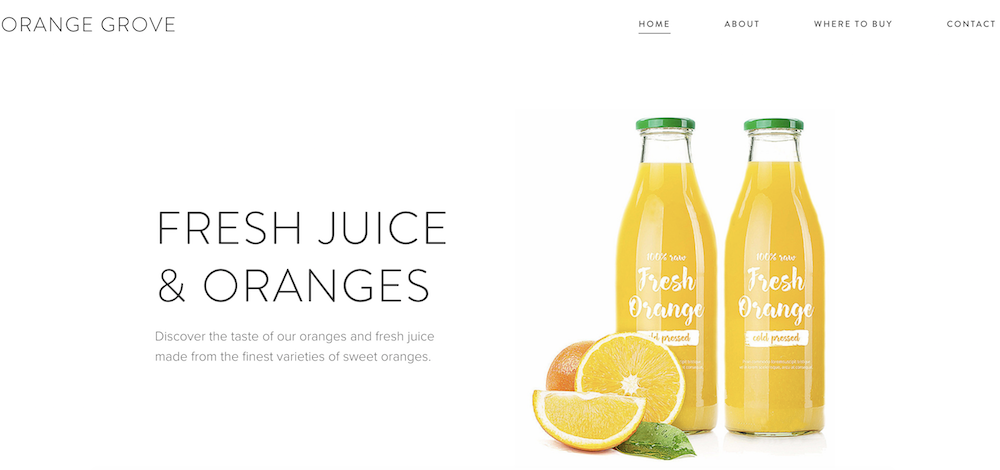
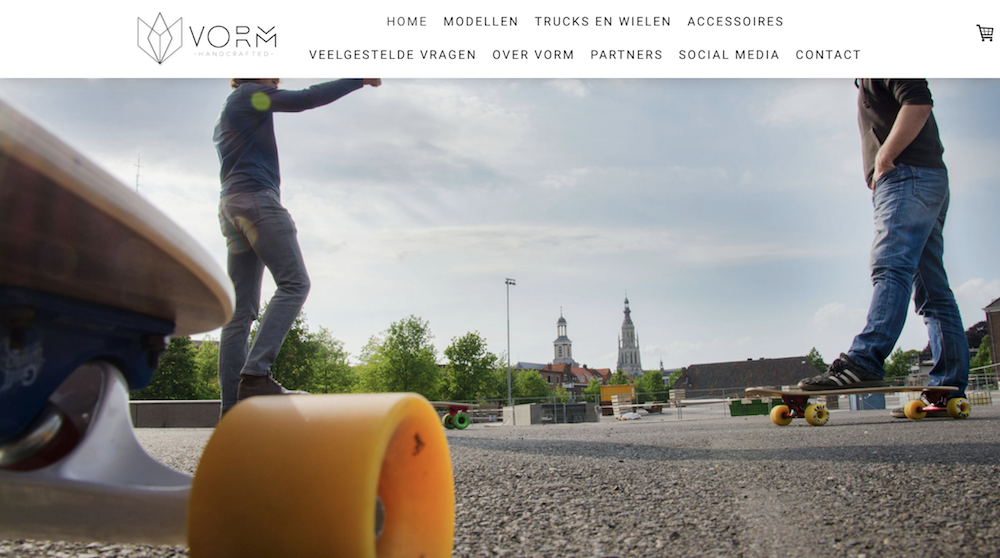
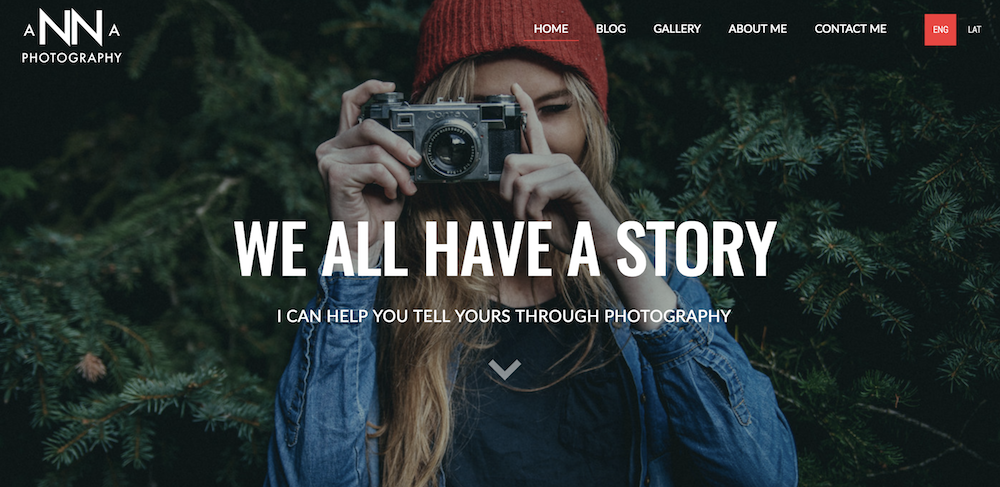
1. Wix: Wix is one of the most popular free website builders out there, with 110 million users. The fully hosted platform offers an easy drag-and-drop editor, and a large collection of professional-looking templates that are well-suited for small businesses, online stores, restaurants, or personal portfolios.

Wix supplies built-in Google Analytics to monitor your site, and even offers additional apps for individual preferences. If you want, Wix can even design your site for you. The biggest downside of Wix’s free version is it doesn’t come ad-free, and each page of your site will have a prominent Wix ad. Ad-free is only an option if you pay for the premium version.

2. Weebly: This open source SaaS offers web hosting, domain registration, web design, and even ecommerce functions, making it suitable for businesses and startups. Weebly’s a particularly flexible website builder, compatible with every device and platform, and easy to use -- like Wix, it has drag-and-drop functionality, as well as an integrated CMS solution, and hand-coded HTML files. The in-house editor comes with SEO tools and Google Analytics. With PayPal integration, an automatic tax calculator, digital gift cards, and more, Weebly is a smart choice for ecommerce businesses. Unlike some of its other free competitors, Weebly is ad-free.

3. WebNode: WebNode is a popular choice for both personal brands and professionals -- it’s easy to use, and you can create a website in a different language or on a different platform to suit your business’s needs. WebNode supports ecommerce stores, and the sites are compatible with Android, Mac, and IOS devices. WebNode will provide statistics to track your site’s success, free of charge, and even with the free version, you won’t have ads.

4. Jimdo: Based in Germany, Jimdo is a valuable option for international companies, with options to create a site in more than nine different languages. The builder is compatible with smartphones and tablets, and there’s a mobile app you can use to build a mobile-optimized site, as well. With no page limit and 500 MB of space, you’ll likely have more than enough space to build your site, and it even provides HTTPS/SSL encryption, meaning your visitor’s information will be kept safe. Plus, you’re able to integrate your site seamlessly with social media accounts. If you do decide to use Jimdo, beware of one thing: the builder prevents free websites from being indexed by search engines.

5. Mozello: One of the biggest selling-points for this Latvian-based company is the builder allows you to create a multilingual site for free -- something unmatched by other website builders. Its features include a blog, online store, SEO options, and 500 MB of storage. There is an advertisment, but it’s just a link in the footer, so most visitors won’t see it. The only drawback is the drag-and-drop system isn’t as intuitive or complex as some other options, and there aren’t a ton of design customization options.

6. Webstarts: With a wide collection of beautiful templates and a user-friendly drag and drop functionality, Webstarts makes building a website as simple as possible: best of all, whatever you see when you’re designing is exactly what your visitors will see when you publish the site. This can take some of the guess-work out of the process.

7. Webflow: While most of the other builders in this list are for people without a ton of coding knowledge, Webflow is specifically for designers and agencies who build sites for clients -- this means the HTML and CSS is entirely in your control. After you’ve built a site on Webflow, you will need to transfer it to a content management system. There are some features, like drag-and-drop widgets for adding social components, maps, and videos, that don’t require coding knowledge, but if you want the full benefits of Webflow, you’ll need to know HTML or CSS. There’s a limited set of themes, a responsive interface, and your Webflow site can be customized for desktop, tablets, or smartphones. Apart from the necessity of knowing code, one other drawback of Webflow is you can only have two pages, and there’s a limit of 500 visits for free users.

8. IM Creator: With over 11, 240, 766 sites build on IM Creator, it’s a popular option for a few reasons: there’s an easy point-and-click interface, an extensive range of templates and images, and unlimited web hosting and domain services. Plus, the platform is scalable, and you can have either single or multipage layouts. This builder is unique for its built-in ecommerce tools, and offers SEO and Google Analytics to fully optimize your site for search engines.

9. SITE123: Arguably one of the most flexible and easy-to-use builders, Site123 lets you customize anything and offers a one-click installation wizard with graphics and templates. Site123 stands out as particularly helpful with its free images library, professional fonts to add visual elements to your site, and creative DIY plans for creating multiple pages (which are unlimited). Plus, since it offers web hosting domain registration, 500 MB storage space, Google Analytics, and is ad-free, you won’t feel pressured to switch to a paid plan.

And there you have it! Since all of these website builders are free, try out a couple if you’re unsure of the best fit. In particular, take note of what you really want to get out of your site to ensure your needs will be met by one of these free builders.

http://bit.ly/2HETDAL