Tuesday, March 6, 2018

9 Email Marketing Habits It Pays to Break

Before you break any email marketing habits or best practices, it’s important to first understand why they work.

Once you’ve mastered basic email content creation, you'll be in a better position to experiment and test certain components of your strategy. In today’s ultra-competitive email landscape, you need to perform tests in order to find out what drives your specific recipients to open, read, and click.

While the right content and design are necessary components for email success, running tests will help you understand how to stand out in your readers’ inboxes. And to understand what to test, it’s helpful to revisit your current strategies and consider which email habits might be appropriate to mix up, or break altogether.

In this post, we'll explore a number of commonly overlooked email habits you should start breaking and experimenting with to find the best strategy for your company.

9 Email Marketing Habits It Pays to Break

1. You Always Use the Same Sender Name

How to Break It: Get Friendly With Your “From” Name

While it’s helpful to set certain expectations with your email recipients, don’t limit yourself to only sending messages from your company name, or from one team member. Experimenting with “friendly froms” can increase open rates. For example, instead of simply sending an email from the name of your company, you might provide an employee’s name, such as “Tim at Awesome.com”

But before you go crazy, always ensure your email activities do not violate the CAN-SPAM act. Your froms should not be false or misleading. However, there are ways your organization can make adjustments that delight your recipients.

Chubbies, a men’s fashion company with over 1.5 million Facebook followers, is well-known for getting creative with their from names. While their approach is very specific to their organization’s tone, style, and audience, you can look to them for inspiration.

One study found that while Chubbies’ messages had slightly lower inbox placement rates, their “fun and unusual friendly forms” saw higher read rates and lower “delete without reading” rates.

Here’s an example of how Chubbies gets creative with the friendly from:
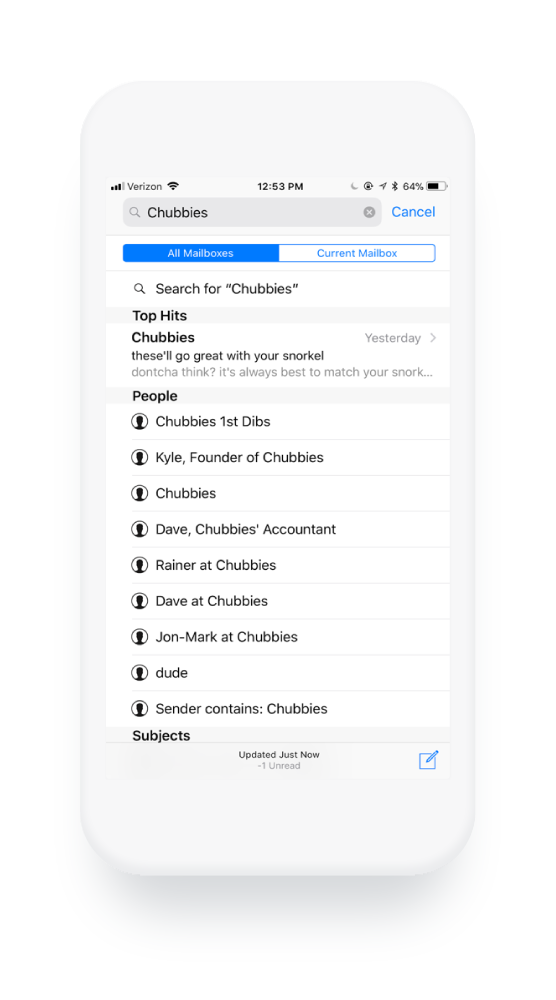
image5-5

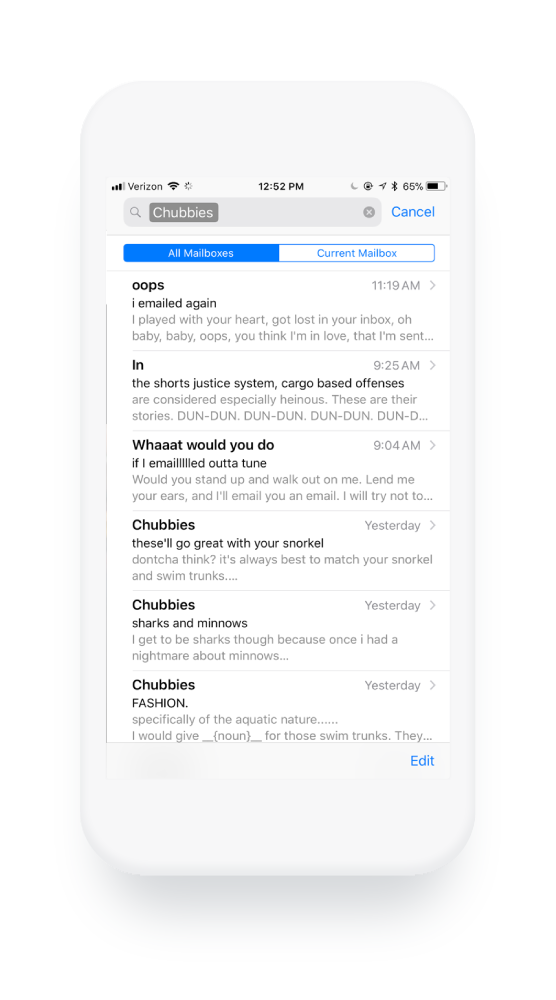
Chubbies also makes sure their fun “friendly” from names go with their subject lines and preview text.
screenshot-assets/blog_email-2.png

This synchronization allows them to use every space available to them in your inbox to grab your attention and make a lasting impression. Again, before testing strategies like this yourself, consult with a law professional about the CAN-SPAM act to ensure you’re not in violation.

2. You Treat Your Subject Line Too Literally

How to Break It: Write Copy That Visually Stands Out

Consumers are inundated with emails all day long, which means your subject line is the one factor that will get someone to open your message.

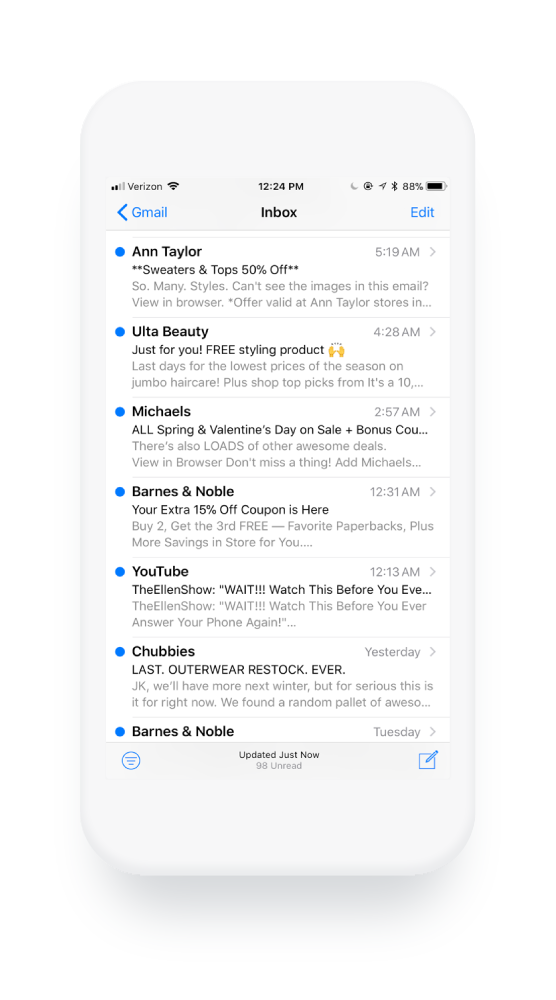
Consider the following example:
screenshot-assets/blog_email-3.png

What stands out? Caps lock text? Numbers? The use of an emoji? Personalization? Humor? White space?

To catch someone’s attention as they scroll through their unread messages, it’s important to consider how your subject line appears next to others visually.

While your subject line text should reflect the contents of your message and match your organization's tone and style, it’s important to use this space as creatively as possible. Test small tweaks with your audience to see if anything helps grab their attention.

3. Your Preview Text Is Auto-Populated

How to Break It: Use That Hot Preview Text Real Estate

If your email client supports preview text, also known as pre-header text, you can optimize it for every email you send. Allowing this text to auto-populate is a lost opportunity to grab attention or delight your recipients.

Though it takes some code, the use of this space will help you stand out from others who do not go to the same lengths to make theirs unique.

Experiment with clever, related text, like how Chubbies does in the example above, or try using just a few words to create more white space.

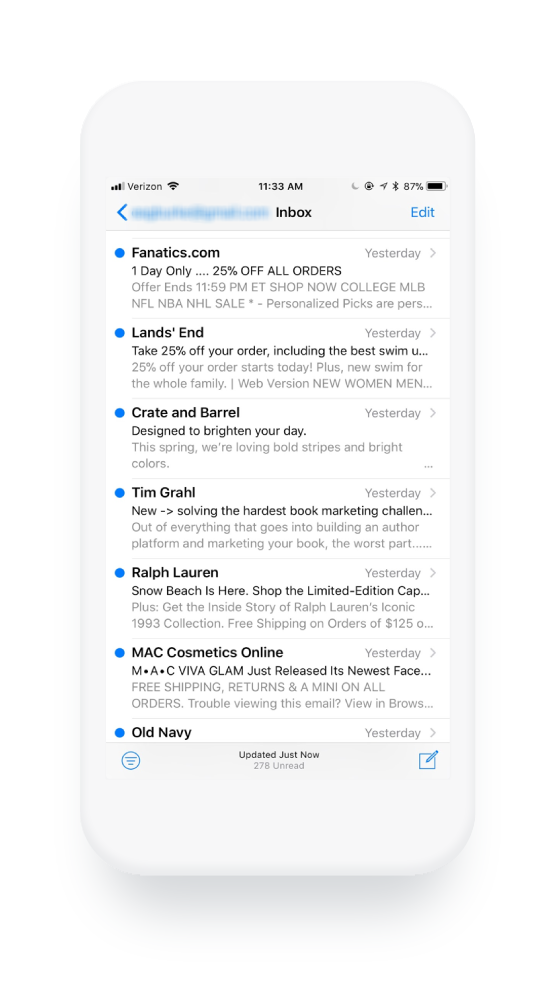
In the example below, Crate and Barrel writes preview text that is an extension of their subject line and creates eye-catching white space.
screenshot-assets/blog_email-4.png

And in the following example, the Skimm uses their preview text to address a previous technical error in a light-hearted manner.

4. Your Copy Is So Professional It’s Boring

How to Break It: Develop a Distinct Tone of Voice

Your organization’s tone of voice can be one of your biggest differentiators. Whether you use a certain style of humor or strive to sound as academic as possible, a well-crafted voice allows readers to connect with your organization on a human-to-human level.

In a time when technological advancement has us fondly looking to the past and remembering more intimate times, businesses can struggle to both scale and maintain the “humanness” of a mom-and pop-shop.

Your tone can help you combat that struggle. The answer is having a personality.

According to one of Chubbies’ four founders, Tom, they thought, “Everything’s a little too serious in men’s fashion.” To stand out and attract people to their brand, he says, “We wrote our emails like we were writing to our friends.”

In a podcast interview by Smart Passive Income, he advised organizations to think about their own brand as a unique person.

“Think about it like a person with a personality. More often than not, that personality is going to be yours—as the business owner, as the person who’s going to be writing or creating this content. Write about the things you care about, write about the things that have an emotional connection with you, and that’s where you’ll start to find kernels. We were not knocking it out of the park every time we wrote but because we were passionate about it, it enabled us to keep testing and keep driving.”

When you approach your communication under this lens, you’re bound to create content that doesn’t just deliver a message, but also forms a connection.

5. Your CTA Is Literal

How to Break It: Get Creative With Button Copy

Every inch of your email is an opportunity and each word should be intentional, especially the areas that ask your readers to take an action.

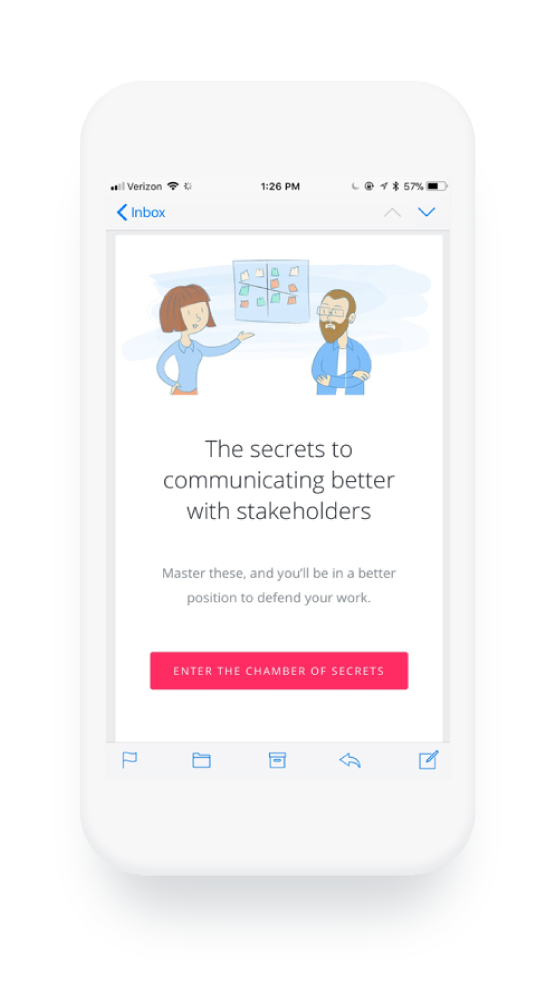
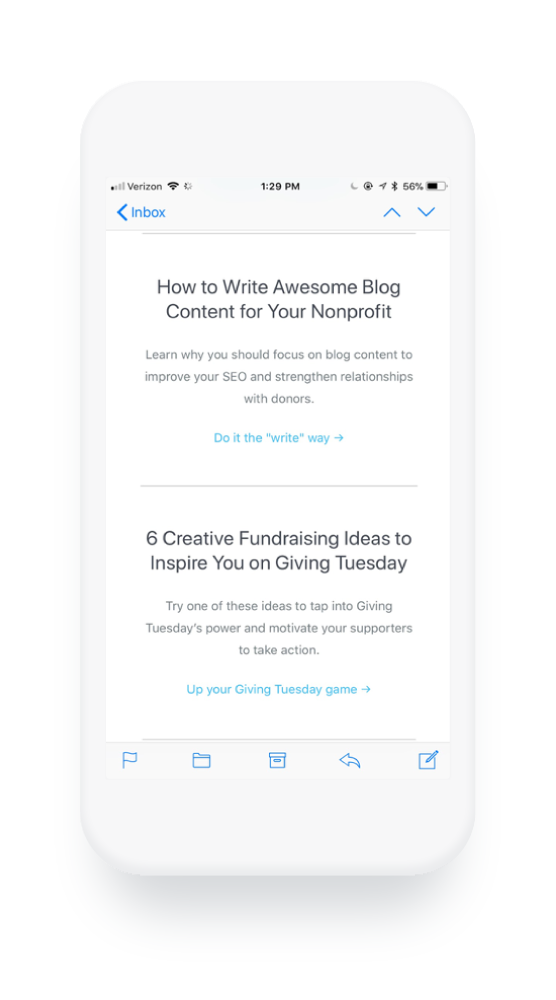
Here a few favorite examples of ways to get clever and entice your reader to click. Today’s consumer is well aware of the fact that you’re trying to lead them to a desired action. With that in mind, you might experiment with your call to action copy and use each “click here” spot as a chance to delight.
screenshot-assets/blog_email-6.png


screenshot-assets/blog_email-7.png

InVision uses witty copy and bright colors to catch the eye and entice their readers to click.

Classy, an online fundraising platform for nonprofits, similarly uses the CTA as an opportunity to be more playful with their copy and create a memorable experience for their blog subscribers.

6. You Keep It Short and Sweet

How to Break It: Experiment With Length

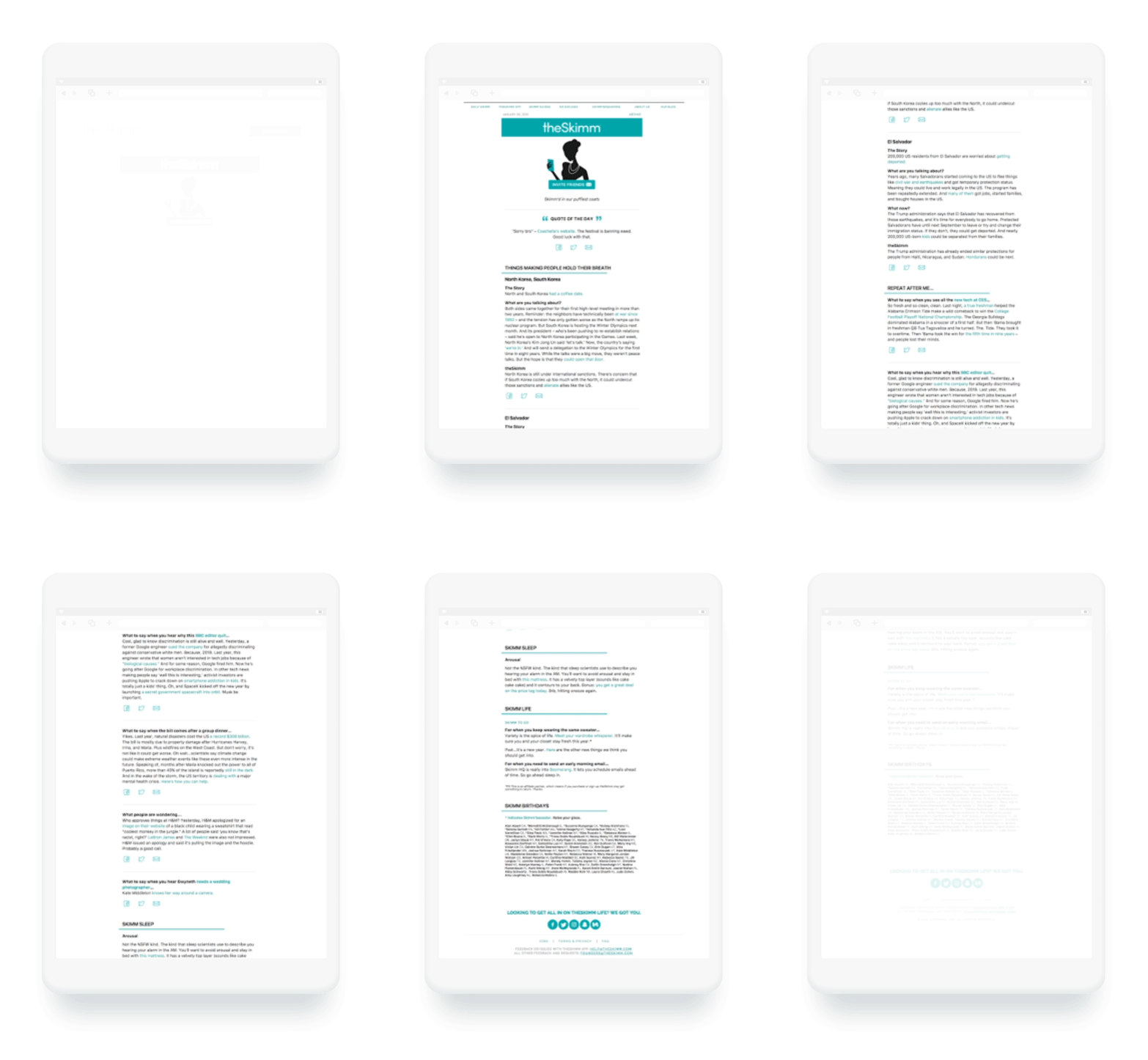
The Skimm’s 6 million email subscribers prove that emails don’t always have to be short and sweet, or highly visual to be successful. While some data points to ideally having relatively short email copy, the Skimm’s emails can get quite long (though they are broken into sections for digestibility). And while they don’t typically include very many visual components, they focus on making one thing very easy for the reader. Sharing.
blog_email-8

In this example alone, there are nine opportunities to share the email with a friend or colleague. Which leads us to our next habit:

7. You’re Focused on Content

How to Break It: Consider How Design Feeds Growth

If content is King, design is Queen.

Your content could be strong and interesting, but if your design doesn’t include the ability to easily share your message, you’re holding your content back. According to Bernadette Jiwa, author of Marketing: A Love Story, “Growth hacking is really the practice of creating and leveraging word-of-mouth with intention.”

She continues, “Growth hackers optimize their business to acquire new customers by first delighting one customer and then making it easy for that customer to share the store with friends.”

You work hard to ensure your content delights—don’t send it off to die in the bowels of your clientele’ inboxes. Incorporate tools that give your email the legs it needs to grow.

8. You Use Personas to Make Assumptions

How to Break It: Demonstrate Intimacy

As marketers, we have to make assumptions. We can’t possibly know each of our audience members intimately. While segmentation and building personas is important to delivering relevant content, today’s consumers are expecting you to more about them than ever.

If you can’t demonstrate intimacy, you’re going to fall short. If marketers aren’t using segmentation by now, they’re at least aware of the tactic and how other organizations benefit from it. While developing personas and lists to send more personalized messages is a step in the right direction, we can take action to further personalize our content and show readers we’re paying attention—and that we’re listening.

Consider what data you might share with your readers to develop a sense of intimacy or help them learn about their own behaviors.

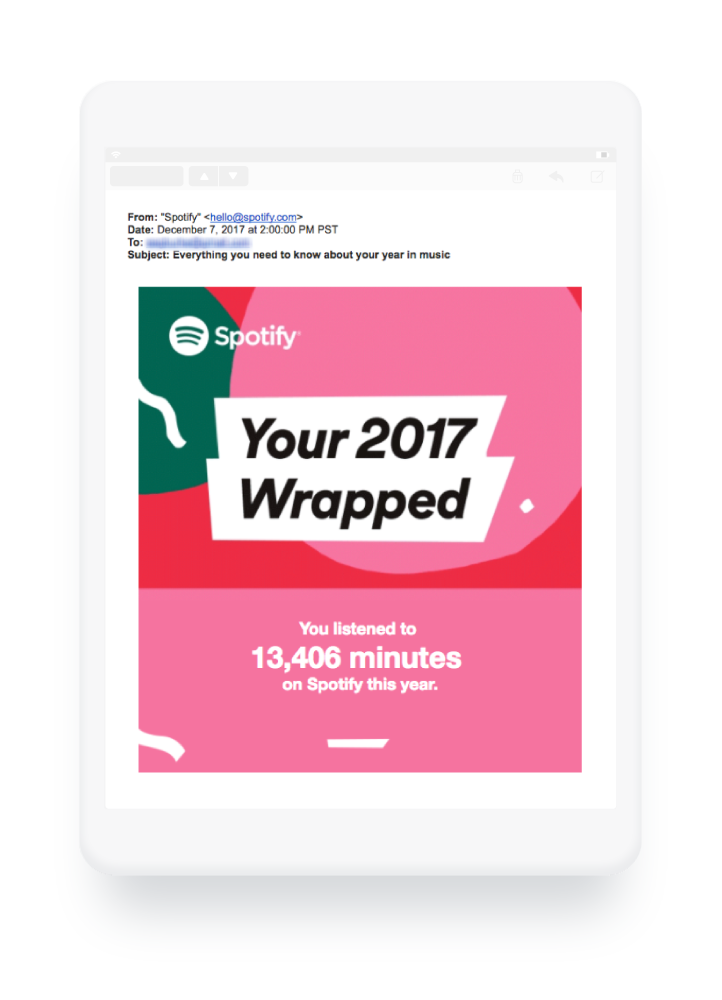
For example, Spotify uses data to demonstrate how well they know their users. These unique messages feel “one-of-a-kind” because they are. Each user receives a message with personalized data and insights around their own actions.
screenshot-assets/blog_email-9.png

9. You Talk Too Much About Yourself

How to Break It: Send an Email, Just Because

It can be easy for messaging to get a little out of balance. After all, your marketing efforts are intended to make your audience aware of the value of your products and/or services. But to become a brand that people identify with in a meaningful way, you need to do more than just keep them updated on your latest deals and features.

You need to add value to each person’s life. Develop a cadence for connecting over something unrelated to your sales efforts, but very related to your organization’s core values and culture.

This will help you to grow a following of like-minded individuals passionate about who you are and how you make them feel, not just what you’re selling.

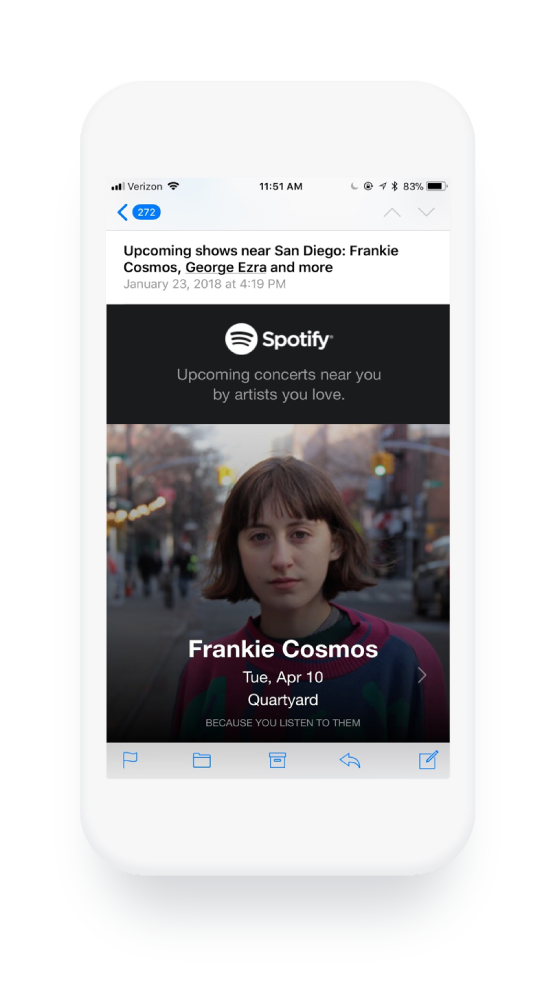
For example, Spotify sends messages to let their users know about upcoming concerts in their area:
screenshot-assets/blog_email-10.png

Additionally, Chubbies sends a “Weekender” email every Friday that doesn’t include links to products. Instead, they round up fun and entertaining bits of information purely aimed at providing a laugh. This fits right into their culture and core values, as indicated by the statement on their website, “We believe in the weekend.”

According to Kyle, one of their founders, “It’s all about all the wild stuff in the world and what you should be doing this coming weekend. And the purpose of it is to send you into the weekend. It doesn’t drive sales. It’s for nothing but creating a valuable experience with our customers. And we’ve done that every Friday for six years. That’s part of how we build a real relationship with our customers.”

Ready to Switch Things Up?

While best practices emerge for a reason, if you’re not regularly experimenting in this competitive communications landscape, your efforts will soon appear stale and your growth, stagnant. Build time into your team’s workflows to reassess your current best practices regularly to allow for ample creativity.


http://bit.ly/2FjSA4a

A Disaster Waiting to Happen? Businesses Could Send You Ads on Messenger

In November 2017, Facebook began internally testing Messenger Broadcast: a service for businesses that allows them to send marketing content to users, without building a bot.

Last week, the social media platform announced that Messenger Broadcast would be available for testing to select Page administrators in the U.S., Mexico, and Thailand.

While several businesses have been using Messenger as a customer service communication method, that's been largely restricted to those who can build bots: software that simulates a conversation with humans on messaging platforms. Many Messenger users see them when they first reach out to a brand with a question or when they execute a task.

But despite these functionalities, which are still emerging, Messenger is still in somewhat early stages of use as a direct method of broadcasting promotional content from Pages to users.

As with any new feature, there are pros and cons.

The Pros

At first glance, this feature seems beneficial to small-to-midsize businesses (SMBs) that might not have the in-house coding talent or budgets to build bots. That limits the way these brands can interact with users on Messenger, as any communication they receive requires a manual response.

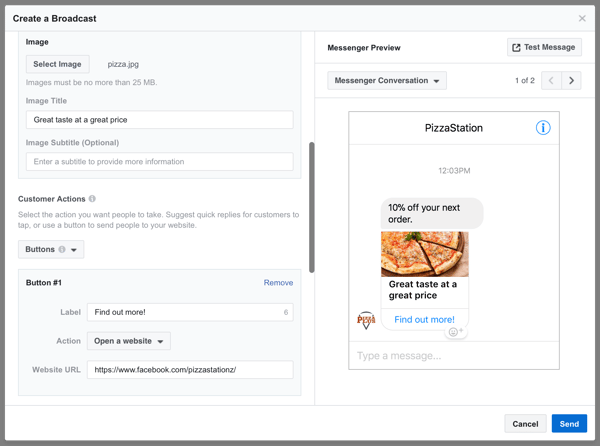
With Messenger Broadcast, however, businesses facing this issue can use a fairly comprehensive messaging setup -- which appears to be similar to creating a promoted post on a Facebook Page -- to compose a title and text, add visuals, and create a call-to-action for the message recipients.

And, similar to promoted posts or ads, Page administrators can also target recipients according to interests.

Source: TechCrunch

According to TechCrunch, Messenger Broadcast is free for businesses to use -- for now. Prior to the recent display of ads, Facebook had not outwardly monetized the platform, despite a user base of 1.6 billion.

Broadcast might provide another method for doing so -- and if its trial is successful, Facebook could begin tiering charges for Pages according to targeted audience size. 

The news comes at a time when many SMBs are experiencing some frustration with Facebook due to a declined reach following the channel's algorithm changes surfacing less Page content. 

But "by building tools like Broadcast into Messenger that allow SMBs to better communicate with their customers," says Dylan Sellberg, HubSpot's associate product manager for messaging, "Facebook has a shot at earning back the good graces of this massive market."

That's especially true for those who are already working with limited resources, for whom "building chatbots is a technical skill far out of the realm of possibility," Sellberg continues. "Creating basic experiences on Messenger that solve for a specific use-case, like customer support or disseminating popular information, is something businesses can lean into. After all, they've been executing on this playbook via email for decades."

It's that likening to email, however, that causes concerns about Broadcast. Between the display ads -- and the potential to receive messages from Pages -- some wonder if the introduction of promotional content on Messenger defeats the purpose of Facebook's algorithm change to emphasize friends-and-family content.

"This is reminiscent of Facebook’s 2012 experiment where anyone could message anyone else for as little as $1 and as much as $100 for Zuckerberg himself," says Daria Marmer, HubSpot's product lead. "That failed, I think, because it was totally outbound -- users didn’t have to show any interest in the message or who it was coming from."

And while Marmer recognizes the doubts around this latest feature, she says it's different than the discontinued Messenger experiment of 2012. For starters, Page administrators can only send this content to users who have proactively reached out to them on the platform before.

"This time, Facebook is taking a more of an inbound approach in letting businesses message only customers who had previously interacted with them," she explains. "I think this inbound strategy will work both for Facebook as a revenue stream, and for marketers, who will be able to use Messenger as a better converting channel than email."

Sellberg, for his part, also understands the concerns -- but also believes the protocol to disallow businesses from cold-messaging users could make a better user experience.

"Many will look at Broadcast and say that it will create a poor, spam-filled, end-user experience," he says. "But I think this is an opportunity for businesses to create high-quality, end-user communication -- something that stands out and really delights."

The Cons

Not everyone is quite so excited about Messenger Broadcast.

As someone who personally uses Messenger more than Facebook itself -- primarily to avoid rogue content from Pages and individuals to whom I'm not particularly attached -- I certainly understand the concern that Messenger could morph into a new-school email inbox, of sorts.

Even the protective protocols -- the ones dictating Page administrators can only send this contact to users who have already messaged them -- are not entirely different from email opt-in rules.

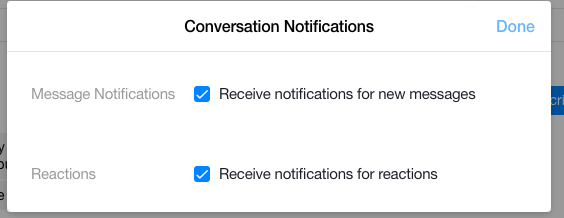
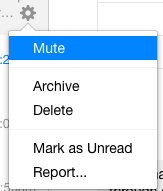
What's more, it isn't entirely clear how users can "unsubscribe" from Broadcast messages, though it could be as simple as the options to mute conversations with or notifications from Pages that are already available.

Some believe we are, in a way, "going back to square one" in terms of best practices for creating and sharing content. 

"If Facebook doesn't teach people how to make valuable, non-intrusive experiences" with the introduction of Messenger Broadcast, says HubSpot Conversational Marketing Manager Connor Cirillo, "this is a disaster waiting to happen."

That's where the analogy to opting into emails becomes particularly salient. While users, in this case, have expressed some level of interest in communicating with the business by messaging it in the first place, that doesn't mean the future communication -- like a Broadcast -- will be contextual or valuable to that user (or group of users, since the option allows sending the Broadcast to multiple users at once).

"Messaging is intimate. As businesses, we have to respect that," says Cirillio. "If a brand doesn’t know how to chat with someone, and only knows how to talk at them, users will get turned off."

Which means, Cirillo explains, even if a user initiates communication with a Page, what it does in response might not necessarily make for a delightful experience if the content of the message isn't relevant or helpful. 

"Just because I asked the pizza place when it's open," he says, "doesn’t mean I want untargeted coupons blasted at me."

It's About Quality Content ... Again

When both sides of the argument are evaluated, the key takeaway on Messenger Broadcast is essentially the same as it is for any new medium of this kind: Content that's high-quality, relevant to the user, and helpful is the most likely to succeed. Even with the cons in mind, if brands using this service can figure that out -- they're more likely to see better results.

And that, says Sellberg, might serve as a barrier to entry for brands who aren't quite ready to use this feature -- for the business and the user alike.

"Plainly, I don’t think marketers who haven't leveraged Messenger at all will not use this tool," he explains. "However, even if they do, they can only Broadcast to those who have messaged them first," which could minimize the intrusive nature of any messages they send.

Because the feature is in its earliest stages, how or if this ultimately plays out has yet to be determined. 

As always, feel free to weigh in with thoughts or questions on Twitter.

http://bit.ly/2tlZtjW

Can Artificial Intelligence Write Better Email Subject Lines Than Humans?

For certain types of email subject lines, the answer is ...

Probably.

That might be surprising to marketers.

For a long time, AI has been either an over-hyped set of technologies that didn’t deliver on their promises or it’s been a pie-in-the-sky idea that didn't translate into real-world applications.

My, how the times have changed.

AI is a term for a group of related, but distinct, technologies. "AI" includes things like machine learning, deep learning, and natural language processing -- to name a few.

Many AI technologies are still in their infancy. They look good on paper but haven't reached their potential.

But other AI technologies have advanced rapidly to become game-changers.

It’s this second group that is driving the very real AI explosion we’re seeing today.

Two technologies in particular have driven AI progress: natural language processing (NLP) and natural language generation (NLG).

NLP is when a machine "reads" text. It turns that text into code a machine system can then interpret. NLG is when a machine uses that code to then generate its own words. Both are AI technologies.

These technologies power Siri and Alexa, ushering in an exciting new age of voice search. In the process, how marketers get found is changing. (In fact, HubSpot is leading the charge for voice search friendly marketing.)

NLG and NLP also power highly accurate Google translations, where you can translate between almost any language. Google has even added this functionality to earbuds that translate speech in foreign languages.

And these technologies are found in AI-powered marketing tools like Acrolinx, which uses NLP to assess your content and recommend improvements.

One other major use case enabled by NLP and NLG is, you guessed it, writing email subject lines.

There are AI tools today that write email subject lines better than people.

Two players in this space are Persado and Phrasee.

Persado has $66 million in funding and offers AI email subject line writing, in addition to automatic social media and language generation for enterprise marketing.

Phrasee, on the other hand, uses AI to write and test email subject lines, email copy and generate email CTAs. You feed it email data and it analyzes the data to learn what works. It generates optimized subject lines that do better than 98% of human ones. And it uses what it learns from your emails to stay consistent with your brand.

In one case study, Phrasee helped Virgin Holidays increase their open rates by 2%. That may not sound like much, but it was worth millions in new revenue. The tool also streamlined a process that used to take weeks; today it takes seconds.

Both tools operate without much human involvement at all.

That's actually a good thing.

See, humans aren't that great at writing and split testing emails, social media, headlines, etc. We get too married to creative ideas. We fail to dispassionately pick the best subject lines based on the data. Heck, sometimes we just aren't great at writing or do split testing wrong.

In this case, AI is better equipped than us at this task. It excels at analyzing vast volumes of data and extracts insights from that data. Phrasee routinely uses 100,000+ emails as a dataset.

So, yeah, often AI can write email subject lines better than humans. And that's good news for marketers.

Why?

Because it makes your marketing better.

Marketers are drowning in data and don’t ever seem to have enough time or budget to maximize performance. Strategically applied AI can automate and augment processes in a significant way. They both improve performance and free you up to do other, higher-value tasks.

In a lot of cases, this is a win-win scenario. Marketers get better results and get to do more of what benefits their brand most. (Which also happens to be the most interesting stuff anyway.)

But this is why marketers need to start seriously experimenting with AI now. You need to begin to understand what tools are out there and what they can do for you.

Because certain marketing AI possibilities are very promising. But if your competitors start using this when you're not, you could be in deep trouble.

AI in marketing right now has a very "first-mover advantage" to it. Let's say I start using a tool like Phrasee to write my email subject lines. I improve performance almost immediately. I reinvest hours each week into building better campaigns in every area of our marketing. And I collect more and more data on what subject lines work best, improving performance even more.

It's a virtuous cycle. A flywheel that spins faster and faster the longer you stick with it.

In other words, the advantages of using AI the right way compound over time. It's hard to catch competitors with a sizable head start. Someday, that may change. But right now marketing AI is in its infancy. Brands using it possess an outsized advantage over those who don't.

No matter what type of marketing you do, one thing is clear: you need to start exploring AI's possibilities. We started the Marketing AI Institute to help. It’s a content hub that provides actionable information on AI for marketers. It features real-world use cases and expert advice from leading companies like HubSpot. We encourage to check it out today.

http://bit.ly/2H77WcP

3 Easy-to-Use Motion Graphics Tools for Marketers

Want to use more animated visuals in your marketing? Looking for affordable tools to create your own animated graphics? In this article, you’ll find three tools that create animated motion graphics for social media ads and posts. #1: Turn Images Into Animated GIFs With GIFMaker.me GIFMaker.me is an excellent free tool that lets you turn [...]

This post 3 Easy-to-Use Motion Graphics Tools for Marketers first appeared on .
- Your Guide to the Social Media Jungle

March 06, 2018 at 12:00PM http://bit.ly/2I6BB72
read more...
from http://bit.ly/2oSWRod
via IFTTT

Monday, March 5, 2018

The 5 Biggest Social Media Lessons HubSpot Learned in 2017

2017 was a year of experimentation.

We were committed to shifting our entire social media strategy to grow our viewership and audience, while continuing to engage with our audience where, when, and how they wanted.

To successfully do this, we spent the year experimenting with how to best deliver content on all platforms, particularly on Facebook.

We succeeded in some risks and failed in others. It was a hefty undertaking.

Here, we’ve compiled our five biggest social media lessons from 2017. We are hopeful that these lessons will prepare you to successfully shift your own social media strategy (without any of the setbacks).

1. The most important factor on Facebook is still your audience.

Facebook can be intimidating for social media teams, particularly those with smaller budgets. Fortunately, we found money isn’t the biggest factor when it comes to performing well (which is ideal, for both us and our audience).

The biggest factor is your audience, measured through views, view retention, and engagement.

Here’s the deal: Facebook is a discovery model platform. Its primary goal is to make the audience happy. So you’ll only get ROI if you create quality content for your audience.

For example, we put equal money behind a Walking Dead spoof video, and a Berlin city pride video. We had a firm understanding of both target audiences and posted at days and times best suited for them.

Our audience greatly preferred the Walking Dead video, which meant Facebook rewarded this video by expanding our reach and capturing more viewers.

Basically, we got more bang for our buck with this video because our audience liked it, not because we paid for it.

2. Live or die by the first three seconds.

You know how you only have seven seconds to make a good first impression?

It’s even shorter for video.

It’s imperative to engage your audience in the first three seconds of your video, or you’ll lose them. So we focused on telling our entire story in three seconds, and then retelling it with more detail throughout the rest of the video.

The better we became at optimizing the first three seconds, the more our average watch time increased.

3. People just want to be seen and included.

The more our videos dug into a specific, targeted audience, the better they performed. Here’s why: we believe if someone can affirm their identity through a piece of content (like an entrepreneur sees herself in a video about “top 5 traits for entrepreneurs”), then that video is more likely to be shared, commented on, and liked.

People are vocal in communities that strongly correlate to their identities and relate to their passions. Essentially, they want to feel included and seen on content that relates to them.

The “top 5 traits for entrepreneurs” video might alienate a broader audience (those who don’t identify with the qualifier “entrepreneur”), but it encourages an entrepreneur audience to be more vocal: to share their opinions, tag their friends, and share the video on their pages.

And, like we’ve said, audience engagement is key to success.

4. Topical is key.

When something really big, good or bad, is circulating the news outlets, you’ve probably noticed the consequences on your newsfeed: instead of puppy videos and a friend’s engagement pictures, you’ll primarily see content related to that event.

Both Facebook and Facebook viewers are interested in seeing content that is most relevant in that time and place.

It’s important to understand that news, seasons, cultural events, and holidays can have an impact on whether or not your video performs well. When evaluating your video’s performance, keep this in mind.

5. Native is better than non-native.

Although we had our hunches, we wanted to verify whether people actually prefer native content to non-native content.

For a long time, HubSpot’s Facebook page consisted primarily of non-native video content and link posts. We decided to compare one of these non-native video posts with a native video almost identical in content.

We had a clear winner: Facebook as a platform, and Facebook’s audience base, clearly favored native video content. The native video was viewed almost 160x more than the non-native link.

This supported our commitment to a major strategy shift, both in 2017 and in the future.

Big Takeaway for Your Business:

In 2017, we focused primarily on video as our content format, and primarily on Facebook as our platform. We made these decisions strategically: Facebook is where the majority of our audience lives, and videos are well-received by this audience.

For you to find the same level of success, you also need to dig deep to understand where your audience lives, and which content format your audience prefers. It might look different than ours, and it might require you to shift in a different direction than we did.

It might even take you a year’s-worth of trial and error (but hopefully, with these tips, a little less error).

Looking Forward to 2018

Now that we’ve succeeded in producing high-quality native content that engages and grows our audience, we want to do the same thing in 2018: only better, bigger, and more.

Here’s the real bottom line: don’t lose sight of what your numbers actually mean. Getting views, comments, and likes on Facebook isn’t about “winning” at Facebook, it’s about creating strong relationships between your audience and your brand.

And targeting ads, optimizing content, and finding the right community to engage with isn’t just about “spending your money wisely.” It’s also about finding the right leads, where and when they want to be found.

Dig into that, and strive for ceiling-breaking results in 2018.

Good luck!

http://bit.ly/2CZ2TIY

How to Bookmark a Tweet

Have you ever seen an article, thread, Tweet, or GIF on Twitter and thought, “I really want to save this for later?”

Until now, the only way to save a Tweet was to like it, copy the link somewhere, or screenshot it.

Now, there’s an easier way.

Twitter just announced a new Bookmarks feature that allows you to save Tweets on Twitter and return to them later.

The Bookmarks feature makes it easier to share Tweets privately. If you see a cool thread and want to share it with a friend but don’t want to tag her in the thread, you can bookmark it and Direct Message it to her (or text, or email).

The Bookmarks feature is rolling out on your Twitter for iOS, Android app, or mobile.twitter.com, but is not available for desktop.

The Bookmarks feature is incredibly simple to use. Here are the three steps you need to know to use Twitter’s Bookmarks feature.

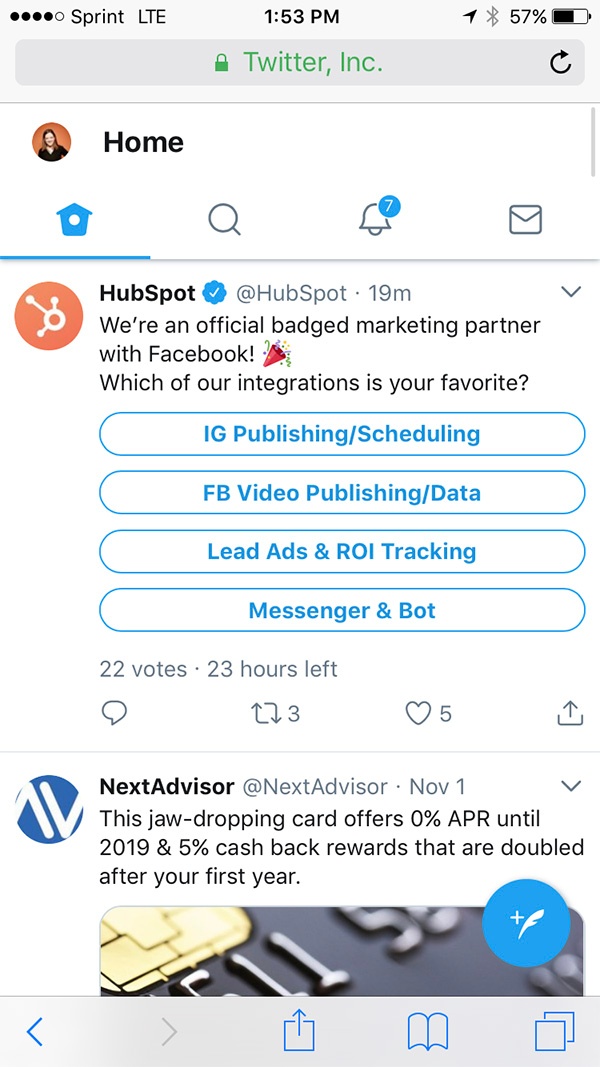
1. Find a Tweet you want to bookmark.

step1-2.jpg


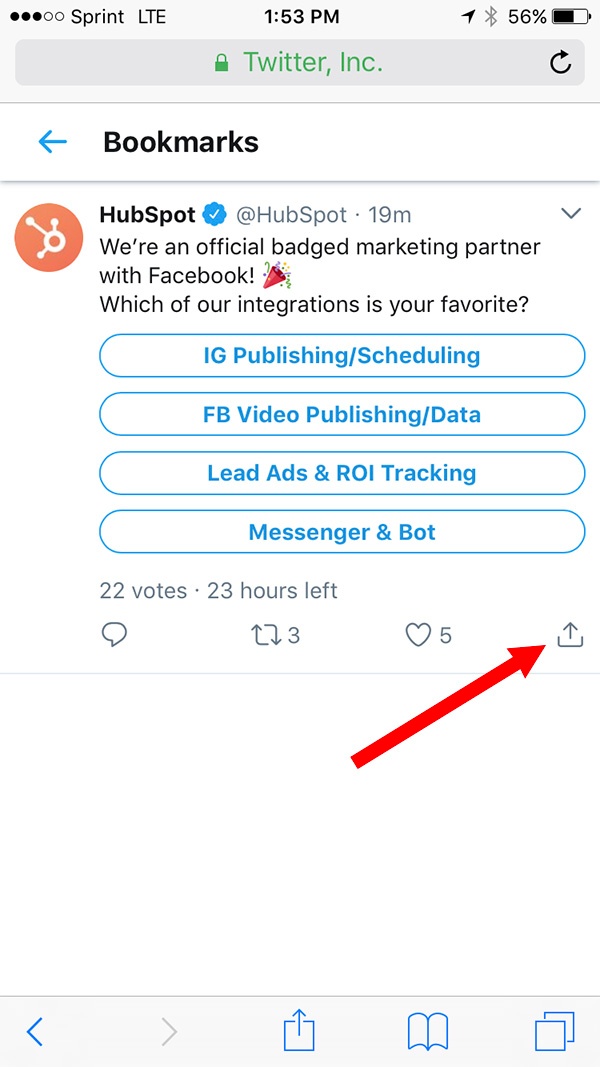
2. Click the share icon.

step2-2.jpg


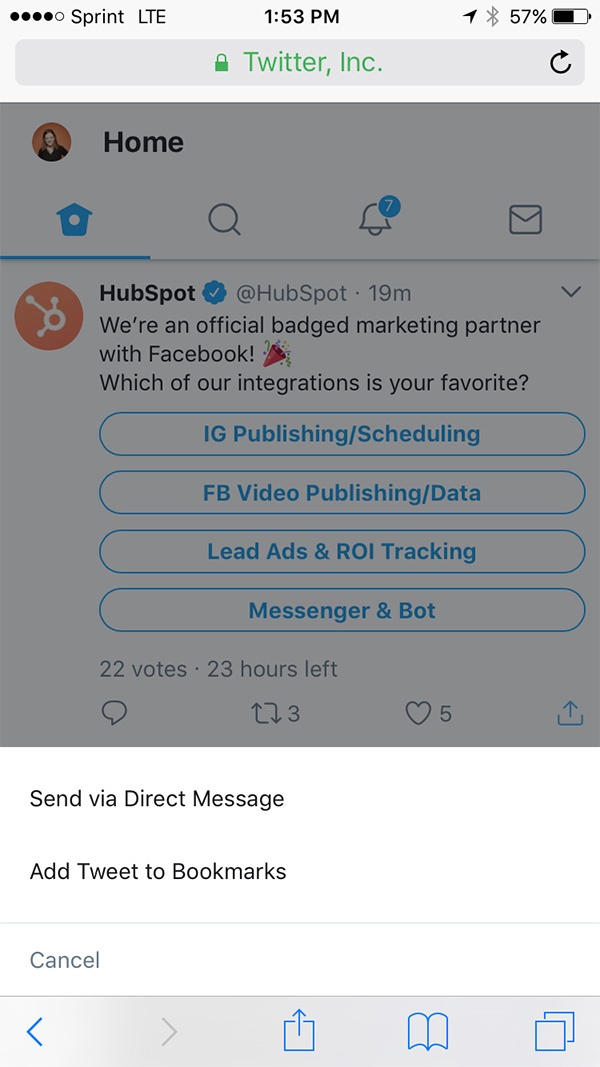
3. Select “Add Tweet to Bookmarks.”

step3-2.jpg


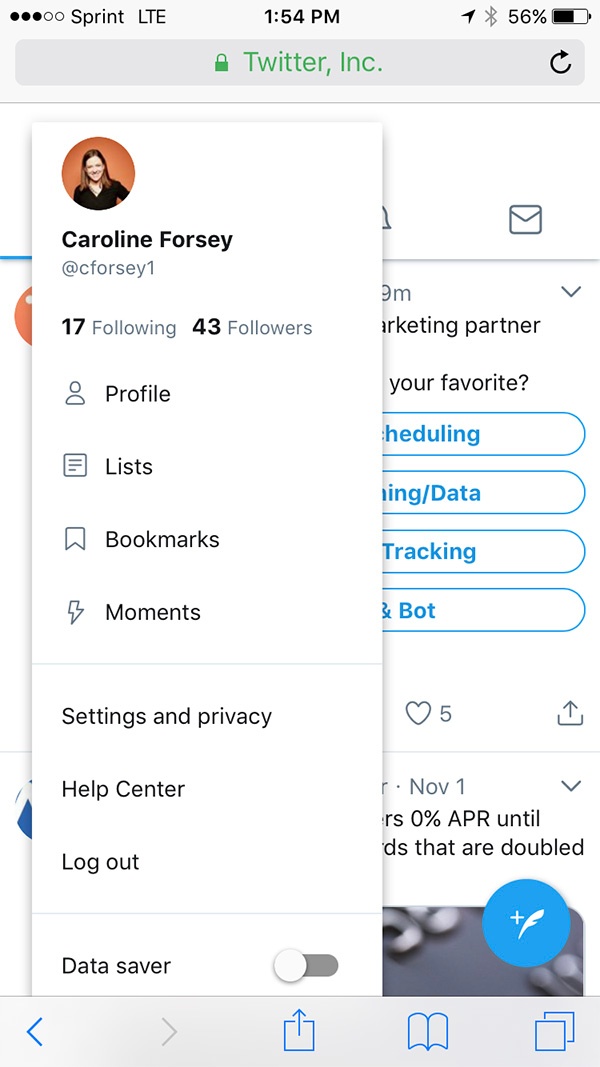
4. To see all your bookmarks, click your profile icon to access the menu and select “Bookmarks.”

step4-2.jpg

If you want to remove Tweets from your Bookmarks, just open your Bookmarks tab, click the share icon on the Tweet you want to remove, and select “remove Tweet from Bookmarks.”

And that’s it! You’re all set to try Bookmarks for yourself. Save your favorite threads, your favorite Tweets, and even your favorite HubSpot blog posts.

You know, just an idea.

http://bit.ly/2I0zamx

The Top Video Typography Trends of 2018 [Video]


This video was created by StudoBinder, and originally appeared in this article. 

http://bit.ly/2CYt5n3