Thursday, August 3, 2017

Marketers Weigh In: Which Live Video Platform Should You Use, and When?

Do you like to argue?

I do. I come from a long line of debaters, negotiators, and general question-askers -- and now, it turns out, sparking these discussions has become part of my job.

That often manifests itself during our team’s lively Slack discussions 

around everything between what’s for lunch and the latest marketing news -- the latter of which often includes a healthy amount of debate around which tools and channels we prefer to use, both as marketers and consumers of technology.

So when my colleague, Marketing Blog Staff Writer Sophia Bernazzani, recently covered an entire discussion around which is better -- Snapchat, or Instagram -- I thought, “That’s a great idea. What else can we debate?” Download our free guide to learn how to create and utilize video in your marketing to increase engagement and conversion rates. 

This time, the contenders were some of the major live video platforms out there: Facebook, Instagram, YouTube, and Snapchat. I opened up the discussion on Slack ...

Screen Shot 2017-07-23 at 2.31.09 PM.png

… and, a la Bernazzani’s approach to her debate, decided to open it up to our inbound.org community members.

We asked marketers the following:

  1. Which is your preferred platform for live video?
  2. Do you use different platforms for different purposes?
  3. Why do you prefer this/these platform(s)?
  4. Do you particularly dislike the non-preferred platforms, and if so, why?

And now, we're sharing some of marketers' biggest reasons why they prefer each platform -- read on for some of the highlights of the debate below.

Why Use Facebook Live?

1) There's more engagement.

According to Facebook Head of Video Fidji Simo, about 20% of all videos on the channel are live, with the time spent watching them having grown 4X over the past year.

Video already makes for a popular content format on Facebook, with roughly 100 million hours of it consumed on the channel each day. So when you consider that 20 million hours of that is comprised of live video, the data speaks for itself -- people are engaged with this kind of content. It’s no wonder that HubSpot marketers agreed:

Screen Shot 2017-07-23 at 3.32.36 PM-1.png

2) There’s greater reach.

Notice that, in his quote above, HubSpot Academy Senior Growth Marketing Manager Eric Peters also spoke to Facebook Live’s reach.

To date, Facebook has 1.28 billion daily active users. On top of that, it continues to rank as Pew Research Center’s most popular social media channel. In other words -- when content is shared on Facebook, it’s done so with a bit of a built-in audience.

With so many people already using Facebook, users often come across content from creators that they don’t already follow because it’s recommended by the platform’s algorithm, or one of their friends engaged with it or shared it, which shows up as activity on their feeds.

Therefore, when marketers share content on Facebook, viewership isn’t necessarily limited to the people who already like their Pages -- it also has the potential to reach new audiences in the ways we mentioned above. HubSpot Social Media Marketer Nick Carney agrees:

NickCFBLive.png

3) It’s easy to use.

Carney also spoke to the fact that, when it comes to broadcasting live video with convenience, Facebook emerges as a leader once again.

Screen Shot 2017-07-23 at 4.03.58 PM.png

As he points out, Facebook Live not only seamlessly integrates with a number of other platforms, but it’s also responsive across more than one viewing or recording medium -- like desktop or mobile. And when you’re a marketer trying to capture an event unfolding, or provide a spontaneous look at what your brand is doing, that sort of translatable use is important.

Maybe that’s why social media strategist Christine Gritmon had the following responses to our questions:

Screen Shot 2017-07-23 at 4.08.29 PM.png

4) The actual content outlives the live broadcast.

Gritmon also mentioned the somewhat evergreen nature of Facebook Live video content. Unlike other ephemeral content platforms, she explains, viewers can continue to consume her live video content long after the broadcast has ended.

Screen Shot 2017-07-23 at 4.10.25 PM.png

Notice how she addressed the idea of repurposing Facebook Live content elsewhere. While non-live Instagram posts, for example, can be shared and embedded elsewhere -- Stories and live video cannot. Using Facebook, Gritmon explains, allows this specific video content to continue existing elsewhere, long-term, so that it can still reach those who didn’t catch the live broadcast.

Why Use Instagram?

1) It’s good for short-form content.

When it comes to streaming live video on mobile, Fresh Egg’s Social Media Manager Mark Longhurst says that Instagram Live is his go-to platform:

Screen Shot 2017-07-23 at 4.24.38 PM.png

Here’s where discoverability comes into play. Instagram, similar to Facebook, is a platform where users are scrolling through a feed of multiple pieces of consumable content. They’re not looking for anything in particular, and haven’t arrived at this destination as a result of searching for something. Rather, they’re here just to see what’s new and what might be interesting.

That’s especially true of Instagram’s “Videos You Might Like" feature, which includes hand-picked Stories, live, and pre-recorded videos that it’s determined a given user might like, based on her viewing behavior on the platform -- and which, personally, has led to following more than one previously undiscovered profile.

IMG_0379.png

That said, people aren’t necessarily looking to consume a long piece of content while they’re scrolling, even if it does come in a live video format. About two-thirds of viewers prefer video that’s under one minute, and in a crowded feed of content, it’s likely to be even less. So as Longhurst says -- when it comes to this platform, keep it short.

2) Sometimes, the content seems a bit more natural.

Pre-produced and formal live videos are great -- in a certain context. If you’re hosting a webinar, for example, or a longer sit-down interview that you’ve teased or promoted in advance, viewers have a better idea of what they’re in for -- in fact, they’ve probably already registered for or planned to watch it before the broadcast begins.

But there’s a time and a place for that, says Greater Kalamazoo Association of Realtors Director of Marketing Angela M. McMillan -- and Instagram Live isn’t it.

Screen Shot 2017-07-23 at 4.43.38 PM.png

When it comes to Instagram Live, focus on short, helpful videos with aesthetic appeal -- and content that doesn’t need to stick around after its initial live broadcast has passed.

These criteria make Instagram an ideal platform for live videos that are update-like in nature -- a way to say “hello” to viewers and show them what your brand and its people are up to. For example, maybe there’s a trendy industry event where you might have a presence -- Instagram Live provides a great avenue for letting your audience know that you’re there and that you’ll be bringing them a glimpse of all the cool action that’s taking place. Later on, if you want to do a compiled review of the event that’s a bit less spontaneous in nature, find a different platform for it.

Why Use YouTube?

1) It’s valuable to those who already have an audience there.

When Gritmon was weighing in on live video platforms, she noted that “YouTube Live is wonderful for those who have an audience there,” but that it’s simply “not where my audience is.” For that reason, if you’re just starting out on YouTube, it might not be the best venue for your live videos.

However, if you already have an established YouTube presence and typically use it for pre-recorded content, it can be a valuable platform for a “special edition” of something, or an event that your audience should “tune in for” -- which you can promote and tease with a non-live video prior to the broadcast.

Here’s an example of how Sony Pictures Entertainment did just that to tease its live Hangout with the Amazing Spider-Man 2 cast:

2) It’s better for long-form content.

As we noted above, YouTube is a better platform for longer live videos -- especially when you’ve promoted them in some of the ways we’ve discussed above. That’s especially true on mobile, says Longhurst -- in fact, check out the latest edition to the platform’s listing in the iTunes store:

Screen Shot 2017-07-23 at 5.04.51 PM.png

That wasn’t always the case -- according to TechCrunch, the listing previously read, “YouTube – Watch, Upload and Share Videos” -- with no mention of live content. But from a consumption standpoint, we haven’t noticed anything remarkably different about the live viewing experience on here than on the other channels we’ve discussed. While it does allow users to minimize the video into a corner for continuous play while browsing elsewhere within the app, Facebook offers the same feature.

It seems, then, that the platform may be making an attempt to catch up with other platforms in the realm of live mobile viewership. And from a marketing standpoint, recording and streaming live video via mobile is currently only available to verified accounts with at least 100 subscribers -- making it less than ideal for short-form, spontaneous content.

Why Use Snapchat?

Truth time: We didn’t hear from a ton of marketers who are too crazy about using SnapChat for live video.

For her part, Gritmon says she uses Snapchat for the sake of “staying in the game” as a social media strategist, and that she doesn’t believe it’s used by the demographic that she or her clients are trying to reach. She also noted that it appears to largely be used for sharing private content with a select group of friends -- not for reaching new audiences with live content.

In sum, it seems the verdict is in:

  • Facebook = Good for engagement and reach, especially with longer-form live videos.
  • Instagram = Good for discoverability, with spontaneous, shorter-form live videos.
  • YouTube = Good for marketers with a pre-established audience on this platform already, who can upload pre-recorded videos on their channels to tease live broadcasts.
  • Snapchat = Good for sharing among friends -- not new audiences.

Many thanks to the HubSpot and inbound.org community marketers who participated in this discussion. Where do you stand on the debate over the best live video platform? Let us know in the comments.

free facebook marketing assessment


http://bit.ly/2vvEY4r

Wednesday, August 2, 2017

Our New Podcast: Social Media Marketing Talk Show

Have you noticed the social networks seem to change every week? How can anyone possibly keep up, right? We have a great new (and free) solution for you–the busy marketer. I’m excited to announce the new Social Media Marketing Talk Show audio podcast. Each week your friends at Social Media Examiner bring you: #1 News: [...]

This post Our New Podcast: Social Media Marketing Talk Show first appeared on .
- Your Guide to the Social Media Jungle

August 02, 2017 at 11:00AM http://bit.ly/2haJ6kb
read more...
from http://bit.ly/2u126nb
via IFTTT

How to Split Test Your Way to Facebook Ads Success

Want to lower the cost per conversion of your Facebook ads? Wondering how to serve the right ad to the right audience? In this article, you’ll discover a six-step plan to test, analyze, and optimize Facebook ads, as well as the audience segments you target. Let Facebook Split Test Multiple Ad Variations When you run [...]

This post How to Split Test Your Way to Facebook Ads Success first appeared on .
- Your Guide to the Social Media Jungle

August 02, 2017 at 12:00PM http://bit.ly/2w62uC7
read more...
from http://bit.ly/2w5ouNu
via IFTTT

Successful Company Logos Have These Attributes In Common [Infographic]

Your company logo might not be a stand-alone indicator of success, but it certainly doesn't hurt to have a thoughtful, eye-catching design -- especially if you're an early stage startup attempting to break into a competitive space. 

To see how high-growth companies are approaching logo design, the folks at SmartSign analyzed more than 2,000 company logos from the Inc. 5000 List of America's Fastest Growing Companies, seeking patterns that might indicate more than just an eye towards popular design trends.Notice something different? Click here to learn more about the HubSpot blog redesign process.

They collected data on each logo's dominant attributes (e.g.: minimal, angular), structure (e.g.: icon, wordmark), color scheme, and industry. While some of the findings clearly reflect expected trends (94% of the logos could be classified as minimal), others revealed some interesting insights into patterns across a variety of industries.

Curious to see what these powerhouse startup logos have in common? Check out the infographic below, and start planning your next redesign with this data in mind. 

Notice something different? Click here to learn more about the HubSpot blog redesign process.

Logo-Attributes.png

HubSpot Blog Design

http://bit.ly/2vi1L3n

Tuesday, August 1, 2017

The 2017 HubSpot Blog Redesign: A Detailed Look At What's New

I have a long, interesting relationship with the HubSpot Marketing Blog.

Before I became editor, I was a full-time writer for this blog. And before I was a writer for this blog, I was a guest contributor to this blog. And before I was a guest contributor to this blog, I was a fan of this blog -- I learned from this blog.

So when it came time to kick off the blog redesign I'm about to walk you through, I had a lot of strong opinions (and arguably too many ideas). You see, our last redesign launched in December 2014. To give you some context, since December 2014:

  • Blog.hubspot.com has more than doubled its monthly traffic, growing from under 2 million monthly views in December 2014 to over 4.5 million.
  • There have been over 20 updates made to the Google algorithm.
  • Snapchat has more than doubled its monthly active users, scaling from 71M at the end of Q4 2014 to 166M at the end of Q1 2017.
  • Facebook Live has been invented, released to influencers, and launched to the general public.

It's safe to say, even though it's only been a few years, we're living in an entirely different time than we were back then. Our team is fresh-faced. Our editorial strategy is new and improved. And our audience is continuing to grow and demand new things.

Notice something different? Click here to learn more about the HubSpot blog redesign process.

We've been overdue for a change for a while now, so a change is what we brought. Now let's talk about what's new -- and why. 

Why We Redesigned the Blog (And What's New)

Reason #1: To set the stage for new mediums.

During the back half of last year, we started to incorporate more video and audio content into our editorial strategy. 

We've experimented with "posts as podcasts":

Posts-as-podcasts.png

And short video recaps of popular articles:

This shift in strategy came at a time where you couldn't visit a marketing or tech blog without bumping into a headline like, "Why 2017 Is the Year of Video." But that wasn't the only driving force.

Around this same time, we'd just started to think about overhauling our email subscription, too. In doing so, we collected a lot of feedback from our subscribers that suggested they'd been craving different content formats -- such as audio and video -- for a while now.

It quickly became obvious to us that this was long overdue. We needed to refresh the blog in a way that lent it to more than just written content. We needed brand new post-level designs that were specific to the medium we were using to tell a story, teach a lesson, share a finding, etc.

How the redesign solves for this:

To create some contrast around all of the different types of content we were creating, we decided that the redesign would offers three distinct post formats: written, video, and audio. 

Written 

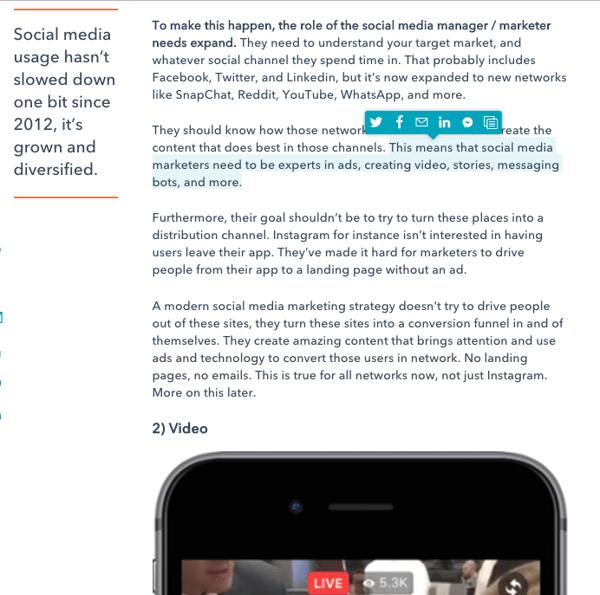
Prior to the redesign, this was the only post type we had -- though it lacked pizzazz. The new written post design incorporates large block quotes for highlighting key quotes and stats, easily shareable text, and a whole lot of white space to make for a clean, inviting experience.

written-post-features.png

Video 

This new post format allows our video content to take center stage, so it feels less like a secondary element. The best part? When you start to scroll, the video shrinks and hops to the side of the screen so you can keep working through the content while staying tuned in. 

Screen Shot 2017-07-30 at 7.09.59 PM.png

Audio

Between our own audio experiments on the blog and the steady stream of amazing audio content coming from our podcast team, we needed a place to show it off. Our new audio-centric post type includes a sleek audio player that puts the focus on the medium. 

Audio Post

Reason #2: To solve for content discoverability.

After recognizing both a shift in the way search engines deliver results and the way searchers input queries, our in-house SEO experts introduced the team to a new way of looking at content mapping and search engine optimization.

The topic cluster model puts topics before keywords, allowing a single "pillar" page to serve as a hub of content for an overarching topic. From there, "cluster content" covering related long-tail keywords then links back to the main pillar to boost its authority. This approach aims to create a more intentional link structure across the blog properties, making it easier for Google to crawl and rank our content. 

Needless to say, this new approach changed the way we organize content on the blog -- and ultimately helped to make related content more discoverable. With nearly 13,000 posts in just the HubSpot Marketing Blog archive alone, we've incorporated new functionality that helps us ensure you're not missing out on any old hidden gems, while also helping you easily surface content you care about.

How the redesign solves for this:

Our blog posts are now systematically tagged based on their associated topic cluster. For example, all of the posts within the "Social Media Trends" cluster receive a "Social Media Trends" tag which links back to the cluster's pillar page. This link helps to push the authority towards the pillar page, allowing it take more easily rank for the term we're going after. 

Screen Shot 2017-07-31 at 7.15.56 AM.png

We also added a related articles section at the bottom of each post. This section pulls in articles from the cluster, allowing for more intentional link distribution. 

Reason #3: To introduce new ways of sharing content.

At the time of our last redesign, Slack -- a real-time messaging app for teams -- had just celebrated its first birthday. Since then, the platform has gained some serious momentum -- so much so that it's referred to as the fastest-growing business app of all time. Here's proof:

Slack-Growth-Chart.png

Source: Slack

As of October 2016, the platform boasts over 4 million daily active users -- including us here at HubSpot. Internally, we use Slack to communicate across our global offices, spark discussions, host meetings, make announcements, and perhaps most often, to share and discover interesting content.

Notice something different? Click here to learn more about the HubSpot blog redesign process.

That's why, when it came time to plan this redesign, we knew that we had to find a way to incorporate Slack into the blog's functionality. 

And then there's Facebook Messenger. With 1.2 billion monthly active users, this was another channel we'd had our eye on in terms of content distribution -- especially after seeing the results from a few Messenger experiments some of my colleague ran. 

Screen Shot 2017-06-29 at 2.48.50 PM-1.png

After testing Facebook Messenger against email as a content delivery system, they saw an open rate of 80% and an average CTR of 13% -- this was 242% and 609% better than the email controls.

How the redesign solved for this:

The redesign introduces both Slack and Facebook Messenger as two new channels for sharing content. These additions can be found in the sticky sharing options to the left of the content. As an added bonus, Facebook Messenger has also been added to the hovering share menu that appears when you highlight any string of text. 

new-social-sharing.png

Reason #4: To refresh our branding.

A former boss once said to me, "We really need someone to come in here and call our baby ugly."

Of course, he wasn't referring to an actual baby. He meant our content. In a sense, it was our baby -- and we'd grown so close to it that it was hard to pull out the flaws, missed opportunities, and so on. 

That was sort of the case here ... except we were pretty well aware that our baby was, in fact, a little ugly.

The old blog felt dated and sort of stale. It wasn't set up in a way that let our content shine (at least not anymore) and it didn't mesh with some of the newer, more polished pages across the website. But perhaps most importantly, it didn't reflect our current brand -- let alone the direction our brand was going in. 

How the redesign solved for this:

If you've been following HubSpot for a while, you may have noticed that our branding underwent a bit of a makeover in the process of this redesign. For example, we've implemented new photo filters that reflect an updated color palette:

New Photo Filters.png

These filters, and several other changes, serve as the first step in rolling out a larger visual brand refresh over the coming months -- one that is true to our brand and values. Stay tuned. 

Feeling Inspired?

If you're starting to think that it might be time for your own redesign, we've got just the thing. Check out this redesign planning guide for a behind-the-scenes look at how we tackled this project -- from start to finish. We've peppered it with free resources -- like editorial calendar templates and CRO advice -- to help you kick off a redesign on the right foot.

Shoutout to the redesign dream team: Matt Eonta, Amelia Towle, Taylor Swyter, Brittany Chin, and Liz Shaw.Untitled design (25).png

HubSpot Blog Design

http://bit.ly/2tZz8rM

3 Instagram Policies Marketers Often Overlook

Do you use Instagram for business? Want to remain in compliance with Instagram’s Terms of Use so you’re not shut down? In this article, you’ll discover three Instagram compliance issues marketers need to understand. #1: You Grant Instagram a License to Use Your Content The bottom line is, if you’re posting images on Instagram, you’re [...]

This post 3 Instagram Policies Marketers Often Overlook first appeared on .
- Your Guide to the Social Media Jungle

August 01, 2017 at 12:00PM http://bit.ly/2viHZ7r
read more...
from http://bit.ly/2viR0NK
via IFTTT

10 of the Best Ads from July: Emotive Billboards, Weird Pizza, and a Perfect Sadvertising Parody

We might be deep in the dog days of summer, but advertisers have been busier than ever producing some stunning new work.

This month's ad roundup features a playful branded stunt that could really only work in summer (tequila fountain, anyone?), a set of billboards that change depending on the weather and traffic forecasts, and a refreshingly funny, star-studded flight safety video from British Airways. Let's dive in.

Notice something different? Click here to learn more about the HubSpot blog redesign process.

10 of the Best Ads from July 

1) Genesis

In this Jung von Matt-produced spot for Hyundai's luxury line Genesis, a resourceful chauffeur faces off with a snobby socialite and her fluffy, obnoxious dog Kevin. Bringing new, hilarious meaning to the slogan "Excellence worth protecting," the spot is part of a global campaign to forge a new, higher-end identity for the automaker. 


2) Taco Bell

2017 has arguably been the year of "sadvertising" -- ads that make us cry, but have nearly nothing to do with the product they're peddling. Taco Bell teamed up with Toronto-based agency Grip Limited to parody the now-ubiquitous format with the not-so-sad story of two dudes who haven't hung out in six days. 

"Because of our disdain for that kind of ad, we started to subvert it and say ‘How would Taco Bell do this trope?’, ‘How would we stand out and maybe give our consumers a little credit?’" associate creative director Trevor Gourley said to Adweek. "The end result was, we think, a pretty faithful send-up of these sort of paint-by-numbers tearjerkers that are becoming so common in advertising."


3) The Specialized Foundation

Director Johnny Green and Goodby Silverstein & Partners present a stunning, empathetic portrait of childhood ADHD in this short film for The Specialized Foundation, a non-profit focused on ADHD-research. The ad features a real group of students with ADHD as they ride through the night on bikes, releasing caged energy and finding a new sense of focus through physical activity. 


4) Pizza Hut

SNL-alum Kristen Wiig brings her unique brand of delightfully unhinged weirdness to her first ever national ad campaign for Pizza Hut, portraying "every man, woman, and child in America." Developed by Droga5, the ad finds Wiig in character as everyone from a grizzled cowboy to an excitable teenage girl. 


5) The Emoji Movie

To promote the animated film The Emoji Movie, a crop of weather and traffic-responsive billboards are popping up in major cities around the US. If the weather was sunny, a pleasant sun glasses emoji would appear. If the weather or traffic was crappy, commuters would see a poop emoji on the billboard -- naturally.

Critics might not have loved the movie itself, but this stunt -- orchestrated by Lamar Advertising -- was an undeniably creative spin on outdoor ads.  

emoji-movie.png

emoji-movie2.png


6) Fruit of the Loom

How do you sing the praises of a really awkward product? Well, according to this new CP+B-produced spot for Fruit of the Loom, you just keep your mouth shut. Their new line of breathable underwear is so good you'll want to talk about it -- but as the ad pleads, please don't. You'll make everyone around you terribly uncomfortable. 


Notice something different? Click here to learn more about the HubSpot blog redesign process.

7) Tourism Ireland

With the seventh season of HBO's Game of Thrones underway, advertisers are attempting to cash in on this massive pop culture phenomenon. To highlight their country's part in the making of the show, Tourism Ireland worked with Publicis London on their second GoT-related stunt: a 250-foot medieval-style tapestry depicting the entire plot of the HBO show's first six seasons.

If you aren't ready to take the trip across the pond to check out the tapestry in person, you can check out a digital version here. 

got-3.png


8) Jose Cuervo Silver

To celebrate National Tequila Day this month, Jose Cuervo set up three tequila-dispensing water fountains in downtown Los Angeles. Orchestrated by CP+B, the stunt gave 300 lucky passerby the opportunity to sample Jose Cuervo Silver -- directly from a projectile spout. To keep things legal and under control, there were reps on the premises to check IDs.

cuervo-fountain.jpgImage via Adweek


9) British Airways

How do you keep people interested during one of those typically dry and repetitive flight safety videos? If this new attempt from BBH London for British Airways is any indication, adding a bunch of British celebrities to the mix certainly doesn't hurt.  

A group including Ian MacKellan, Thandie Newton, and Rowan Atkinson (who naturally appears in full Mr.Bean-mode) deliver helpful safety tips -- like don't wear heels on the inflatable rescue raft -- in British  Airways' charming new safety video. 


10) Tesla

Back in March, Tesla extended an open invitation to fans to develop their own ads for the revolutionary car. This month, Elon Musk named this low-budget ad from Marques Brownlee, aka popular tech YouTuber MKBHD, as the winner.

While most other contest entries focused on Tesla's futuristic personality, this winning ad took a more simple, grounded approach, focusing instead on Tesla's more practical, fun features.  

HubSpot Blog Design http://bit.ly/2voFqkU